Welcome to our final lesson in the module on the RBI and its monetary policy framework. In our previous session, we examined the e-Rupee, a significant step by the RBI to innovate in the realm of digital currency. Today, we continue this theme by exploring two other pivotal RBI initiatives that aim to shape the future of finance: the regulatory sandbox and Project Nexus.
This lesson will outline the objectives and functioning of these two programs. First, we will look at how the RBI uses regulatory sandboxes to safely nurture financial technology (fintech) innovation. Then, we will turn our attention to Project Nexus, an ambitious international collaboration aimed at making cross-border payments as seamless as domestic ones. By the end of this session, you will be able to explain these two key initiatives, which are important topics in current economic affairs for your UPSC Prelims preparation.
Fostering Innovation: The RBI's Regulatory Sandbox
As financial technology evolves at a breathtaking pace, regulators face a classic dilemma: how to encourage innovation without compromising financial stability or consumer protection. The RBI's answer to this is the regulatory sandbox.
In simple terms, a regulatory sandbox is a safe and controlled environment where fintech companies and innovators can test their new products, services, or business models with a limited number of customers for a specific duration. During this testing phase, the RBI may grant certain relaxations from its usual regulatory requirements.
What is Regulatory Sandbox? RBI SEBI IRDAI permits Regulatory Sandbox for Fintech Innovations
To understand this concept from its origin, watch this explanatory video from StudyIQ IAS. It details the "why" and "how" of the regulatory sandbox framework.
Pay attention to these segments: Background (02:41 - 03:33): Learn about the 2016 working group that recommended the sandbox. Definition (03:33 - 05:04): This part clearly defines the sandbox as a live testing environment and explains the process. Advantages (05:04 - 06:28): Note the key benefits for innovators, regulators, and consumers.
As the video explains, the sandbox is not a complete regulatory free-for-all. It is a carefully monitored space that allows regulators to observe the real-world impact of a new financial product. This "learning by doing" approach helps the RBI gather evidence on both the benefits and the risks of an innovation before deciding on the appropriate regulatory framework for it.
The main objectives of the RBI's regulatory sandbox can be summarized into three core areas.
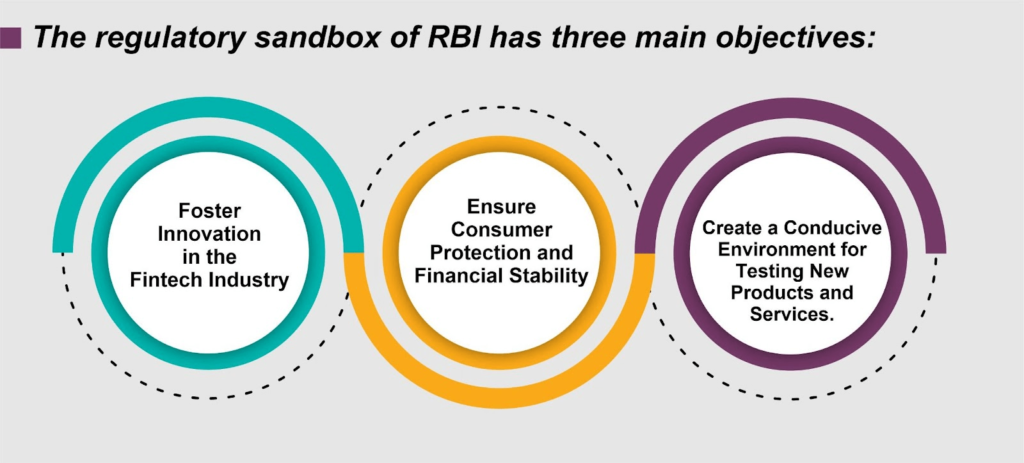
The benefits of this approach are manifold:
- For Innovators: It lowers the barrier to entry by allowing them to test the viability of their products without the high cost and complexity of a full-scale launch under complete regulatory scrutiny.
- For Regulators: It provides first-hand insights into emerging technologies, enabling them to craft more informed and effective regulations.
- For Consumers: It can lead to a wider array of innovative financial products that have been tested for safety, and it can help expand financial inclusion by supporting solutions targeted at underserved populations.
The sandbox is a key part of the RBI's strategy to balance innovation with stability, ensuring that the Indian financial system remains both dynamic and secure.
Revolutionizing Cross-Border Payments: Project Nexus
While the sandbox focuses on domestic innovation, Project Nexus addresses a major global challenge: making cross-border payments faster, cheaper, and more transparent. Currently, sending money internationally can be a slow and expensive process involving multiple intermediary banks.
Project Nexus is a multilateral international initiative that aims to change this by interlinking the domestic Instant Payment Systems (IPS) of participating countries. India's Unified Payments Interface (UPI) is a prime example of an IPS.
Your core study material, the Vision IAS PT365 PDF, provides a concise and factual overview of Project Nexus. This is exactly the kind of information you need for Prelims.
Please read the section on Project Nexus under the 'PAYMENT SYSTEMS & FINANCIAL MARKET' heading. You can find it by searching for the term. Focus on this entire section, paying close attention to who conceptualized the project, which countries are involved, and its primary goal.
As you've just read, a crucial point for your exam is that Project Nexus was conceptualized by the Bank for International Settlements (BIS) Innovation Hub, not by the RBI. The RBI, representing India, has joined this initiative as one of its founding members, alongside the central banks of Malaysia, the Philippines, Singapore, and Thailand.
The video below offers a clear explanation of this arrangement and the project's goals.
RBI Project Nexus | UPI | ASEAN Countries | UPSC | Indepth | Drishti IAS English
This video from Drishti IAS English provides an excellent summary of Project Nexus, reinforcing the key facts.
Watch the following parts to solidify your understanding: What is Project Nexus? (01:54 - 04:15): This explains the core idea of linking domestic fast payment systems like UPI across borders. Conceptualized by BIS (05:34 - 06:10): This segment emphasizes the important distinction that BIS, not RBI, initiated the project. Benefits (09:17 - 10:36): This outlines the key advantages, such as speed, low cost, and standardization. Member Countries (10:42 - 11:13): Note the list of founding members.
How Project Nexus Works
Instead of each country establishing separate bilateral links with every other country (a complex and inefficient process), Project Nexus provides a single, standardized blueprint. Each country's IPS connects to the Nexus platform once, which then allows it to communicate with all other connected systems. This is often described as a "hub-and-spoke" model.
The process involves several actors, as illustrated below.
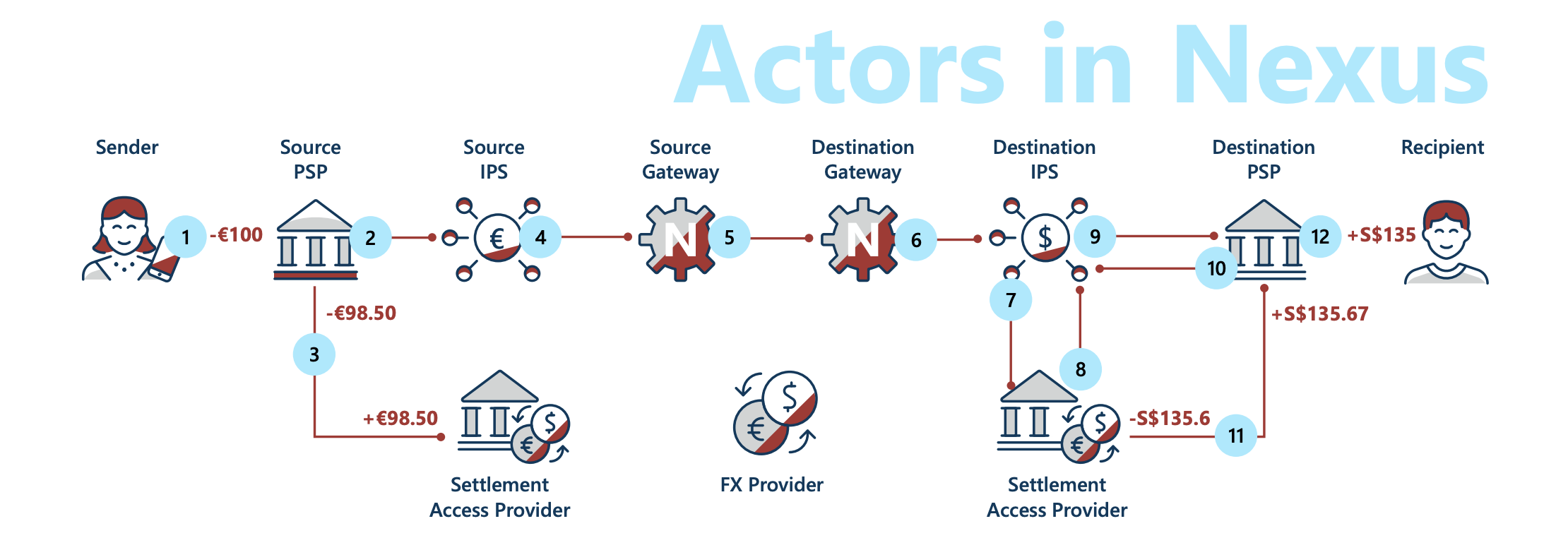
Let's break down the flow shown in the diagram:
- A Sender in one country (e.g., using Euros) initiates a payment.
- Their bank or payment app, the Source PSP (Payment Service Provider), sends the instruction to the domestic Source IPS.
- The Source IPS routes the payment to the Source Gateway of the Nexus network.
- The Source Gateway communicates with the Destination Gateway in the recipient's country.
- An FX Provider handles the currency conversion (e.g., Euros to Singapore Dollars). This happens in the background, with a pre-agreed exchange rate.
- The Destination Gateway passes the payment to the Destination IPS.
- The Destination IPS forwards the funds to the Destination PSP (the recipient's bank).
- The Recipient receives the funds in their local currency, with the goal of completing this entire process in under 60 seconds.
By standardizing this process, Project Nexus aims to meet the G20's targets of making international payments significantly faster, cheaper, more accessible, and more transparent.
Conclusion
In this lesson, we have examined two key RBI initiatives that demonstrate its forward-looking approach to regulating the financial sector. We learned about the purpose and function of both the regulatory sandbox and Project Nexus.
Key Takeaways:
- Regulatory Sandbox: A controlled environment created by the RBI to allow live testing of new fintech products. Its goals are to foster innovation, protect consumers, and enable the RBI to develop evidence-based regulations.
- Project Nexus: A multilateral initiative conceptualized by the Bank for International Settlements (BIS) to link the instant payment systems (like UPI) of member countries. India is a founding member. The project aims to make cross-border retail payments fast (under 60 seconds), cheap, and transparent.
This concludes our module on the RBI and its monetary policy. We have covered the Monetary Policy Committee, policy rates, liquidity tools, the RBI's surplus transfer, forex reserves, grievance redressal, and finally, its major innovation initiatives.
In our next lesson, we will begin a new module on Banking Sector Institutions and Regulations. Our first topic will be Non-Banking Financial Companies (NBFCs), where we will define what they are, explore their classification, and examine the framework for their self-regulation.