Hello! Welcome back to your course on race car suspension.
In our last lesson, we defined the instant center (IC) as the virtual pivot point for the suspension linkage. We established that finding this point is the crucial first step in analyzing suspension geometry. Today, we'll take that next step.
This lesson will introduce the concept of the roll center. You will learn what the roll center represents and, more importantly, how to determine its location using the suspension geometry you're already familiar with. The roll center is a fundamental concept that directly links the design of the suspension linkages to how a car's body behaves when you turn the steering wheel.
What is the Roll Center?
When a car corners, you feel it lean, or "roll," toward the outside of the turn. This rotation of the car's main body (the sprung mass) doesn't happen randomly; it occurs around a specific, geometrically defined axis. The roll center is the point on that axis of rotation at a given axle (front or rear).
You can think of the roll center as a virtual hinge that connects the suspension to the car's body in the front view. The car's body pivots around this hinge as it rolls.
The article 'Our Suspension Engineer Explains...' from The Autopian provides an excellent conceptual introduction to the roll center, using a helpful analogy.
Read the first three paragraphs under the heading 'What Is the Suspension Roll Center'. The author likens the roll axis to a door hinge, which is a great way to visualize the concept.
The car has a roll center for the front suspension and one for the rear suspension. A line connecting these two points forms the roll axis, which is the axis the entire car body rolls around.
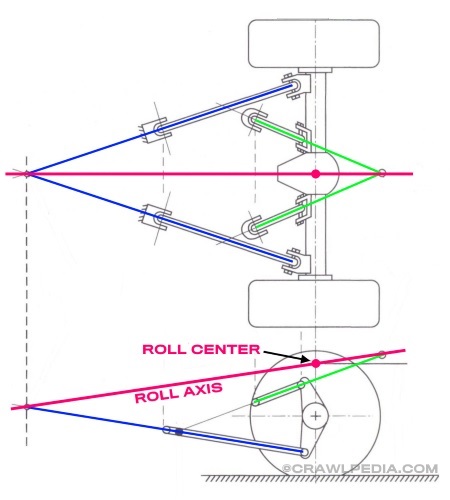
How to Find the Roll Center
Now, let's get to the geometry. The process of finding the roll center builds directly on what you learned in the last lesson about finding the instant center.
To get a quick, clear overview of the geometric construction, let's watch a video.
Roll Center & Vehicle Body Roll - Explained
The video 'Roll Center & Vehicle Body Roll - Explained' from Engineering Explained provides a concise and well-animated demonstration of the geometric method.
Watch from 0:20 to 1:37. Pay close attention to the three steps: 1) finding the instant center, 2) drawing a line to the tire's center, and 3) finding the intersection at the vehicle's centerline.
As you saw, the method is a logical extension of our work with the instant center. Here is the step-by-step process:
- Find the Instant Center (IC) for one side of the suspension by extending lines through the upper and lower control arms until they intersect. (This is what we covered last lesson).
- Draw a line from that Instant Center (IC) to the center of the tire's contact patch on the ground.
- Repeat steps 1 and 2 for the other side of the suspension.
- The point where these two lines intersect is the roll center (RC) for that axle. Assuming the suspension is symmetrical left-to-right, this point will lie on the vehicle's centerline.
For a more detailed, practical guide on how to perform these steps, the following resource is excellent. It breaks down the process with clear diagrams for both double wishbone and MacPherson strut suspensions.
Roll Centre and Roll Moment – How To Adjust And Tune ...
The article 'Roll Centre and Roll Moment' from Suspension Secrets offers a hands-on guide to locating the roll center.
First, read the section 'How to Locate Roll Centre for a Double Wish Bone Set Up'. This will reinforce the video you just watched. Then, review the next section, 'How to Locate Roll Centre for A MacPherson Strut Set up'. Notice that while the method for finding the instant center is different for the strut (using a line perpendicular to the strut axis), the final step of drawing a line from the IC to the contact patch remains the same.
This geometric method is a powerful tool for visualizing how the physical layout of the suspension arms dictates this critical handling characteristic.
Test your understanding!
Imagine a double-wishbone suspension where the upper and lower control arms are angled downwards towards the center of the car. The lower arm is much flatter (more horizontal) than the upper arm.
Will the instant center be relatively high or low? Following that, will the roll center tend to be higher or lower compared to a design with more parallel arms?
Show answer
The significant angle difference will cause the lines to intersect relatively close to the wheel, resulting in a low instant center.
When you draw a line from this low instant center to the tire contact patch, that line will also be quite low. This will cause it to intersect the vehicle centerline at a lower point, resulting in a lower roll center.
The Roll Center is Not a Fixed Point
Just like the instant center, the roll center's location is not static. As the suspension moves through bump and droop, the control arm angles change, the instant centers move, and therefore the roll center moves up or down.
Even more interestingly, the roll center moves sideways during cornering. As the body rolls, the suspension on the outside of the turn compresses while the inside suspension extends. Since the geometry is no longer symmetrical, the roll center migrates away from the vehicle centerline.
This migration is a key aspect of suspension design, as it affects how the car feels as cornering forces build up.
The Complete Guide To Suspension Roll Centers - Part 1
Let's turn to a video that does an excellent job of showing this roll center migration.
Watch the segment from 'The Complete Guide To Suspension Roll Centers - Part 1' from 6:01 to 7:34. The presenter uses a model to show how, during body roll, the lines from each side no longer meet at the vehicle centerline. The true roll center is where these two lines intersect, which is now off to one side.
A More Universal Method
The geometric method we've used is perfect for simple wishbone or strut designs. However, as you know from your mechanical engineering background, linkages can get very complex. Modern high-performance road cars, for example, often use multi-link suspensions where it's not obvious which links are the "upper" and "lower" arms.
In these cases, engineers use a more fundamental method. Instead of focusing on the arm geometry, they track the path of the tire contact patch as the wheel moves up and down. By finding the instantaneous center of rotation of the contact patch itself, they can determine the roll center line without needing to find the suspension's instant center first. This method works for any suspension design.
While we won't go deep into the calculations, it's important to know this concept exists as it's what's used in modern suspension design software and is crucial for the multi-link systems we'll discuss later in the course.
The Autopian article you looked at earlier also describes this more advanced method.
Read the section 'The Instantaneous Radius Method'. The key takeaway is that the roll center is ultimately defined by the motion of the tire contact patch, not the suspension arms themselves.
Conclusion
In this lesson, we demystified the roll center by defining it and learning the classic geometric method for finding its location.
Here are the key takeaways:
- The Roll Center (RC) is the virtual point, found in the front-view plane of an axle, around which the car's body rotates during cornering.
- The line connecting the front and rear roll centers is the Roll Axis.
- The RC is located by finding the intersection of lines drawn from each side's Instant Center (IC) to the center of its respective tire contact patch.
- The RC's location is dynamic: it moves vertically with suspension travel and horizontally during body roll.
You now understand the direct geometric link between the suspension arms and the point that governs body roll.
In the next lesson, we will explore the consequences of the roll center's location. We'll examine the relationship between the roll center and the center of gravity, and see how the distance between them—the "roll moment arm"—determines the forces that cause the body to roll in a turn.