Welcome to the first lesson of your course, Indian Politics III. Building on your sophisticated understanding from the previous two courses, we will now turn our attention to the most recent and defining events shaping India's political landscape. This first module unpacks the results and immediate aftermath of the 2024 Lok Sabha elections, a verdict that surprised many and has significantly altered the balance of power in New Delhi.
Today, we will focus on the fundamental outcome of this election. Our goal is to analyze the key results, specifically the Bharatiya Janata Party's (BJP) failure to secure a single-party majority and the unexpected resurgence of the opposition INDIA bloc. We will examine the top-line numbers, explore the crucial regional shifts that defined this election, and begin to piece together the narrative of how this surprising mandate came to be. This analysis will serve as the foundation for the entire course, as the dynamics of this new coalition era will influence every topic we discuss, from legislative agendas to federal relations.
The Unexpected Verdict: A Tale of Numbers and Narratives
The run-up to the 2024 general election was dominated by a narrative of inevitability. Preelection surveys, media commentary, and the BJP's own confident slogan, "Abki Baar 400 Paar" ("This time, more than 400 seats"), all pointed towards a third successive landslide for the party. The final results, however, told a very different story.
While the BJP-led National Democratic Alliance (NDA) did secure a third term with 293 seats, the BJP itself fell to 240 seats, 32 short of the 272 required for a majority in the Lok Sabha. This was a significant drop from its 303-seat tally in 2019. In stark contrast, the opposition Indian National Developmental Inclusive Alliance (INDIA) defied expectations, winning 234 seats. The Indian National Congress, written off by many, nearly doubled its seats from 52 to 99, re-establishing itself as a credible national opposition force.
To begin, let's ground our analysis in the detailed figures and the context of pre-election expectations.
The Resilience of India's Fourth Party System
This article from the Carnegie Endowment for International Peace provides an excellent academic summary of the election outcome, contrasting the results with the dominant narrative that preceded them.
Please read the introduction, which outlines the final seat tallies for the major alliances and parties. Then, proceed to the section "Presence of a Dominant Party" and read the initial paragraphs that contextualize the BJP's 2024 result against its historic victories in 2014 and 2019.
As the article from the Istituto Affari Internazionali (LINK) puts it, the result was a "political earthquake" which, within the Indian political context, made the BJP's victory look like a "resounding defeat."
Deconstructing the Results: A Story of Regional Divergence
A fascinating aspect of this election is that the BJP's all-India vote share declined only marginally, from 37.3% in 2019 to 36.6% in 2024. So, how does a less than one percentage point drop in votes translate to a loss of 63 seats? The answer lies in the regional distribution of those votes.
Analysts have pointed to the existence of "two BJPs" in this election:
- The Incumbent BJP: In its traditional strongholds in the Hindi heartland (like Uttar Pradesh, Rajasthan) and western India (like Maharashtra, Haryana), the BJP was the dominant, established power. Here, it faced significant anti-incumbency and suffered heavy seat losses.
- The Challenger BJP: In southern and eastern states (like Kerala, Telangana, Odisha), where it has historically been a marginal player, the BJP was the challenger. In many of these areas, it made significant gains in vote share, even if it didn't always translate into a large number of seats.
This dynamic meant that the 2024 election was not a single, national referendum on Prime Minister Modi, as seen in 2014 and 2019. Instead, it reverted to an aggregation of state-level verdicts, where local issues, candidates, and alliance arithmetic played a decisive role.
The Resilience of India's Fourth Party System
The same Carnegie Endowment article provides a clear breakdown of this regional divergence, which is key to understanding the final tally.
Focus on the subsection "Disaggregating the BJP Vote," which details the party's performance drop in the Hindi belt versus its gains in the south. Following that, read the section "Federalization of the 2024 Verdict" to understand why this election is being described as a return to a more state-by-state contest.
Political strategist Prashant Kishor, despite having incorrectly predicted a BJP majority, based his initial assessment on this very dynamic of regional gains offsetting heartland losses.
Prashant Kishor First Interview Post 2024 Lok Sabha Results With Rajdeep Sardesai & Rahul Kanwal
In his first post-election interview, Prashant Kishor offers a sharp, candid analysis. He explains how his pre-election assessment captured the underlying regional trends, even if his final seat projection was off.
Watch the segment from this clip, where he discusses the pre-election logic of "geographic expansion in East and South" and how it played out in the final results.
The Opposition's Revival: Unity and a Resonant Message
The other half of the story is the remarkable resurgence of the opposition. The INDIA bloc's success can be attributed to several factors, chief among them being strategic unity and effective messaging.
First, by forming pre-election alliances and agreeing on seat-sharing arrangements in key states, the opposition was able to consolidate the anti-BJP vote. This prevented the fragmentation of votes that had benefited the BJP in previous elections.
Second, the opposition successfully turned the BJP’s "400 paar" slogan into a political weapon. They crafted a powerful narrative that the BJP sought a supermajority to amend the Constitution and potentially dismantle reservation policies for Scheduled Castes (SCs), Scheduled Tribes (STs), and Other Backward Classes (OBCs). This message found significant traction, particularly among Dalit communities.
India's 2024 Elections: Has Democratic Backsliding Come ...
This analysis from the Istituto Affari Internazionali explores the drivers behind the INDIA bloc's effective performance.
Please read two short sections. First, the analysis on how the opposition's narrative about defending the Constitution resonated with voters concerned about affirmative action. Second, the section on Opposition unity, which explains the crucial role of strategic coordination.
Case Study: The Bellwether State of Uttar Pradesh
Nowhere was the political shift more dramatic than in Uttar Pradesh, India's most populous state and a BJP bastion. The party's seat count plummeted from 62 in 2019 to just 33. The Samajwadi Party (SP) and Congress alliance, meanwhile, surged to 43 seats. Understanding what happened here is crucial to understanding the national verdict.
Lok Sabha Elections Result 2024: What Went Wrong For The BJP in UP? | News9 Plus Decodes
To appreciate these dynamics at a granular level, let's examine the upset in Uttar Pradesh. This concise report by News9 decodes the key factors behind the BJP's setback.
Watch the video from the beginning until this point. Note the discussion on four critical elements: the limited electoral traction of the Ram Temple issue, the effectiveness of the opposition's narrative around the "400 paar" slogan, the SP's astute ticket distribution beyond its traditional base, and the disciplined, strategic voting by Muslim communities.
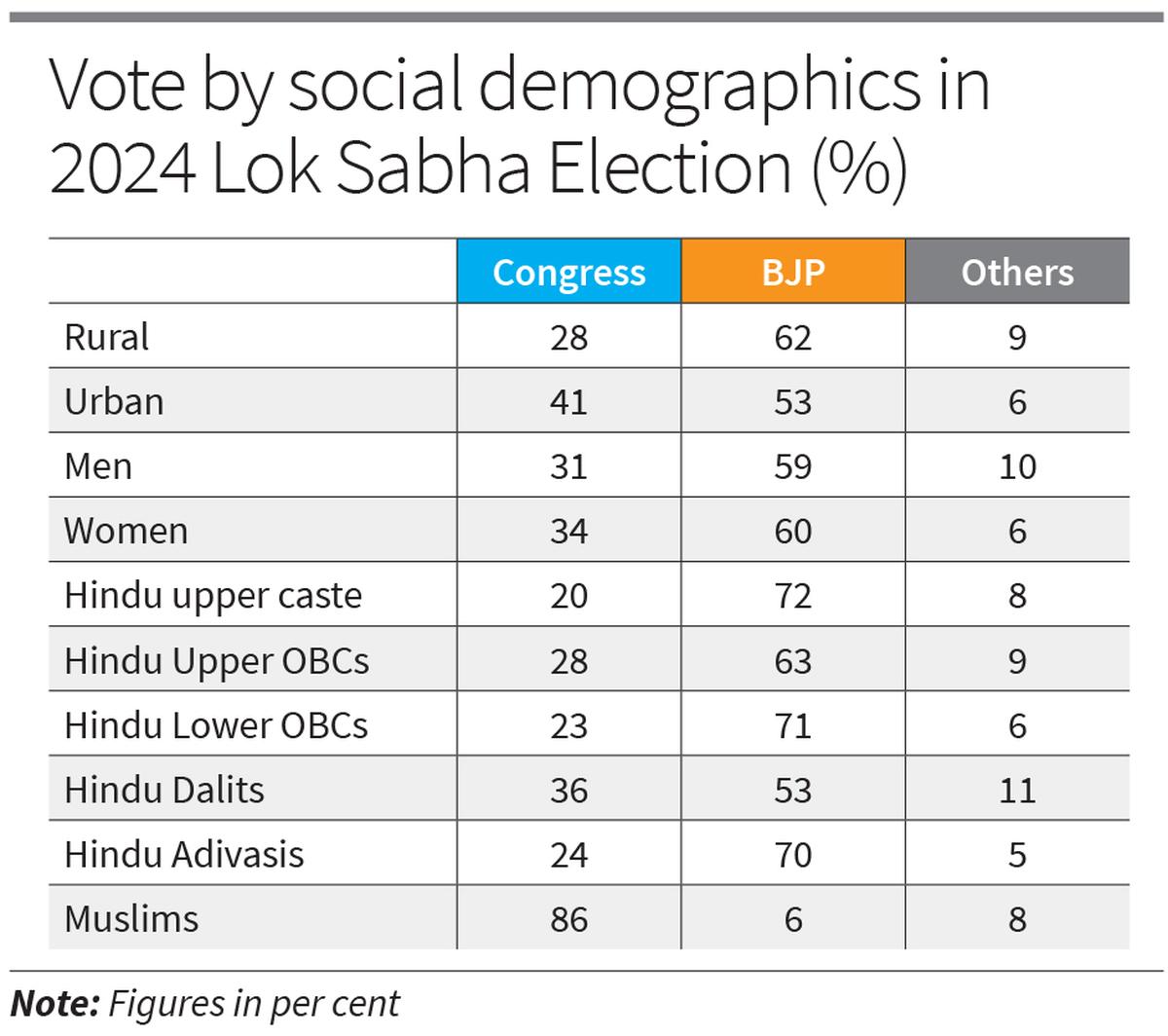
The Voter's Verdict in Data
The CSDS-Lokniti post-poll survey data allows us to visualize some of these trends. The two tables below provide a snapshot of voting patterns by social demographics and by satisfaction with the government's performance.

Conclusion
The 2024 election has undeniably reset the board of Indian politics. While the NDA remains in power, the BJP's loss of a single-party majority marks the end of a decade of legislative dominance and ushers in a new era of coalition politics. The verdict was not a uniform national wave but a complex aggregation of state-level contests, where a newly unified opposition successfully capitalized on localized anti-incumbency and anxieties about the BJP's long-term agenda. The INDIA bloc, anchored by a resurgent Congress, has emerged as a formidable parliamentary force, promising a more contentious and balanced political term.
Key Takeaways:
- The BJP lost its parliamentary majority for the first time since 2014, winning 240 seats, while the INDIA bloc surged to 234.
- The BJP's marginal national vote share loss concealed major seat losses in its Hindi heartland strongholds, which were partially offset by gains in southern and eastern states.
- The election was a series of state-level contests rather than a single national referendum.
- The opposition's success was driven by strategic seat-sharing and an effective narrative that portrayed the BJP's quest for a supermajority as a threat to the Constitution and reservation policies.
In our next lesson, we will build directly on this analysis. Having established what happened, we will delve deeper into the why, evaluating the primary drivers of voter sentiment, with a specific focus on economic issues like unemployment, inflation, and agrarian distress.