Introduction
In our previous lesson, we thoroughly examined the case for 'One Nation, One Election' (ONOE), focusing on the arguments of financial savings, administrative efficiency, and uninterrupted governance. This perspective presents ONOE as a pragmatic solution to the inefficiencies of India's staggered electoral calendar. Today, we turn to the other side of this high-stakes debate to evaluate the profound constitutional and federalist objections raised against the proposal.
This lesson addresses the core counter-argument: that ONOE is not merely an administrative tweak but a fundamental structural change that could undermine India's parliamentary democracy. We will focus on how the proposal clashes with the autonomy of state assemblies and grapple with the contentious role of Article 356 (President's Rule). By analyzing these objections, you will gain a critical understanding of why many view ONOE as a threat to the delicate balance of power that defines the Indian republic.
The Constitutional and Federalist Challenge
The opposition to ONOE is rooted in foundational principles of India's constitutional design. Critics argue that the proposal attempts to force a logic of fixed terms, more suited to a presidential system, onto a parliamentary framework built on continuous accountability.
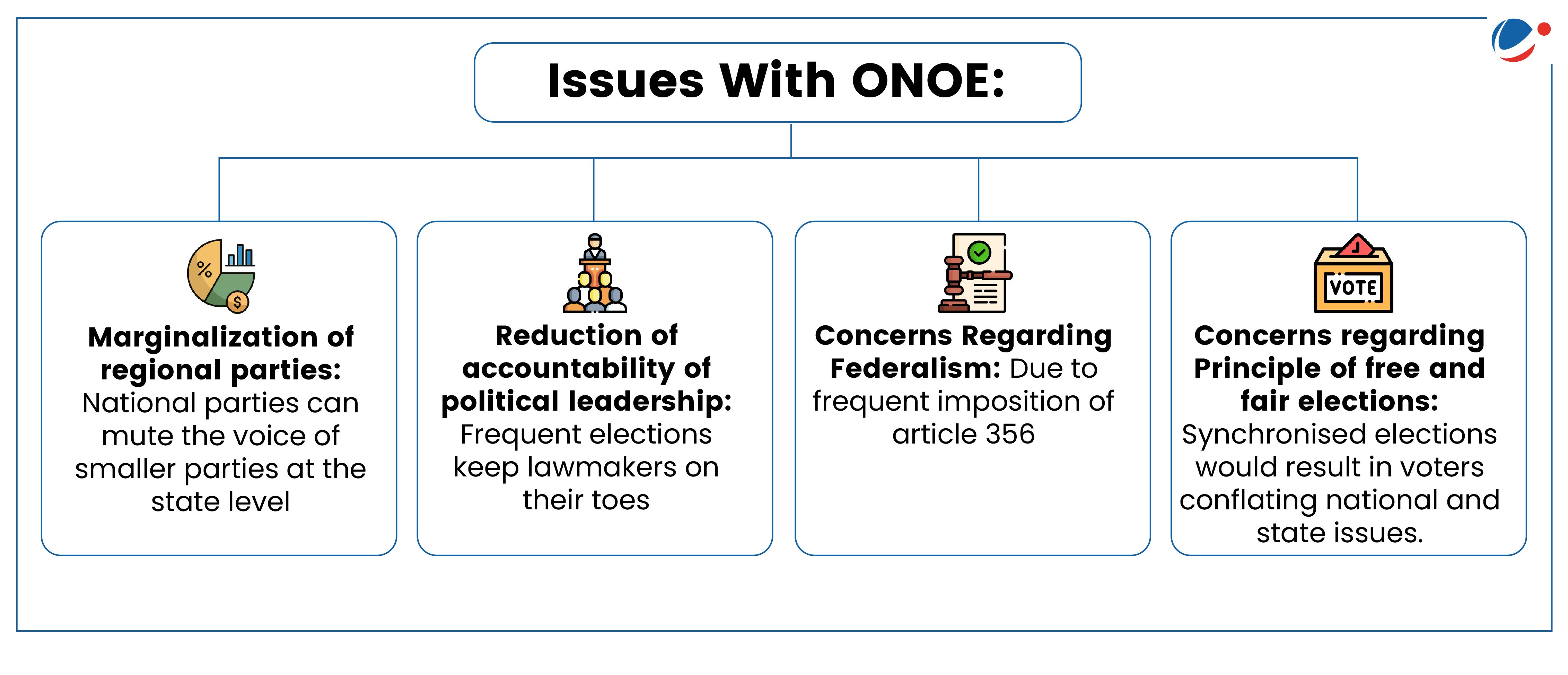
The central tension is that in a parliamentary system, a government's right to rule is contingent on maintaining a majority in the legislature. If that majority is lost, the government falls. ONOE's attempt to synchronize and fix the electoral calendar for five years runs directly counter to this principle of accountability.
To understand this conflict, let's explore the analysis in the Carnegie Endowment paper, "Does “One Nation, One Election” Make Sense for India?".
Does “One Nation, One Election” Make Sense for India?
This article provides a sharp analysis of the democratic principles at stake.
Please read the first two paragraphs in the section "Democracy's Future," starting from this point. The author, Gautam Bhatia, argues that the very essence of parliamentary government is the continuous accountability of the executive to the legislature, a principle that a fixed-term system upends. Note the cautionary example of the UK's experiment with a Fixed-term Parliaments Act, which was later repealed.
This fundamental clash sets the stage for the specific constitutional hurdles that any ONOE proposal must overcome.
Hurdle 1: Tampering with Legislative Terms (Articles 83 & 172)
The first major constitutional obstacle involves the duration of the Lok Sabha and the State Legislative Assemblies, governed by Articles 83(2) and 172(1) respectively. Both articles stipulate a five-year term "unless sooner dissolved." The ONOE proposal requires amending these articles to enforce synchronization.
This would involve two major interventions:
- A one-time, transitional measure to align all state assembly terms with the Lok Sabha, which would necessitate either prematurely dissolving some assemblies or extending the terms of others.
- A permanent mechanism to handle situations where a government collapses mid-term. The Kovind Committee's solution is that a new government would only serve the "unexpired" portion of the original five-year term.
The Think School video explains the constitutional changes and the implications of this "unexpired term" logic.
Masterstroke or Death of Democracy: One Nation One Election EXPLAINED
This video breaks down the complex constitutional challenges and their practical consequences.
First, watch the segment on constitutional hurdles. It clearly lists the key articles that would need to be amended and highlights the politically difficult requirement of securing approval from at least half the states. Next, jump to the section that discusses the unexpired term problem. Consider the core question raised: Would a government serving a short, borrowed term of one or two years focus on long-term reforms or resort to short-term populism to survive the next election?
Critics argue that tampering with the natural five-year mandate of an elected state government compromises its legitimacy and effectiveness. Forcing a newly elected assembly to operate on a truncated timeline could destabilize state-level governance, directly contradicting the pro-ONOE argument for greater stability.
Hurdle 2: The Resurgence of Article 356
Perhaps the most significant federalist concern revolves around Article 356 of the Constitution, which allows the President, on the advice of the central government, to dismiss a state government and impose central rule.
Historically, this article has been used—and many argue, misused—by central governments of all political stripes to dismiss opposition-led state governments. In fact, the arbitrary use of Article 356 was a primary reason why India's electoral calendar became desynchronized in the first place after 1967.
The ONOE framework creates a scenario where the use of President's Rule could become a default response. If a state government falls and no alternative coalition can be formed, what happens until the next synchronized election?
The academic paper "Reconstructing India's Electoral Architecture" provides a detailed legal analysis of this issue.
Reconstructing India's electoral architecture
This paper delves into the specific constitutional articles at play.
Please review the subsections that discuss Article 356. In the section "Legal and Constitutional Framework", find subsection 1.3 Article 356 - President’s Rule (read here). This explains how ONOE and Article 356 are interlinked. Then, look at the "Recommendations for India" section, and read point 2 under 3.1 Constitutional and Legal Reforms (read here). This shows that even proponents recognize the need for safeguards. Finally, read the conclusion's summary of the constitutional challenges (this paragraph), which reinforces the centrality of this issue. The paper emphasizes the need for legal safeguards to prevent "central overreach," a core fear of ONOE's opponents. The landmark S.R. Bommai v. Union of India (1994) case is mentioned as a crucial judicial check against the misuse of Article 356, a check that critics fear ONOE might weaken.
The fear is that in a synchronized system, the Centre would be strongly tempted to impose President's Rule to keep a state aligned with the national calendar rather than hold a standalone election. This would represent a significant blow to state autonomy and the federal structure.
The Federalist Objection: A Threat to the 'Basic Structure'?
Beyond specific articles, the most profound objection is that ONOE strikes at the heart of India's federal character, which some legal experts argue is part of the 'Basic Structure' of the Constitution—a set of fundamental principles that even Parliament cannot amend.
In an interview with The Wire, Professor Jagdeep Chhokar, a co-founder of the Association for Democratic Reforms (ADR), makes this powerful argument.
One Nation One Election Violates the Basic Structure of Constitution & I’ll Go to Supreme Court
This video presents a forceful critique of ONOE from a constitutional and federalist standpoint.
First, watch Professor Chhokar's primary assertion from 17:49 to 20:06. He states his certainty that ONOE breaches the federal structure and therefore violates the 'Basic Structure Doctrine,' and that he would challenge it in the Supreme Court. Next, watch his explanation of how it undermines federalism from 15:31 to 17:12. He argues that simultaneous elections cause voters to focus on national issues, neglecting or subsuming state-specific concerns. This effectively centralizes politics and diminishes the attention given to smaller states and regional matters.
This argument about centralizing the political narrative is a cornerstone of the anti-ONOE position. Critics contend that:
- National issues will dominate: When voting for both state and central governments simultaneously, voters may prioritize national leadership and issues, as evidenced by studies showing reduced split-ticket voting.
- Regional parties will be marginalized: Parties that thrive on state-specific platforms may be unable to compete with the financial and media power of national parties campaigning on a single, overarching narrative.
- Accountability is diluted: Staggered state elections currently function as crucial mid-term referendums on the central government's performance. ONOE would eliminate this vital feedback and accountability mechanism, further concentrating power at the Centre.
This potential transformation of India's political landscape from a federal to a more unitary system, even if by default rather than by design, is the deepest fear animating the opposition to 'One Nation, One Election'.
Conclusion
In this lesson, we have moved beyond the pro-ONOE narrative of efficiency to evaluate the serious constitutional and federalist objections against it. These are not minor technicalities but challenges that go to the core of India's democratic and federal identity.
Key Takeaways:
- Clash with Parliamentary Principles: ONOE's push for a fixed, synchronized calendar conflicts with the fundamental principle of a parliamentary system, where the executive is continuously accountable to the legislature.
- Constitutional Hurdles: Implementing ONOE requires amending key articles like 83 and 172, which govern the terms of legislatures. The proposed solutions, such as "unexpired terms," raise new questions about governance and political stability.
- The Threat of Article 356: The proposal creates a strong incentive for the central government to use President's Rule to manage mid-term collapses of state governments, which would severely undermine state autonomy.
- Assault on Federalism: Critics argue that ONOE would centralize political discourse, marginalize regional parties, and eliminate the crucial check that state elections provide on national power, potentially violating the 'basic structure' of the Constitution.
Preview of the Next Lesson:
Having now analyzed the arguments both for and against ONOE, we are equipped to synthesize these competing views. In our final lesson on this topic, we will assess the competing narratives of ONOE as either a necessary efficiency reform or a structural power grab, allowing you to form a nuanced and comprehensive conclusion on one of the most debated political reforms of our time.