Introduction
In our last lesson, we examined the stark demographic and political consequences of a future Lok Sabha delimitation, establishing the core conflict between the democratic principle of equal representation and the federalist principle of state equity. We saw how this has created a major fault line between the rapidly growing northern states and the demographically stable southern states, and we touched upon the proposal to expand the parliament as a potential, though imperfect, compromise.
This lesson drills down into one side of that conflict, fulfilling your preference for analyzing competing narratives. We will move beyond simply stating the southern states' opposition and instead conduct a thorough evaluation of their arguments. You will analyze the specific claims that a population-based reallocation of seats effectively penalizes them for their successful implementation of national policies and, in doing so, fundamentally undermines India's federal structure.
The 'Penalty for Performance' Argument
At the heart of the southern states' position is a powerful and intuitive argument: they are being punished for their success. For decades, the central government promoted family planning as a national priority. The southern states took this mandate seriously, investing heavily in education, healthcare, and women's empowerment, which led to a significant and successful stabilization of their populations.
This demographic divergence is not abstract; it is quantifiable.
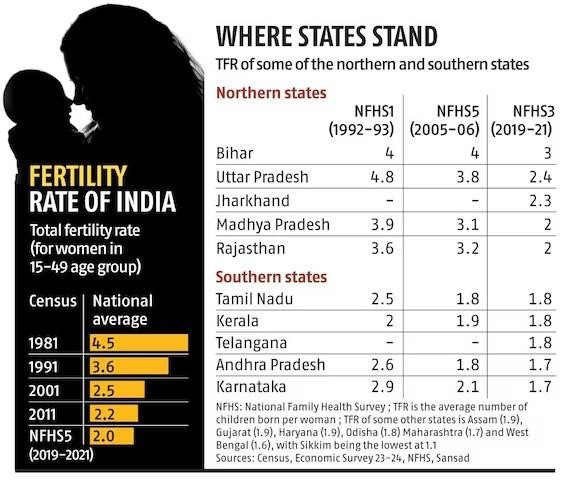
The original 1976 freeze on seat allocation, which we discussed previously, was enacted precisely to avoid this punitive outcome. It was an explicit recognition that states should not lose political representation for heeding a national call. To understand this principle, which southern leaders feel is now being abandoned, let's revisit its origin.
The delimitation dilemma: Why India's north-south divide is at a ...
This article from The Week by a former Chief Election Commissioner frames the 1976 freeze not just as a technical fix, but as a core promise within India's federal structure.
Please read the section titled "A historic compromise." Focus on the author's characterization of the freeze as a "moral commitment" to ensure that states would not be punished for their performance in population control.
This idea of a "moral commitment" is crucial. From the perspective of southern states, a delimitation based purely on current population figures is a direct violation of this foundational promise. They argue that they upheld their end of the federal bargain, only to now face a reduction in their political voice as a consequence. This sentiment is concisely articulated in the following video.
What Is Delimitation, Why Southern States & Central Govts Are At The Loggerheads?
This news report from NDTV directly captures the core of the southern argument.
Watch the brief segment from the main argument, where the narrator explains the southern leaders' position that states that successfully controlled population growth should not be "punished with fewer seats."
The Economic 'Double Whammy'
The sense of being penalized is compounded by a significant economic grievance. Leaders and analysts from the southern states frequently argue that they are not just demographically responsible but are also the primary drivers of India's economy. They contend that they contribute a disproportionately large share of national tax revenue and GDP, yet receive a smaller share of central funds in return.
This creates what many have termed a "double whammy": the southern states perceive themselves as subsidizing the northern states financially, and now they face the prospect of also having their political power transferred to those same states.
Constitutional Challenges and Federal Implications of India's 2026 ...
This academic paper provides data to substantiate the economic dimension of the southern states' concerns.
Read the section titled "South Indian States’ Concerns." Pay attention to the paragraph starting "The economic dimension compounds these concerns." Note the specific data point provided for Tamil Nadu, which contributes significantly more to the national GDP relative to its population share.
This argument transforms the debate from one of abstract principles into one of tangible fairness. The southern states' question is pointed: why should states that are both more demographically responsible and greater economic contributors have their say in national policy-making systematically reduced?
Federalism as a Pact, Not Pure Arithmetic
This leads us to the most fundamental constitutional argument: the southern states' conception of federalism itself. While the northern argument rests on the democratic purity of "one person, one vote, one value," the southern perspective argues that Indian federalism was never meant to be a system of simple majoritarianism.
Instead, they view it as a compact—a negotiated partnership between diverse states. In this view, federalism's purpose is to balance the interests of all constituent units and protect smaller or less populous states from being perpetually dominated by a larger, more populous bloc. To them, reducing the entire basis of representation to population arithmetic threatens to break this compact and turn the country into a "tyranny of the majority."
The delimitation dilemma: Why India's north-south divide is at a ...
This article again provides a sharp analysis of the federalist principle at stake.
First, read the paragraph under "Why the logic still holds" that begins "More importantly, federalism is not merely arithmetic." This captures the essence of the argument that the Union requires a balance of power. Next, read the section "The problem of absolute numbers." This is crucial because it explains why simply expanding the size of the Lok Sabha doesn't solve the problem. Focus on how the absolute vote gap between northern and southern states would widen, diminishing the South's relative power to influence legislation.
The fear, as the reading explains, is not just a marginal loss of influence. It is the prospect of being rendered structurally irrelevant on key national issues. A bloc of northern states could potentially command a sufficient majority in an expanded Lok Sabha to pass budgets, enact laws, and even amend the constitution without needing consensus from the southern states.
This potential future is what the southern states see when they look at projections for a newly delimited parliament.
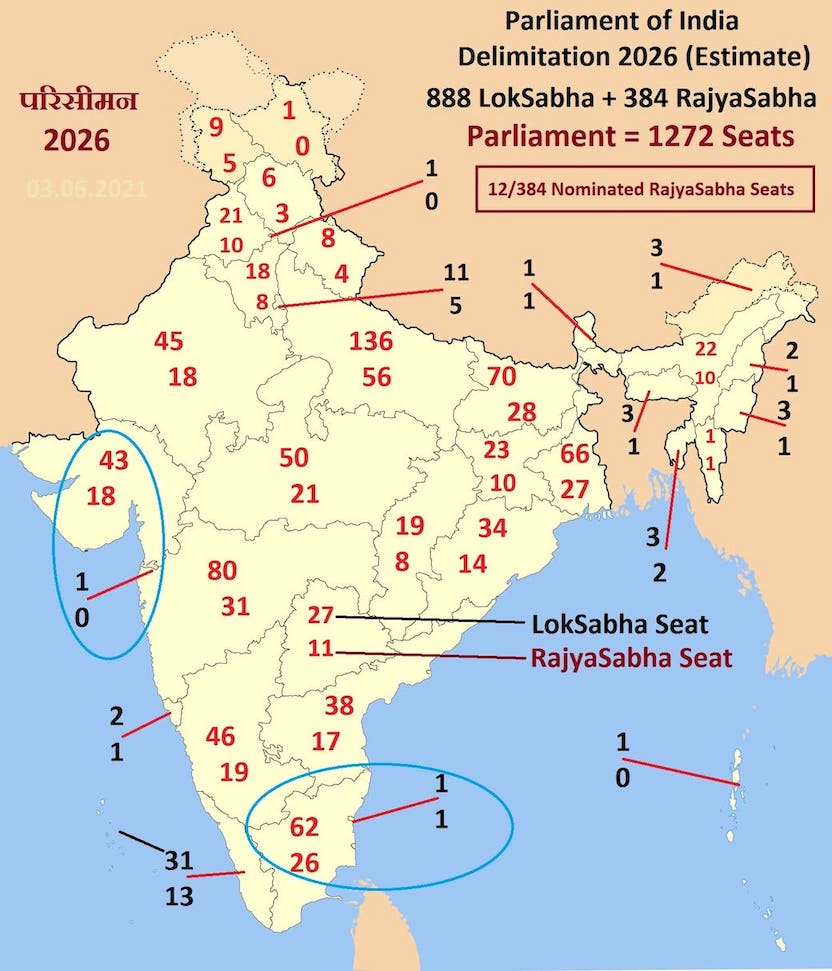
For these states, this map represents the erosion of the federal pact. It visualizes a future where their economic and social priorities could be sidelined by the sheer demographic weight of the northern states, turning cooperative federalism into a system dominated by one region. This is what leaders mean when they argue that population-based delimitation "undermines federalism."
Conclusion
In this lesson, we have moved past the general outlines of the delimitation conflict to evaluate the specific, multi-layered arguments of the southern states. We've seen that their opposition is not based on a single grievance, but on a powerful convergence of principles and pragmatics.
Let's summarize the key arguments you've evaluated:
- The Penalty for Performance: Southern states argue that population-based delimitation punishes them for successfully implementing national family planning policies, violating the "moral commitment" that underpinned the 1976 freeze.
- The Economic 'Double Whammy': They contend that this political penalization is compounded by an existing economic disparity, where they feel their larger contributions to the national exchequer are not matched by a fair share of resources or political power.
- The Federalism Principle: Fundamentally, they argue that federalism is about maintaining a balance of power between diverse states, not just ensuring arithmetic equality. They fear that a purely population-based system will lead to a "tyranny of the majority" and erode the federal compact.
The delimitation debate is a profound challenge to India's political architecture. As we will see in our next lesson, its complexities are now deeply entangled with another landmark piece of legislation. We will explore the Nari Shakti Vandan Adhiniyam (Women's Reservation Act) and analyze the controversial 'implementation clause' that explicitly links its future to the completion of both the census and this very delimitation process, adding yet another explosive variable to the equation.