Introduction
Welcome to the final lesson of our course on Indian Politics. Over the past two sessions, we have explored the dual nature of India's democratic health. First, we examined the deep-rooted pillars of its resilience—the vibrancy of its electoral process, the historical activism of its judiciary, and the mobilizing power of its civil society. Then, we confronted the significant evidence of democratic erosion, analyzing the stress points that challenge the integrity of its institutions, the freedom of its press, and the rights of its minorities.
This capstone lesson is designed to help you synthesize these conflicting realities. Our goal is to move beyond simplistic labels like 'democratic' or 'autocratic' and construct a nuanced, evidence-based assessment of the current trajectory of Indian democracy. We will weigh the arguments, analyze the impact of the pivotal 2024 election, and engage with the central scholarly debates that define this critical moment for the Indian republic. This synthesis is the culmination of our entire journey through the complexities of contemporary Indian politics.
The Core Debate: A Top-Down Push or a Bottom-Up Pull?
At the heart of any nuanced assessment is a fundamental question: What is driving the changes we are witnessing in India's democratic character? Is the 'illiberal turn' a top-down project, thrust upon the country by a powerful leader and a dominant party? Or is it a bottom-up phenomenon, reflecting a deeper shift in societal preferences towards majoritarianism, with leaders merely responding to a pre-existing demand?
This distinction is crucial for understanding whether the current trends are contingent on a specific political configuration or indicative of a more permanent transformation. A collection of essays from leading political scientists, published by the American Political Science Association, frames this debate perfectly.
[PDF] Democracy and Autocracy - APSA Connect
This essay by Larry Diamond, Šumit Ganguly, and Dinsha Mistree clearly outlines the two competing scholarly explanations for India's democratic regression. Understanding this framework is the first step in building your own synthesis.
Please read the entire essay, which starts with the heading "Taking Stock of India's Democracy." As you read, focus on how the authors articulate the two contending strains of scholarship: The first view maintains that the decline is driven by the leadership of Narendra Modi and the BJP, who are orchestrating a "top-down dismantling of India’s liberal democracy." The second view suggests that this trend is symptomatic of larger societal forces, such as a long-standing "politics of anxiety" among the Hindu majority, and that leaders are opportunistically giving voters the "strong leadership" and Hindutva agenda they desire.
This framework of "supply-side" versus "demand-side" illiberalism provides the analytical lens through which we can interpret the events and data that follow.
Beyond the Binary: Competitive Authoritarianism
As we seek to move past simple labels, it's helpful to look at the terminology used in comparative politics to describe regimes that blend democratic and autocratic features. India's situation is not unique; it is part of a global trend of democratic backsliding, where the erosion happens not through a coup, but from within.
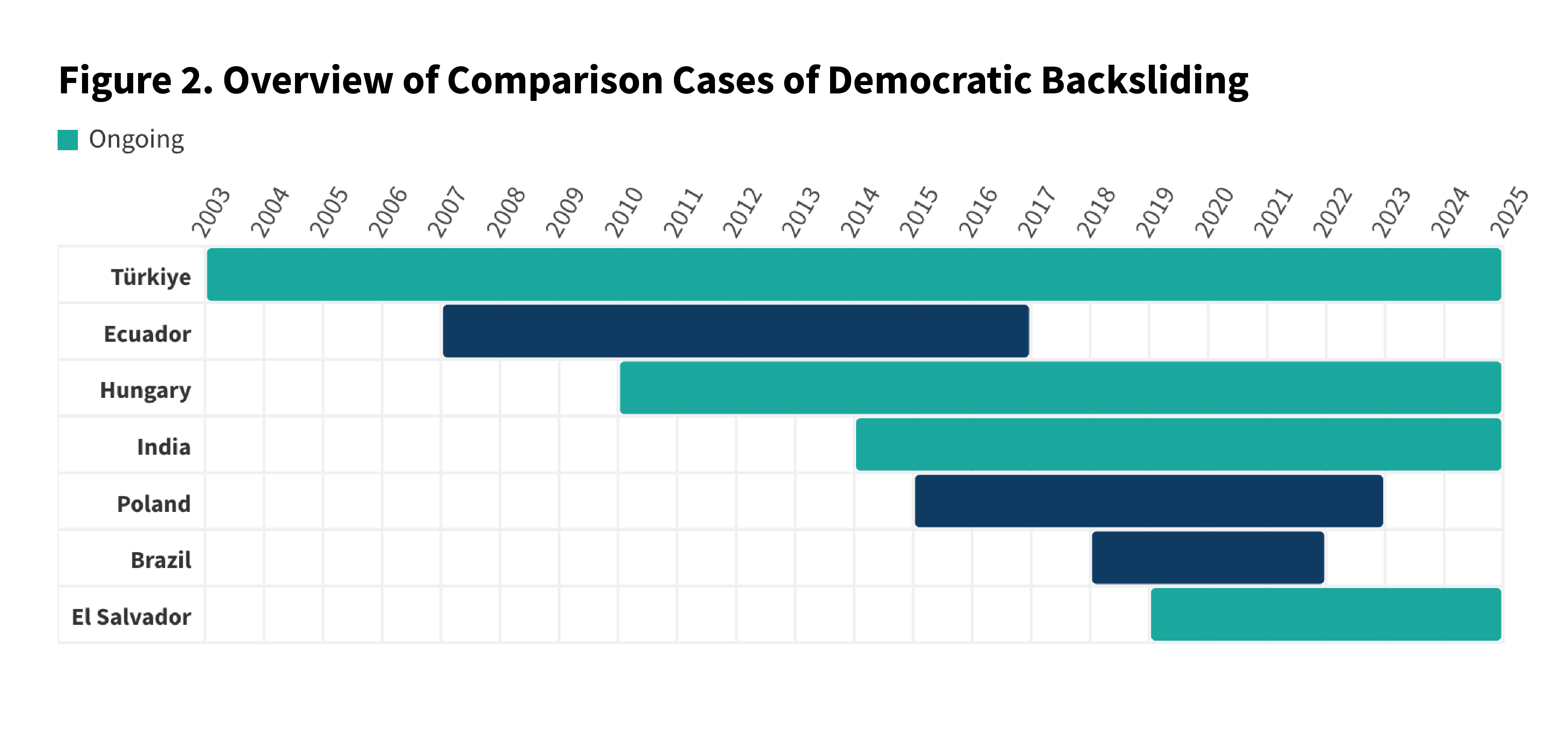
Political scientists often use the term competitive authoritarianism to describe such hybrid systems. This concept acknowledges that elections remain the central arena for competition, but the playing field is heavily tilted in favor of the incumbent. Let's explore this concept with Christophe Jaffrelot, a leading scholar of Indian politics.
Indian Democracy and Hindu Nationalism
In this panel discussion, Christophe Jaffrelot explains why "competitive authoritarianism" is a useful label for understanding the current political reality in India and elsewhere.
Please watch the segment from this discussion on hybrid regimes. Note his argument that national-populist leaders need elections to claim a popular mandate, which forces them to take the risk of losing. This distinguishes such regimes from outright dictatorships, even while the competition is unfair due to biased media, money power, and institutional capture.
This framework of competitive authoritarianism allows us to hold two thoughts at once: democratic institutions are being systematically weakened, yet the possibility of defeating the incumbent through elections, however difficult, still exists. The 2024 general election served as a powerful stress test for this very proposition.
The 2024 Verdict: A Systemic Correction?
The results of the 2024 Lok Sabha elections, where the BJP lost its single-party majority for the first time in a decade, were interpreted by many as a powerful reassertion of democratic accountability. Public intellectual Pratap Bhanu Mehta, in an interview immediately following the results, offered a trenchant analysis suggesting the electorate had pulled India back from the brink.
“India has walked back from the brink but our democracy is still in danger”: Pratap Bhanu Mehta
Mehta's analysis captures the sense of a significant political shift and provides a strong argument for the resilience of India's voters.
Watch these two key segments from his interview on The Wire: Tectonic Shift or Reversal? Here, Mehta argues that the result was tectonically important because it prevented the consolidation of a "one party, one ideology, one leader" system and "pricked the bubble" of Modi's personal authority. Exhaustion of the Agenda: He further contends that the verdict signals an "exhaustion of both" the Hindutva project and Modi's governance credentials, suggesting the BJP is running out of new ideas and credibility.
Mehta’s perspective suggests that the democratic system's self-correcting mechanisms are still functional. Voters, when presented with a viable alternative and faced with an overreaching executive, demonstrated their capacity to impose checks and balances through the ballot box.
A Deeper Look: Resilience of the System or of the Dominant Party?
While Mehta’s analysis captures the significance of the 2024 verdict as a check on executive power, a more structural, data-driven analysis complicates the narrative of a full-scale democratic revival. A detailed study from the Carnegie Endowment for International Peace argues that despite the BJP's setback, the core features of its dominance—what is termed the "fourth party system"—remain largely in place.
The Resilience of India's Fourth Party System
This analysis by Milan Vaishnav and Caroline Mallory provides a crucial counterpoint, arguing that the BJP remains the central gravitational force in Indian politics, even without a parliamentary majority.
Please read the following three sections of this paper: The Introduction, which presents the core argument that the 2024 verdict represents a curtailing, not a repudiation, of the BJP's dominance. The section titled "Presence of a Dominant Party." Pay close attention to the data on vote share, the party's changing geographic footprint, and its continued strength in state legislatures and the Rajya Sabha. The Conclusion, which powerfully synthesizes the evidence and frames the key questions that will determine the future trajectory of the party system.
This analysis suggests a more complex reality. While the return to coalition governance has restored a degree of horizontal accountability, the BJP's stable national vote share, its expansion into new territories, and its continued status as the "system-defining party" around which all politics revolves, indicate that the structural shift of the last decade has not been undone. The democratic system showed resilience, but the dominant party at its center has also proven resilient.
Crafting Your Assessment: Synthesizing the Paradoxes
We are now equipped to construct our final, nuanced assessment. This requires holding the competing evidence and frameworks in productive tension, rather than seeking a single, simple answer.
One of the most insightful perspectives for this synthesis comes from political scientist Eswaran Sridharan, who draws a critical distinction between a party's electoral power and its ideological hold over the electorate.
[PDF] Democracy and Autocracy - APSA Connect
In this concluding essay from the "Democracy and Autocracy" collection, Sridharan offers a balanced assessment that helps explain the paradox of the BJP's simultaneous strength and vulnerability.
Read the subsection "Possible Implications for the Quality of Democracy in the Near Future." Focus on his central argument: while the BJP has achieved electoral dominance, survey data suggests it has not yet achieved ideological dominance, as a majority of the electorate still holds liberal and accommodating attitudes toward minorities. This gap, he argues, is a key safeguard for Indian democracy.
Sridharan's argument helps explain the 2024 result: the BJP's electoral machine, while powerful, could not overcome the limits of its ideological appeal when faced with pressing material concerns like unemployment and inflation.
As you form your own judgment, consider these synthesizing questions:
- Resilience, Backsliding, or Reconfiguration? Does the 2024 election signify the resilience of Indian democracy, a temporary pause in its backsliding, or a reconfiguration into a new form of competitive politics where a dominant party is constrained by federal and coalition partners?
- The Durability of Checks and Balances: The election acted as a popular check. But what about institutional checks? Given the arguments about the pliability of the judiciary and other bodies, can we expect a revival of institutional independence, or does that depend on sustained political change, as argued by the panelists in the Indian Democracy and Hindu Nationalism discussion?
- The Future of the 'Modi-BJP' Project: Was the 2024 verdict a rejection of Narendra Modi's personal style, as the RSS's post-election comments might suggest? Or was it, as Mehta argues, a sign of the "exhaustion" of the entire Hindutva-plus-welfarism agenda? The answer has profound implications for whether a post-Modi BJP would moderate or double down.
- The End of a Cycle? Christophe Jaffrelot suggests Indian politics moves in cycles, with caste-based mobilization and federalism re-emerging as an antidote to Hindutva. Does the 2024 result, with the resurgence of parties like the Samajwadi Party, support this cyclical theory? Or are the ideological roots of Hindutva now too deep to be easily displaced?
Your task is not to definitively answer these questions but to use them to structure a sophisticated assessment that acknowledges ambiguity and paradox. The trajectory of Indian democracy is not a settled matter but an ongoing contest.
Conclusion
This course has guided you through the turbulent crosscurrents of contemporary Indian politics. We began by analyzing the new coalition era ushered in by the 2024 elections and the revival of the political opposition. We delved into festering crises in Manipur and the unresolved questions of citizenship in Assam. We scrutinized the challenges to liberty and accountability posed by state surveillance and debated the monumental structural reforms on the agenda, from delimitation and women's reservation to 'One Nation, One Election' and the Uniform Civil Code.
Our journey culminates here, with a recognition that Indian democracy is a complex, contested, and evolving entity. We have seen that it is neither dead nor entirely safe. It exists in a state of dynamic tension, characterized by the resilience of its diverse society and the severe stress on its liberal institutions. The most accurate assessment is not a static label but an appreciation of this ongoing struggle. As you continue to follow India's political journey, the analytical tools and frameworks we have developed in this course will empower you to look beyond the headlines and understand the deeper forces shaping the destiny of the world's largest democracy.