Introduction
In our last lesson, we analysed the Paradox of Tolerance, concluding that healthy relationships sometimes require being intolerant of behaviours that violate core boundaries. We focused on the "how" and "when" of enforcing those boundaries as a "hard loving" act.
Today, we shift our focus from managing destructive behaviour to managing the flow of information itself. We'll explore the Transparency Paradox, which reveals the counterintuitive idea that more transparency can sometimes lead to less trust and honesty. Your learning outcome for this session is to analyse the Transparency Paradox and evaluate the trade-offs between full disclosure and strategic communication in sensitive situations.
This paradox is fascinating because it challenges the modern mantra that "radical honesty" and total transparency are always the best policy. We will first define the paradox in a professional context and then apply its principles to the delicate and sensitive communication required within a vee relationship.
1. Defining the Transparency Paradox
The core idea of the Transparency Paradox is that when people feel they are being constantly observed, they may hide their true actions and thoughts to present a more acceptable "performance." This can paradoxically result in less genuine insight for the observer, not more.
The term was popularised through research at a large manufacturing plant, which provides a clear, foundational example.
Hiding From Managers Can Increase Your Productivity
Let's begin with the original case study that defined this concept. The article 'Hiding From Managers Can Increase Your Productivity,' from Harvard Business School, explains how increased visibility on a factory floor actually reduced real transparency.
Please read the introduction, the section 'What Managers Saw Wasn't Real,' and the subsequent section that explicitly defines the paradox (it begins with an image of a curtain). Focus on why employees performed a 'show' for managers and hid their more efficient 'tribal tricks,' and how privacy actually led to more innovation being shared.
The factory study perfectly illustrates the paradox: the goal of full transparency (closely spaced assembly lines) led to the opposite outcome. Workers hid their most effective innovations to avoid the "cost of explaining" them. Only when given privacy (the curtain) did they perfect their methods and then proactively share them. This created more real transparency about effective work practices, not less.
This happens because there is a crucial difference between simply revealing facts and communicating with honesty and integrity.
2. The Trade-off: Truth vs. Honesty
The Transparency Paradox forces us to distinguish between being "truthful" (stating facts) and being "honest" (acting with integrity, which includes emotional context and intention). Full, unfiltered disclosure can feel like a data-dump, overwhelming the recipient and failing to convey the real meaning.
Radical Honesty vs Telling the Truth: The Definition of Integrity
The paradox often emerges when one person demands 'radical transparency' without creating the safety needed for genuine honesty. This video does an excellent job of exploring the subtle but critical difference between 'telling the truth' and 'being honest.'
Please watch the segments from 1:05–2:33 and 6:45–10:50. The first part explains how telling the truth can be a form of dishonesty if it omits key information or is driven by a hidden motive. The second part discusses the long-term benefits of genuine honesty, which requires choosing integrity over securing a desired short-term outcome.
As the video highlights, communication is dishonest if there's a "hidden strategy and motive." The workers in the factory were being truthful—they performed the tasks according to the official manual when watched—but they weren't being honest about their better methods. Their strategic communication was a rational response to the environment.
A classic tool for mapping this landscape of disclosure is the Johari Window. As a social researcher, you're likely familiar with this model, which maps awareness into four quadrants.
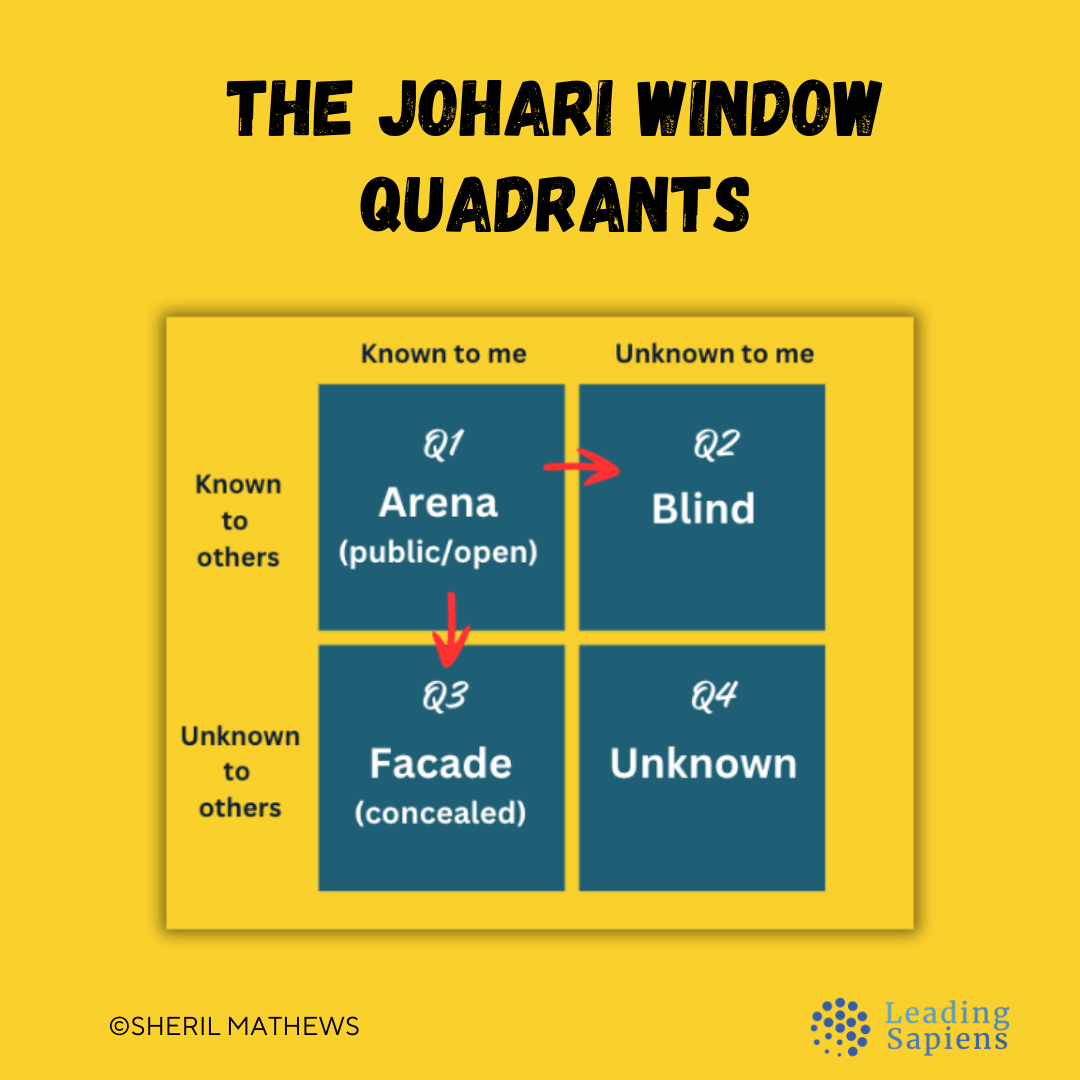
The paradox suggests that demanding someone empty their 'Façade' (Q3) without establishing trust can cause them to retreat, shrink the 'Arena' (Q1), and damage the relationship. The key is not to force disclosure, but to create conditions where voluntary, honest sharing feels safe and productive.
3. A Framework for Strategic Communication
If a firehose of facts isn't the answer, how do we navigate sensitive topics? The solution lies in strategic communication, which prioritises connection and understanding over raw data.
The first step is to correctly identify the nature of the conversation.
The Science Behind Dramatically Better Conversations | Charles Duhigg | TED
Communication expert Charles Duhigg explains that misaligned conversations are a primary source of conflict. He proposes that we must first identify and match the type of conversation—practical, emotional, or social—before we can truly connect.
Please watch from 2:12 to 9:11. Focus on the 'matching principle' and the story of the cancer surgeon. Notice how he failed when leading with a 'practical' conversation (facts about surgery) and succeeded only after starting with an 'emotional' one ('What does this diagnosis mean to you?').
The surgeon's story is a masterful example of navigating the Transparency Paradox. His initial approach—full, immediate transparency about the medical facts—was failing. By shifting to an emotional conversation first, he created the trust needed for the patient to actually hear and accept his practical advice. He didn't hide the truth; he strategically sequenced the conversation to ensure the truth could be received.
To build on this, we can use a structured framework to decide what, why, and how to make information transparent.
The transparency paradox: Could less be more when it comes to trust?
This Deloitte report on the Transparency Paradox provides a practical framework for making these decisions, structured around four key questions: What, Why, Who, and How.
Please read just the framework section that begins with 'WHAT information or whose actions will be made transparent?'. Review the 'Go (proceed thoughtfully)' and 'Caution (think twice)' examples. This serves as a useful checklist for evaluating the trade-offs of disclosure.
This framework moves us from a binary choice of "disclose/hide" to a more sophisticated evaluation of how to communicate in a way that builds, rather than erodes, trust.
4. Application: A Scenario in a Vee Relationship
Let's apply these concepts to a sensitive situation in a vee relationship.
Scenario:
Imagine a vee relationship involving a wife (Clara), her husband (David), and David's girlfriend (Eva). Clara and David have been married for years, while David and Eva have been together for one year. Clara recently gave birth and is struggling with insecurities about her post-partum body. This has made her feel distant and less confident during intimacy with David.
Clara has kept the depth of her insecurity hidden (her 'Façade'). She tells David she's just "tired," which is true but incomplete. She fears that full disclosure would make her seem unattractive to David or put pressure on him. She also worries that discussing it could make Eva feel awkward or view her as a "problem" in the triad.
David senses the distance and, wanting to fix things, insists they need "radical honesty and total transparency" between all three of them to make the vee work.
Your Task:
Please take about 10 minutes to analyse this scenario.
- Analyse the Paradox: How does David's demand for "total transparency" risk triggering the Transparency Paradox? Why might Clara's "truthful but incomplete" communication (saying she's "tired") be a rational, albeit temporary, strategy?
- Evaluate the Trade-offs: Using the Johari Window as a reference, describe the information in Clara's 'Façade'. What are the risks of her maintaining this façade long-term? Conversely, what are the risks of a sudden, full disclosure in response to David's demand?
- Propose a Strategy: Using the 'What, Why, Who, How' framework and the concept of different conversation types, design a communication strategy for Clara. How should she approach this conversation—first with David, and then potentially with Eva? What would be a better first step than a full, unfiltered disclosure of all her insecurities?
Click here to see a possible analysis.
-
Analyse the Paradox: David's demand for "total transparency" creates pressure and may feel like an interrogation, not an invitation. This could cause Clara to retreat further and reinforce her belief that she needs to "perform" being okay, triggering the paradox. Her statement that she is "tired" is a classic example of a "truthful lie"—factually correct, but used to obscure a deeper, more vulnerable truth because the environment doesn't yet feel safe for full honesty.
-
Evaluate the Trade-offs:
- Clara's Façade: Contains deep feelings of vulnerability, body insecurity, and fear of rejection.
- Risks of Concealment: If she maintains the façade, the emotional distance from David will grow, potentially leading to a severe breakdown in intimacy and trust. David might invent his own explanations for her withdrawal (e.g., "she's not attracted to me anymore," "she resents Eva"), causing more damage.
- Risks of Full Disclosure: If, in response to David's demand, she blurts out, "I feel ugly and I'm afraid you don't want me," she risks putting David on the defensive. It frames the issue as a high-stakes practical problem for him to solve, when what she likely needs is emotional connection. It bypasses the crucial step of establishing emotional safety.
-
Propose a Strategy: Clara's best strategy is to initiate an emotional conversation, not a practical one.
- WHO: She should start with David alone. The foundational marital relationship is where this insecurity is rooted, and bringing Eva in too early adds unnecessary complexity.
- WHAT & WHY: She doesn't need to share every negative thought. She can start by naming the emotion and creating an opening. For example: "I want to talk about something that's been hard for me lately. I've been feeling distant, and I want to feel close to you again." This frames the WHY as a shared goal (restoring closeness).
- HOW: She could use a "deep question" approach on herself. Instead of stating facts ("my body has changed"), she can share feelings ("I've been struggling to feel like myself lately, and it's making it hard for me to connect"). This invites David into an emotional conversation where his role is to listen and empathise, not to "fix" her body image.
- Next Steps: Only after re-establishing that emotional safety with David can they decide together what, if anything, needs to be shared with Eva, and for what purpose (e.g., to explain why they might need more one-on-one time temporarily). This follows the principle of creating privacy to solve a problem before broadcasting it.
Conclusion
The Transparency Paradox teaches us a sophisticated and compassionate lesson: genuine communication is not about the volume of information disclosed, but about the quality of the connection. Striving for total transparency without building trust can backfire, forcing people to hide what is most important.
Key Takeaways:
- Forced or excessive transparency can paradoxically lead to more secretive behaviour and less trust.
- Strategic communication is not dishonest; it is the art of sharing information in a way that can be heard and understood, often by prioritising emotional connection before practical problem-solving.
- Evaluating the What, Why, Who, and How of disclosure helps navigate sensitive situations effectively, balancing the need for honesty with the preservation of trust.
- The goal is to create an environment where voluntary, authentic sharing feels safer and more productive than performing a "show."
Next Lesson Preview:
In our next lesson, we will begin Module 7, "Paradoxes of Individual Choice." We will shift our focus back to your interest in design by analysing the Inventor's Paradox, which suggests that the solution to a specific, narrow problem can sometimes be found by tackling a more general, ambitious one.