Introduction
Hello! In our last lesson, we diagnosed the 'Growth and Underinvestment' archetype, seeing how a business can inadvertently cause its own demise by failing to invest in the capacity needed to sustain success. We applied this to a scenario involving your lingerie design business, justifying the need for early investment to protect your brand's growth engine.
Today, we move to the next letter in your FLATS GEDS mnemonic: 'E' for Escalation. This archetype describes a common and often destructive dynamic where two or more parties become locked in a reinforcing cycle of one-upmanship. Each party's "rational" action is perceived as a threat by the other, provoking a counter-action that is seen as an even greater threat, spiraling into a conflict that no single party may have wanted.
Your learning outcome for this lesson is to diagnose an 'Escalation' dynamic by identifying its reinforcing feedback loop structure. As requested, we will focus our main example on the domain of personal relationships, exploring how this dynamic can manifest in a non-monogamous context.
1. The Structure of Escalation
At its heart, the Escalation archetype is an arms race. One party does something, the other party sees it as a threat and responds in kind, which just provokes the first party to escalate further. This pattern appears everywhere, from corporate price wars to international military conflicts.
Let's begin with a short video that uses these classic examples to introduce the core concept.
Systems Thinking Tools: Archetypes
This clip from the System Dynamics Society provides a clear, high-level definition of the 'Escalation' archetype, using concise examples to illustrate the dynamic.
Please watch from 25:23 to 26:38. Focus on how one party's action triggers a reaction from the other, which in turn triggers a larger action from the first, creating an upward spiral.
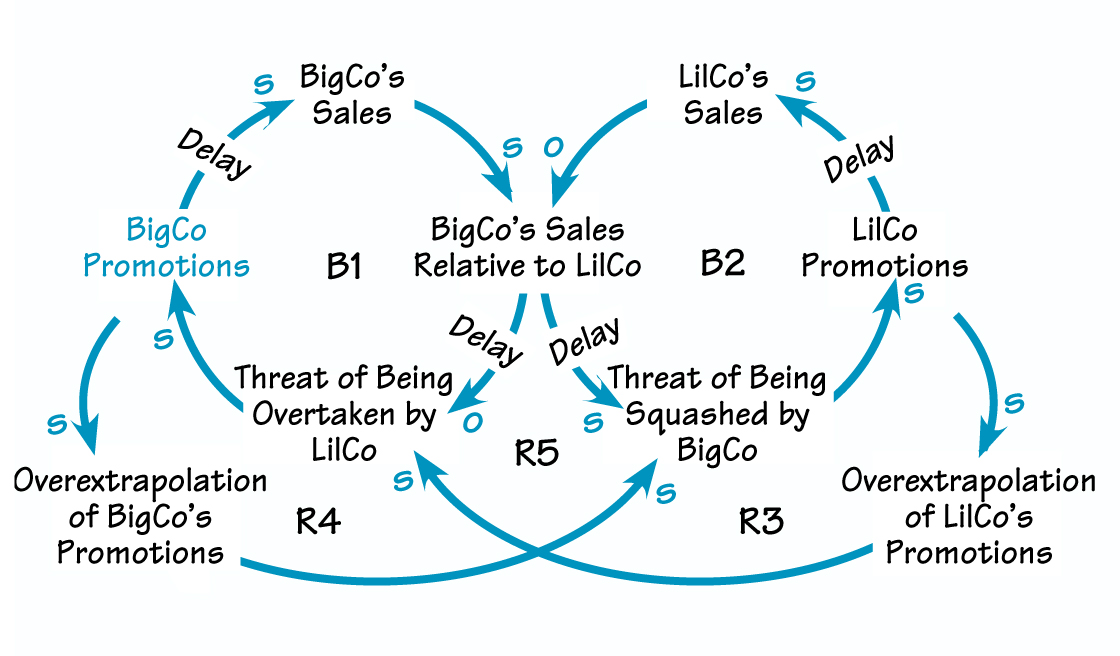
The underlying structure of this dynamic is what makes it so powerful and difficult to escape. It's composed of two parties (A and B), each acting to manage their own situation. However, because their situations are defined relative to each other, their individual attempts at control combine to create a single, powerful reinforcing loop.

This structure is often described as a "figure-8," where two individual balancing loops (each party trying to maintain their own standing) are interlocked in a way that creates one overall reinforcing loop of escalating competition.
To clarify this structural point, let's turn to a guide from The Systems Thinker.
[PDF] Applying Systems Archetypes
This guide provides a formal definition of the Escalation archetype's structure, which will be crucial for our diagnosis.
Please read the short section on 'ESCALATION' on page 6 of the PDF. Pay close attention to the description of how two balancing loops create a 'reinforcing figure-8 effect'. You can also glance at the accompanying diagram on page 7.
2. Diagnosing Escalation in a Relationship
Now, let's apply this abstract structure to a concrete and complex human situation. We will analyze how an 'Escalation' dynamic can emerge within a "Vee" relationship, where a husband is in a relationship with both his wife and a metamour. The resource being competed for is often intangible: time, attention, emotional energy, or a sense of security.
The following article provides a perfect template for this analysis, using a simple couple's crisis to illustrate how a systems perspective can reveal the underlying reinforcing loop.
Living with and within feedback loops – Examples from daily life of ...
This article, 'Living with and within feedback loops,' provides an excellent example of a 'couple crisis escalation.' It shows how to move from a linear, blame-focused view to a circular, systems view that reveals the trap.
Please read the section titled 'Positive Feedback Loop: couple crisis escalation'. Focus on how the author diagrams the shift from an 'exogenous' (it's all his fault) perspective to an 'endogenous' (we're both part of this) perspective, revealing the reinforcing loop that traps both individuals.
Let's use the insights from that article to map out an 'Escalation' dynamic between a Wife and her husband's partner, the Metamour.
The Scenario:
The Wife (Party A) and the Metamour (Party B) both value their time and connection with their shared partner, the Husband. The "relative measure" that fuels the escalation is the perceived fairness or balance of the Husband's time and attention.
-
Initial Action & Threat: The Wife feels a bit insecure and that her connection is waning. To restore her sense of security (her balancing action), she asks the Husband to schedule a recurring, dedicated "us night" every Friday. From her perspective, this is a reasonable request to ensure her needs are met. However, the Metamour perceives this as a threat. It removes spontaneity and unilaterally claims a prime slot of time, making her feel her own relationship is now less important or flexible.
-
Retaliation & Counter-threat: To restore her own sense of security and importance (her balancing action), the Metamour plans a special, all-expenses-paid weekend getaway with the Husband for the following month. From her perspective, this is a positive act to create a special memory. However, the Wife perceives this as a massive counter-threat. It's a much larger block of time and feels like a competitive move to "outdo" her date night.
-
The Cycle Continues: The Wife, now feeling even more insecure, might respond by insisting on "veto power" over the Husband's plans or demanding a full, shared calendar that must be pre-approved weeks in advance. The Metamour sees this as a controlling move and might respond by creating "secret" time with the Husband.
The reinforcing loop is now in full swing:Wife's insecurity → Wife's demands on Husband's time → Metamour's perceived loss of status/time → Metamour's insecurity → Metamour's counter-demands on Husband's time → Wife's perceived loss of status/time → Wife's insecurity ... and so on, with each cycle growing in intensity.
3. Identifying the Reinforcing Feedback Loop Structure
To formally diagnose this, you must identify the components of the reinforcing "figure-8" structure. Each person is trapped in their own balancing loop, but the loops are interconnected in a destructive way.
Wife's Balancing Loop (B1):
- Gap: A gap between her desired level of security/attention and her current perceived level.
- Action: She makes demands on her husband's time.
- Result: The gap is temporarily closed; she feels more secure.
Metamour's Balancing Loop (B2):
- Gap: The Wife's action creates a gap for the Metamour between her desired level of connection/flexibility and her current situation.
- Action: She makes a counter-demand on the husband's time.
- Result: Her gap is temporarily closed; she feels more secure.
The Reinforcing Loop (R):
The critical link is that the Metamour's action (the result of B2) directly widens the Wife's original gap, causing her to take an even stronger action in her own loop (B1). The system escalates because each person's "solution" is the other person's "problem." As a statistician, you can recognize that the behavior over time will be exponential growth of tension, demands, and conflict until an external limit is hit—such as the collapse of one or both relationships.
To help in diagnosis, here is a concise checklist of questions.
[PDF] Applying Systems Archetypes
The 'Applying Systems Archetypes' guide provides a sharp diagnostic toolkit in its appendix. These questions help you quickly identify the key components of an Escalation structure in any scenario.
Please read the 'ESCALATION' section in 'APPENDIX A' on page 13. Focus specifically on the questions listed under 'Guidelines'.
Let's apply those diagnostic questions to our relationship scenario:
- What is the relative measure...? It's the perceived share of the husband's time, attention, and emotional energy. The core issue is that both parties are measuring their success relative to the other rather than against an independent standard of what makes a good relationship for them.
- What are the significant delays...? There are perceptual delays. It takes time for one person's insecurity to build, for them to act, and for the other person to register that action as a threat. During these delays, resentments can fester and misinterpretations solidify.
- What are the deep-rooted assumptions...? The most dangerous assumption is that the husband's attention is a zero-sum game. Other assumptions might include: "If I don't fight for my position, I will be marginalized," or "The other person is intentionally trying to undermine me." Breaking the escalation cycle requires surfacing and challenging these assumptions.
Conclusion
In this lesson, we dissected the 'Escalation' archetype, a potent system limiter where rational individual actions lead to irrational and destructive collective outcomes.
Key Takeaways:
- 'Escalation' occurs when two or more parties get locked in a reactive cycle, where each party's actions are perceived as a threat by the other, provoking ever-stronger counter-actions.
- The underlying structure is a powerful reinforcing loop, often described as a "figure-8," created by the interconnection of two individual balancing loops.
- Diagnosing this archetype involves identifying the parties, the competitive "relative measure" they are tracking, and the cycle of threatening actions that form the core reinforcing feedback loop.
- The key to intervention often lies in making the structure visible and challenging the deep-rooted assumption that the parties are in a zero-sum game.
Next Lesson Preview:
In our next lesson, we will explore another system limiter from your mnemonic: 'Drifting Goals.' This archetype explains how standards can slowly and insidiously erode over time under pressure, leading to a long-term decline in performance that goes almost unnoticed.