Welcome to the first lesson of your course on the essential concepts of Artificial Intelligence. Your goal is to build the expertise needed to transition into AI Product Management, and this course is designed to provide you with the foundational, strategic knowledge to do just that. We will focus on the 'what' and the 'why' behind AI technologies, equipping you to lead product strategy and collaborate effectively with technical teams.
In this introductory lesson, we will start at the very beginning by addressing a fundamental question: What exactly is Artificial Intelligence? We will define the term, not as a buzzword, but as a field of study with specific goals. By the end of this lesson, you will be able to define AI and explain its core objectives, setting a solid foundation for the more advanced topics we'll explore later.
What is Artificial Intelligence?
Let's begin by establishing a clear and practical definition of AI. At its heart, the concept is quite straightforward.
AI for Product Managers: The Complete 101 Guide
This article from "Just Another PM" is written specifically for product managers. It offers a clear, high-level entry point into the topic.
Please read the section What Is Artificial Intelligence?. Pay close attention to the core definition provided and how it positions AI as an "umbrella term" that encompasses other technologies.
The definition you just read—"teaching machines to perform tasks that typically require human intelligence"—is a great starting point. It's broad, and intentionally so. AI isn't a single technology but a vast, interdisciplinary field.
For a more formal perspective that details the kinds of "human intelligence" we aim to simulate, let's turn to a brief explanation from IBM, a company with a long history in AI development.
What Is Artificial Intelligence (AI)?
This resource provides a concise, corporate-level definition that expands on the specific capabilities AI seeks to enable.
Read the initial section, What is AI?. As you read, notice the list of human faculties that AI aims to simulate, such as comprehension, problem-solving, and creativity.
As both resources highlight, AI is a "suitcase" or "umbrella" term. It covers any technique that enables a machine to mimic human behavior. The key takeaway is that AI systems are designed to perceive their environment, reason about knowledge, and take actions to achieve specific goals.
To see this breadth illustrated, let's watch a short clip that breaks down the various capabilities that fall under the AI umbrella.
AI/ML Fundamentals for Product Managers
This video, "AI/ML Fundamentals for Product Managers," provides an excellent overview of the different technologies that are part of the AI landscape.
Watch the segment from this portion of the video, where the presenter outlines key types of AI you'll encounter. This will give you a sense of the diverse tools available to an AI product manager, from basic machine learning to more complex areas like computer vision and natural language processing.
The Core Objectives of AI
Now that we have a working definition, we can ask a more strategic question: What is the purpose of building these systems? From a product management standpoint, understanding the objectives of AI is crucial for identifying opportunities and defining value propositions.
The goals of AI are not just about replicating human intelligence for its own sake; they are about delivering tangible outcomes. These outcomes often translate directly into business benefits.
What Is Artificial Intelligence (AI)?
We will return to the IBM article, which outlines the primary benefits of implementing AI. These benefits are, in effect, the objectives driving its adoption.
Read the section titled Benefits of AI. As you go through the list, think about how each benefit could translate into a feature or a product in an e-commerce context, drawing on your own experience.
As you read, you likely saw direct connections to challenges in product and program management. Let's frame these benefits as the core objectives of AI:
- Automation: This is the most common objective. AI can automate repetitive, tedious, or complex tasks, freeing up human capital for more creative and strategic work. For example, in e-commerce, AI can automate inventory forecasting or categorize customer support tickets.
- Augmentation and Enhanced Decision-Making: AI systems can analyze vast datasets to find patterns and insights that a human might miss. This enables faster and more accurate data-driven decisions. A product manager might use an AI tool to predict the potential market reception of a new feature based on historical data.
- Increased Efficiency and Accuracy: By reducing or eliminating human error, AI can improve the quality and consistency of processes. This is critical in areas like manufacturing, but also in digital products where AI-powered validation can prevent data entry mistakes.
- Enabling New Capabilities: Perhaps the most exciting objective is the creation of entirely new user experiences. Technologies like natural language processing (which powers chatbots) and computer vision (which enables self-driving cars) solve problems that were previously intractable with traditional software.
How are AI Objectives Achieved? A Glimpse into Methods
Understanding that AI can achieve these objectives is one thing; knowing how it does so at a conceptual level is the next step for a product manager. It's not about code, but about approach.
There are fundamentally two different ways to build an AI system. The following video explains this crucial distinction.
Fundamentals of AI Product Management - AI PM Community Session #32
This video, from the AI PM Community, clearly explains the difference between rule-based AI and machine learning.
Watch the segment from this clip. The speaker first defines AI, then distinguishes between a "rule-based system" and "machine learning." This distinction is vital for scoping AI projects, as it impacts development effort, data requirements, and maintainability.
This difference between "hard-coding rules" and "learning from data" is a central theme we will return to throughout this course. For now, it's enough to recognize that modern AI predominantly relies on machine learning.
The following diagram illustrates a typical workflow for a learning-based AI system. This cyclical process—from data collection to decision-making and feedback—is the engine that powers many of the AI products you see today.
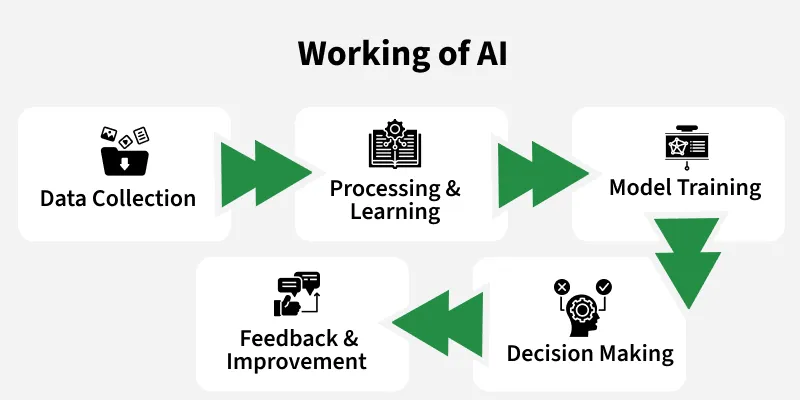
This process-oriented view should be familiar from your experience in program management. In a later module, we will explore each of these stages from a product manager's perspective.
Conclusion
In this lesson, we established a clear and actionable definition of Artificial Intelligence as a broad field focused on enabling machines to perform tasks that require human intelligence. We've seen that its core objectives are not merely technical but are tied to strategic outcomes like automation, enhanced decision-making, and the creation of novel product capabilities. Finally, we took a first look at the distinction between rule-based AI and the data-driven approach of machine learning, which underpins most of modern AI.
As we move forward, we will build upon this foundation. In our next lesson, we will explore the different levels of AI. We'll distinguish between the specialized systems we use every day, known as Artificial Narrow Intelligence (ANI), and the more futuristic concept of machines with human-like cognitive abilities, known as Artificial General Intelligence (AGI). This will help you frame the current capabilities and future potential of AI technology.