Hello! In the previous module, we grappled with the inherent challenges of distributed systems, such as partial failures and network latency. We finished by building resilient clients that use timeouts and retries to survive temporary service slowdowns. Now, we shift from tackling the problems of distributed systems to architecting the solution.
Welcome to the module on Microservice Design and Decomposition. This is arguably the most critical stage in building a microservices-based system. Today's lesson focuses on the foundational first step: figuring out where to draw the lines between services. We'll explore how to apply a key concept from Domain-Driven Design (DDD), the Bounded Context, to identify logical and robust service boundaries based on the business domain itself. This will help us avoid the most common pitfall: creating a "distributed monolith" where services are technically separate but hopelessly entangled.
The Million-Dollar Question: Where Do You Draw the Lines?
When decomposing a monolith, the first impulse for many developers, especially those with a background in database-centric applications, is to model services around data entities. You might think, "I have a User table, a Product table, and an Order table, so I'll create a User Service, a Product Service, and an Order Service."
While this seems logical, it's often a trap. It leads to highly "chatty" services that are constantly querying each other for data, creating tight coupling and defeating the purpose of microservices. For instance, the Order Service would need to call the User Service for shipping details and the Product Service for price and stock information, making it impossible to change one without potentially breaking the others.
The right approach isn't to look at your database schema, but at your business. This is the core idea of Domain-Driven Design (DDD).
Boundaries: The Real Foundation of Any Modern Architecture
This article from dev.to provides a direct and practical take on why business-aligned boundaries are crucial.
Start by reading the section "Practical ways to get boundaries right," which introduces DDD's bounded contexts as the primary guide. Then, read the section "Real-World Examples of Finding (and Refining) Boundaries." Pay close attention to the "Bad start (common anti-pattern)" and the "Better way" for an e-commerce platform. This clearly contrasts the wrong (entity-based) approach with the right (capability-based) approach.
Domain-Driven Design and the Ubiquitous Language
At its heart, DDD is about creating software models that deeply reflect a business domain. A key practice is establishing a Ubiquitous Language—a shared, unambiguous vocabulary used by everyone on the project, including developers, domain experts, and stakeholders.
However, a single, universal language for an entire complex business is often impossible. The word "Customer" can mean one thing to the sales team (a potential lead in a sales pipeline) and something entirely different to the support team (an existing user with a history of support tickets).
This is where the concept of a Bounded Context comes in.
Domain-Driven Design: Bounded Contexts Explained! 🚀
This video from ByteMonk gives an excellent explanation of why language ambiguity is a problem and how Bounded Contexts solve it.
Watch the introduction to understand the problem. Next, watch the example of the term "student" in an online education platform. Notice how the data and concerns related to a "student" differ completely for the enrollment, content, and support teams. Finally, listen to the formal definition of a Bounded Context.
What is a Bounded Context?
As the video explains, a Bounded Context is a clear boundary within which a specific domain model is consistent and its language has a precise, unambiguous meaning. Think of it as a logical frame around a part of your system. Inside that frame, the term "Customer" always means the same thing and has a consistent set of attributes and behaviors. Outside that frame, "Customer" can mean something else entirely.

By defining these contexts, you prevent semantic confusion and create explicit boundaries for your models. This is the perfect foundation for a microservice.
From Business Problem to Software Solution
So, how do we find these Bounded Contexts in our business? We look for Subdomains.
- A Subdomain is a distinct area of business capability or a specific part of the business problem you're trying to solve. For example, in e-commerce,
Inventory Management,Shipping, andBillingare all subdomains. This is the problem space. - A Bounded Context is the corresponding model and boundary you create in your software to solve that problem. This is the solution space.
There is often a one-to-one mapping: you identify a business subdomain and then design a bounded context to implement it. This bounded context becomes a natural candidate for a microservice.
Domain-Driven Design: Bounded Contexts Explained! 🚀
Let's return to the ByteMonk video to solidify the distinction between subdomains and bounded contexts.
Watch the section that differentiates subdomains and bounded contexts. The key takeaway is: "A subdomain answers the question 'What is the business area we are trying to solve?' whereas a bounded context asks 'How do we design and implement that problem in the software?'"
Subdomains themselves can be categorized, which helps prioritize development effort.
DDD Bounded Contexts & Subdomains
This short video from Drawing Boxes provides a concise overview of the different types of subdomains.
Watch the segment explaining subdomains. It introduces the concepts of core, supporting, and generic subdomains, which is a useful way to think about which parts of your business provide a competitive advantage.
Applying Bounded Context to an E-commerce Monolith
Let's put this into practice. Imagine you're tasked with decomposing a monolithic e-commerce application. Following the principles of DDD, you'd collaborate with business experts to identify the key subdomains (business capabilities).
Understanding Bounded Context in Microservices Architecture
This blog post by Luc Bories provides another clear example of applying bounded contexts to an e-commerce platform.
Read sections 1 ("What Is a Bounded Context?") and 2 ("Why Is Bounded Context Crucial in Microservices Architecture?") for a quick refresher on the definitions. Then, carefully study section 3 ("Real-World Example: E-Commerce Platform"). The table in this section is especially useful, as it explicitly maps microservices to their bounded contexts and corresponding business models.
The article highlights that each bounded context has its own model. For example:
- The Catalog context has a rich
Productmodel with descriptions, high-resolution images, and categories. - The Order context only needs a simplified representation of a product, perhaps just an
id,name, and thepriceat the time of purchase.
This decoupling is powerful. The Catalog team can add new fields like country_of_origin to their Product model without affecting the Order service at all.
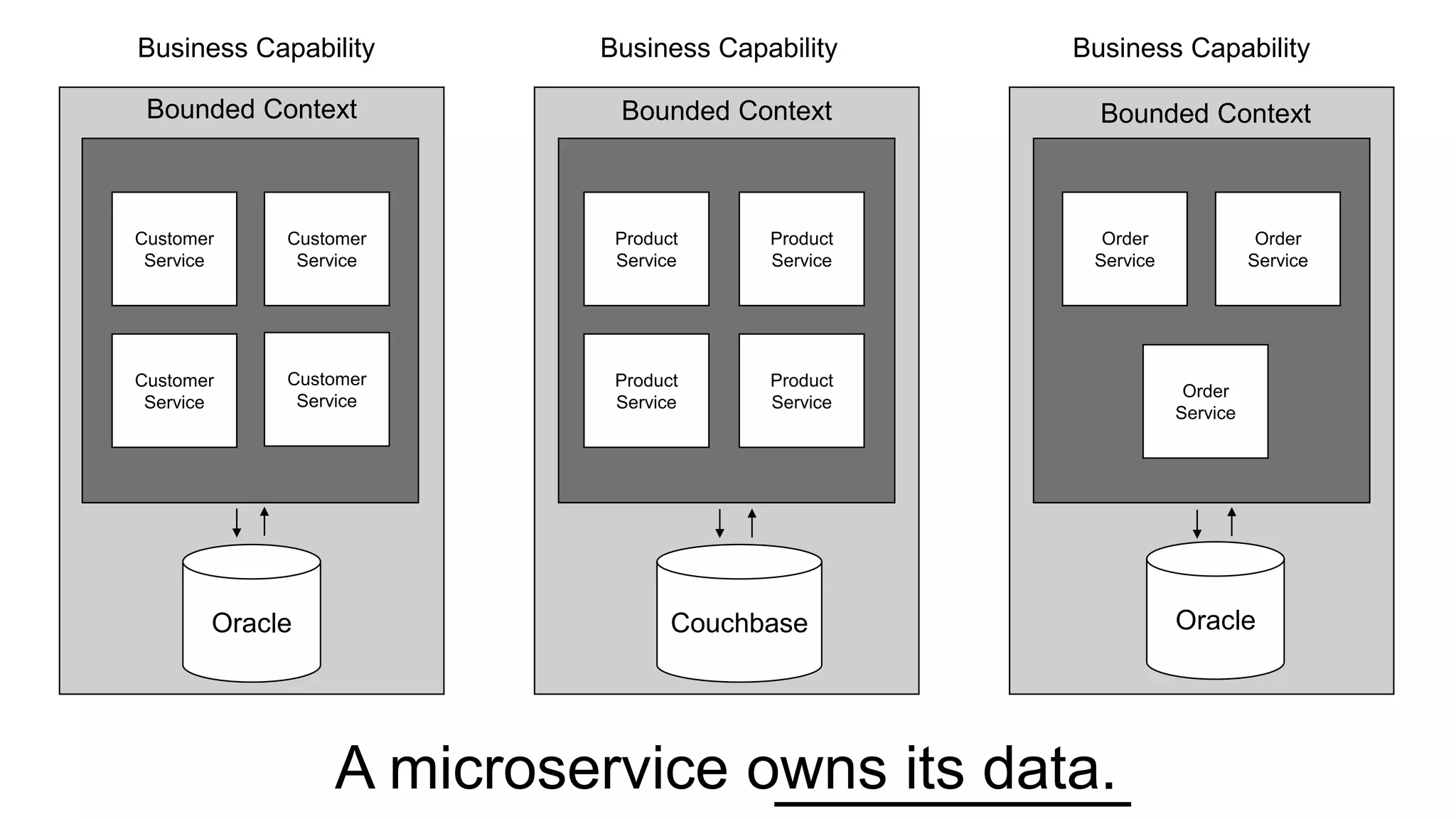
This leads us to a target architecture that looks something like this:
Conclusion
In this lesson, we've established the most important principle for designing microservices: boundaries should be drawn along business capabilities, not technical layers or data entities. By applying the concepts of Domain-Driven Design, specifically the Bounded Context, you can identify logical, coherent, and autonomous units within your system.
Key Takeaways:
- Decomposing a monolith based on database entities often leads to a "distributed monolith" with tight coupling and chatty communication.
- Domain-Driven Design (DDD) advocates for aligning software design with the business domain.
- A Bounded Context is a boundary within which a specific business model and its language are unambiguous.
- The process for identifying service candidates is to first identify Subdomains (the business problem space) and then design Bounded Contexts (the software solution space) to address them.
- Each Bounded Context is a strong candidate for a microservice, owning its own data and logic.
Preview of the Next Lesson:
Theory is great, but practice is better. In our next lesson, we will take these concepts and apply them in a hands-on exercise. You will be given a description of a monolithic e-commerce application and tasked with decomposing it into a set of candidate microservices, defining the specific responsibilities for each one.