Hello! In our last lesson, we explored how the iterated elimination of strictly dominated strategies (IESDS) can simplify games by removing irrational choices. We concluded that while powerful, this method is not universally applicable, as many games contain no strictly dominated strategies. This limitation highlights the need for a more general and foundational solution concept.
This lesson introduces that very concept: the Nash Equilibrium. Named after the brilliant mathematician John Nash, it is arguably the single most important idea in non-cooperative game theory. A Nash Equilibrium describes a stable outcome in a strategic interaction—a state from which no single player has a profitable reason to deviate on their own. We will formally define what constitutes a pure strategy Nash Equilibrium and explore several methods for identifying and verifying them in different types of games.
What is a Nash Equilibrium?
At its core, a Nash Equilibrium is a strategy profile that is "regret-free." It represents a state of stability where, after the game is played and the outcome is known, no individual player would look back and say, "Given what everyone else did, I wish I had chosen a different strategy." Every player, in a sense, correctly anticipates the actions of their opponents and chooses their own best possible action in response.
Let's explore two key interpretations of this concept.
2. Nash Equilibrium: Formal Definition and Intuition (Game Theory Playlist 3)
This video provides an excellent intuitive explanation of the Nash Equilibrium.
First, watch the segment explaining the idea of a stability concept, where the presenter frames it as a "regret-free outcome." Then, consider the alternative perspective discussed from best responding to beliefs. This second interpretation emphasizes the assumption that players' beliefs about their opponents' actions are not only rational but also correct.
The idea of "correct beliefs" is a strong assumption, but it's central to the equilibrium concept. The stability comes from this perfect alignment of beliefs and actions. Now, let's formalize this intuition.
A strategy profile is a Pure Strategy Nash Equilibrium (PSNE) if, for every player , their chosen strategy is a best response to the strategies of all other players, . No player can unilaterally switch to a different strategy and achieve a better payoff.
For a rigorous statement of this condition, please consult the following definition.
Pure Strategy Nash Equilibrium - Game Theory lab
This document provides a concise mathematical framework for the concept.
Please read the formal definition of a Pure Strategy Nash Equilibrium (Definition 1). The inequality presented, u_i(s_i^*, s_{-i}^*) \geq u_i(s_i, s_{-i}^*), is the mathematical embodiment of the "no regrets" condition.
Verifying a Nash Equilibrium
With a formal definition in hand, we can now develop methods to find and verify Nash Equilibria.
1. Cell-by-Cell Inspection
The most direct method is to test each potential outcome. For a given strategy profile, you ask for each player in turn: "If everyone else sticks to their strategy, can I improve my payoff by changing mine?" If the answer is "no" for all players, then the profile is a Nash Equilibrium.
Let's apply this to the classic Prisoner's Dilemma.
This document walks through the Prisoner's Dilemma to illustrate the Nash Equilibrium.
Recall the payoff matrix for the Prisoner's Dilemma. The text explains why the profile (Betray, Betray) is a Nash Equilibrium. Notice how it checks for unilateral deviations from that state and finds none are profitable. It also shows why (Stay silent, Stay silent) is not a Nash Equilibrium, as each player has an incentive to betray.
2. The Best Response Method
While cell-by-cell inspection works, a more systematic approach for matrix games is to identify each player's best responses. A strategy is a best response for player to the opponents' strategies if it maximizes player 's payoff. A Nash Equilibrium is a profile where every player's strategy is a best response to the others'—it is a mutual best response.
A common technique is to go through the payoff matrix and underline the best payoff for a player given each of their opponent's choices.
- For each column (a strategy for Player 2), find the highest payoff for Player 1 and underline it.
- For each row (a strategy for Player 1), find the highest payoff for Player 2 and underline it.
Any cell in the matrix where both payoffs are underlined constitutes a pure strategy Nash Equilibrium.
Let's see this in practice.
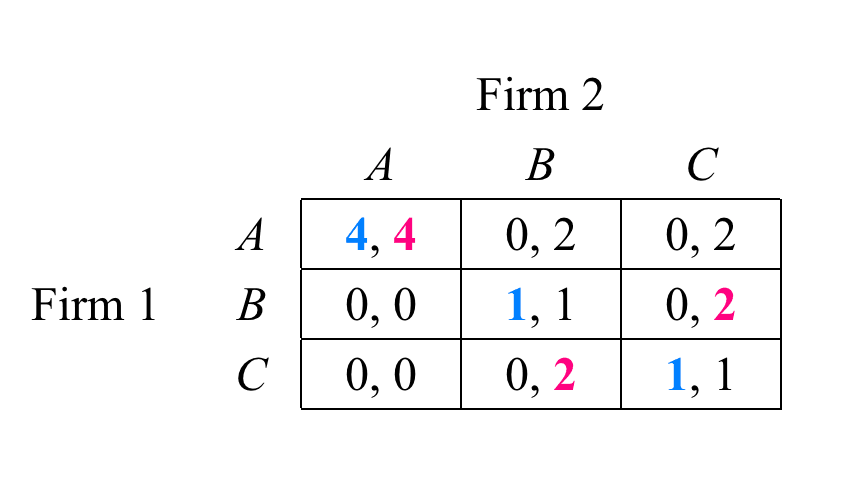
In this matrix:
- If Firm 2 plays A, Firm 1's best payoff is 4 (from strategy A). So, the
4in (A, A) is highlighted for Firm 1. - If Firm 2 plays B, Firm 1's best payoff is 1 (from strategy B). The
1in (B, B) is highlighted. - If Firm 2 plays C, Firm 1's best payoff is 1 (from strategy C). The
1in (C, C) is highlighted.
Now we do the same for Firm 2:
- If Firm 1 plays A, Firm 2's best payoff is 4 (from strategy A). The
4in (A, A) is highlighted for Firm 2. - If Firm 1 plays B, Firm 2's best payoff is 2 (from strategy C). The
2in (B, C) is highlighted. - If Firm 1 plays C, Firm 2's best payoff is 2 (from strategy B). The
2in (C, B) is highlighted.
The only strategy profile where both payoffs are highlighted (i.e., where both players are simultaneously playing a best response) is (A, A). This is the unique pure strategy Nash Equilibrium of this game.
3. Best Response Functions (Continuous Strategies)
When players have continuous strategy spaces (e.g., choosing a price or quantity), we can't use a discrete matrix. Instead, we derive each player's best response function, , which gives the optimal choice for player for any given strategy combination of the other players. A Nash Equilibrium is a strategy profile that lies on every player's best response function simultaneously—it's a fixed point of the system.
A canonical example, which aligns with your interest in industrial organization, is the Cournot duopoly model, where two firms compete on the quantity of a good to produce. Your background in applied mathematics and optimization is perfectly suited for this type of analysis.
Game Theory 13: Cournot Duopoly, Best Response Functions, and Nash equilibrium
This video provides a complete walkthrough of deriving the Nash Equilibrium in a Cournot duopoly game. It is a perfect demonstration of using calculus to find best response functions.
The video proceeds in several logical steps. Watch how it: Introduces the model and sets up the firms' profit functions, \pi_i(q_1, q_2). (setup) Formulates each firm's profit maximization problem, where each firm chooses its quantity q_i to maximize \pi_i, taking the other's quantity q_j as given. (formulation) Derives each firm's best response function by taking the partial derivative of the profit function with respect to its own quantity and setting it to zero. This is the core of the optimization. (derivation) Finds the Nash Equilibrium by solving the system of best response functions simultaneously. (solution)
The intersection of these best response functions graphically represents the Nash Equilibrium.

Existence and Multiplicity of Equilibria
We've seen how to find Nash Equilibria, but two crucial questions remain:
- Is a pure strategy Nash Equilibrium guaranteed to exist?
- If an equilibrium exists, is it always unique?
The answer to both questions is no.
Pure Strategy Nash Equilibrium - Game Theory lab
This resource discusses both the multiplicity and potential non-existence of pure strategy Nash Equilibria.
First, read the section on the BOS (Battle of the Sexes) game under "2.1 The BOS Game". You'll see this is a simple coordination game with two distinct pure strategy Nash Equilibria, (A, A) and (B, B). Then, look at the example of Matching Pennies in section 2.7. As the text notes, it is easy to see that no profile is stable. In any outcome, one player always has an incentive to switch. This non-existence of a pure strategy equilibrium is what motivates the move to mixed strategies, a topic for a future lesson.
When multiple equilibria exist, as in the Battle of the Sexes, game theory alone doesn't always specify which one will be chosen. This has led to concepts like focal points (or Schelling points), where social conventions or other external factors might guide players to coordinate on one specific equilibrium.
Conclusion
In this lesson, we have formally defined the concept of Nash Equilibrium and established it as a cornerstone of strategic analysis. It represents a self-enforcing, "regret-free" outcome where each rational player's strategy is a best response to the strategies of all others.
Here are the key takeaways:
- A Pure Strategy Nash Equilibrium is a strategy profile where no player can gain by unilaterally changing their strategy.
- We can verify a Nash Equilibrium by cell-by-cell inspection, using the best response (underlining) method in matrix games, or by solving a system of best response functions in games with continuous strategies.
- The Cournot model demonstrates how calculus and optimization can be used to find the Nash Equilibrium in economic contexts.
- Pure strategy Nash Equilibria are not guaranteed to exist (e.g., Matching Pennies), and games can have multiple equilibria (e.g., coordination games).
We have already used the Prisoner's Dilemma to illustrate the mechanics of a Nash Equilibrium. In our next lesson, we will analyze this famous game in more depth, focusing on the profound and often paradoxical implications of its equilibrium: a situation where individual rationality leads to a collectively suboptimal outcome.