In our last session, we saw how the fast, automatic judgments of System 1, while efficient, can lead to predictable errors. You wrestled with puzzles that demonstrated how easily intuition can be misled and got a first-hand look at confirmation bias in action. Today, we will build directly on that foundation by moving from general awareness to specific identification.
This lesson focuses on three of the most common and influential cognitive biases: confirmation bias, anchoring bias, and the availability heuristic. Our goal is for you to be able to spot these cognitive traps in decision-making scenarios. Mastering this skill is fundamental to your aim of challenging hidden assumptions, as these biases are often the very source of those unexamined beliefs, especially in high-stakes environments where data and initial impressions can steer your thinking without you even realizing it.
Let's begin by looking at a map of the territory. The biases we are discussing today are just a few of many.
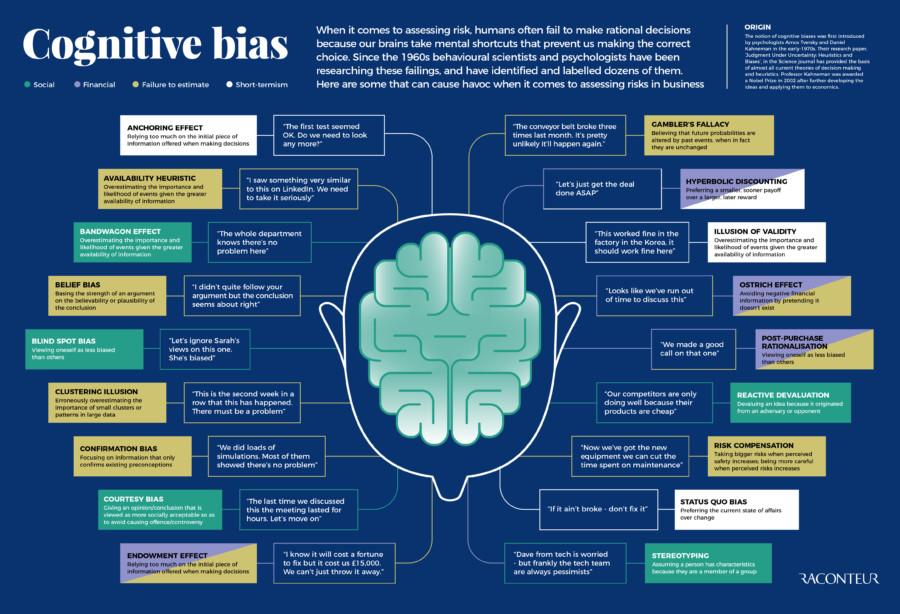
1. Confirmation Bias: The Echo Chamber in Your Head
We've already encountered this one in the previous lesson with the "2, 4, 8" number puzzle. You saw how the natural tendency is to test for examples that confirm a hypothesis (e.g., "the rule is doubling, so I'll try 10, 20, 40") rather than trying to falsify it (e.g., "what if I try 2, 4, 7?"). This isn't just a quirk for puzzles; it's a deeply ingrained human tendency.
Confirmation bias is the habit of seeking out, interpreting, and remembering information that supports our pre-existing beliefs, while simultaneously filtering out or downplaying information that contradicts them. It's our brain's way of maintaining a consistent and orderly view of the world.
For a formal definition and a clear example from the world of intelligence analysis, let's turn to the Handbook on Cognitive Biases.
This section of the handbook provides a concise definition of confirmation bias and explains its effect, especially in environments like social media.
Please read the section on Confirmation bias. Start with the formal definition. Then, review the first example, which illustrates how this bias can affect professional judgment.
In your work as a systems engineer, this bias might manifest during a post-mortem of a system failure. If you have an initial hypothesis that the bug is in the database, you might focus all your energy on combing through database logs and performance metrics, while subconsciously ignoring signals from the application layer that suggest a different root cause. A more robust approach, much like the number puzzle, is to ask, "What evidence would prove my database theory wrong?"
2. Anchoring Bias: The Power of the First Number
Imagine you're negotiating a salary, evaluating a project budget, or even just buying a car. The first number that is put on the table has a disproportionate amount of power over the entire process. This is the essence of anchoring bias. Our minds tend to "anchor" on the first piece of information we receive and then adjust our subsequent judgments from that starting point. Crucially, these adjustments are often insufficient.
The following video provides a classic and very famous example of anchoring in a commercial setting.
9 Cognitive Biases You Need to Avoid
This video from Mind Known explains several biases. We'll focus on its excellent illustration of anchoring.
Please watch the segment on anchoring bias, which uses Steve Jobs's iPad launch as an example. It starts at this timestamp. Notice how the initial high price makes the final, lower price seem like a fantastic deal, even though there was no pre-existing basis for the iPad's value.
This effect is not just for marketing. It's a powerful force in any situation involving numerical estimation, a frequent task in engineering and finance. The first cost estimate for a project, the initial performance benchmark of a system, or the first offer in a negotiation all act as powerful anchors.
For a more formal look at anchoring and its effects, let's return to the handbook.
This section explains the mechanism of anchoring and provides further examples.
Read the section titled "Anchoring". Pay attention to how anchors work even when the information is completely irrelevant, as shown in the wheel of fortune experiment. Also, consider the negotiation example and how it applies to setting a high initial anchor.
When you're asked to estimate the time to complete a software project, the first number you hear (perhaps from a manager saying, "Do you think you can get this done in two weeks?") can anchor your own, more detailed estimate. To counteract this, it's often useful to generate your own estimate from first principles before being exposed to anyone else's number.
3. The Availability Heuristic: If You Can Think of It, It Must Be Important
Which is more likely: dying from a shark attack or from a falling airplane part?
Most people instinctively feel that shark attacks are more probable. We've all seen movies and news reports that make such events feel vivid and memorable. In reality, you are far more likely to be killed by a falling airplane part.
This is the availability heuristic at work. We mistake the ease with which we can recall examples of an event for the actual frequency or probability of that event. Things that are recent, emotionally charged, or widely reported in the media are more "available" to our minds and therefore seem more likely than they statistically are.
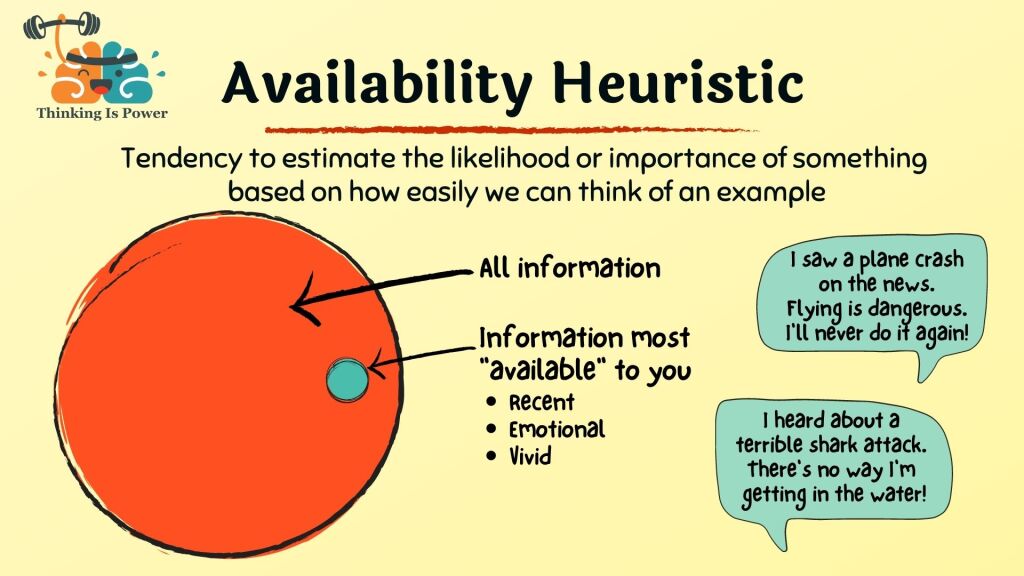
This mental shortcut is often useful for making quick risk assessments, but in a complex world, it can be dangerously misleading.
This final reading from the handbook defines the availability heuristic and its subtype, vividness bias.
Please read the section on "Availability bias". Focus on the core definition: we consider events more likely if we can recall them easily. Note the classic example comparing the fear of plane accidents to heart attacks. Also, pay attention to the concept of vividness bias, where anecdotes are given more weight than abstract data.
In your role, the availability heuristic could cause you to overestimate the risk of a rare but dramatic system failure that happened recently, leading you to allocate disproportionate resources to preventing a repeat, while underestimating a more common but less "spectacular" source of system instability. Vivid anecdotes from a single user ("the system felt really slow yesterday!") can sometimes carry more weight than statistical reports showing that average performance was normal, a clear case of vividness bias.
Practice Scenario: Putting It All Together
Let's test your ability to spot these biases in a realistic scenario. Read the following paragraph and think about where each of the three biases might be influencing the decision-making process.
You are a systems engineer at a financial firm, tasked with evaluating a new automated trading platform. The lead developer of the platform, who you respect, gives you a demo and confidently states, "We're aiming for a go-live date in just two weeks." Later, you read an internal report about a major outage that occurred last year on a different trading system, caused by a rare data corruption bug. As you begin your analysis, you start by reviewing the vendor's case studies, which highlight several clients who saw a 20% increase in trading profits after implementation.
Where might you see the influence of:
- Anchoring Bias?
- Availability Heuristic?
- Confirmation Bias?
Analysis:
- Anchoring Bias: The developer's confident "two weeks" timeline acts as a powerful anchor. Your own, more detailed project planning may now be unconsciously skewed toward that initial number, even if a more realistic assessment would suggest a two-month timeline.
- Availability Heuristic: The memorable, vivid report of the major outage last year makes that specific type of failure (a rare data corruption bug) feel more probable than it is. You might spend an inordinate amount of time testing for that specific scenario while potentially neglecting more common but less dramatic failure modes.
- Confirmation Bias: The vendor's case studies showing a "20% increase in trading profits" create a positive first impression. You might now subconsciously look for evidence that confirms the platform is a good choice, while glossing over or rationalizing away performance logs that show mediocre results or system instability during non-peak hours.
Conclusion
In this lesson, we put names and faces to three of the most wanted cognitive culprits that undermine rational thought.
Key Takeaways:
- Confirmation Bias: We see what we want to see. The remedy is to actively seek out disconfirming evidence—try to prove yourself wrong.
- Anchoring Bias: The first number dominates. The remedy is to be aware of the initial anchor and to consciously generate your own estimates before being influenced.
- Availability Heuristic: We mistake vividness for probability. The remedy is to rely on actual data and statistics over memorable anecdotes and recent news.
Recognizing these biases in fabricated scenarios is the first step. The true challenge, and the focus of our next lesson, is learning to detect their subtle influence in your own thinking. We will explore practical techniques for self-reflection to help you build that internal "cognitive alarm system."