Welcome to the first lesson of your course on critical and out-of-the-box thinking. Our journey begins not with complex techniques, but with the very foundation of how your mind works. Understanding the fundamental processes of thought is the first step toward mastering them. Your goal is to learn how to challenge assumptions and think from fresh angles, and this lesson provides the essential framework for doing just that.
Today, we will focus on distinguishing between two primary modes of thinking: a fast, automatic system and a slow, deliberate one. By the end of this lesson, you will be able to identify these two systems, understand their core characteristics, and appreciate how they interact. This distinction is the bedrock upon which we will build all subsequent strategies for critical thinking and problem-solving.
The Two Engines of Thought
To begin, let's try a quick puzzle. Read it and go with your first, immediate answer.
A bat and a ball together cost $1.10. The bat costs $1 more than the ball. How much does the ball cost?
If you thought "10 cents," you're in good company. It's the intuitive answer that springs to mind for most people. However, it's incorrect. If the ball were 10 cents, the bat would be $1.10, and the total would be $1.20.
Take a moment to work it out.
The correct answer is 5 cents. (Ball = $0.05, Bat = $1.05, Total = $1.10)
This simple puzzle perfectly illustrates the two "systems" of thought at the heart of our cognition, a concept popularized by Nobel laureate Daniel Kahneman. Your initial, incorrect answer of 10 cents was a product of what we call System 1. The slower, more deliberate process you engaged in to find the correct answer of 5 cents is System 2.
To get a formal introduction to this powerful model, please read the following brief excerpt.
System 1 and System 2 Thinking
This article provides a concise summary of Kahneman's model. As you read, focus on how the author defines each system and uses the bat-and-ball puzzle to demonstrate their difference.
Please read the section titled "System 1 & 2 - A Refresh". Pay close attention to the descriptions of the two systems and the explanation of how they apply to the bat-and-ball puzzle.
System 1 vs. System 2: The Key Differences
As you've just read, our thinking can be broadly categorized into these two modes.
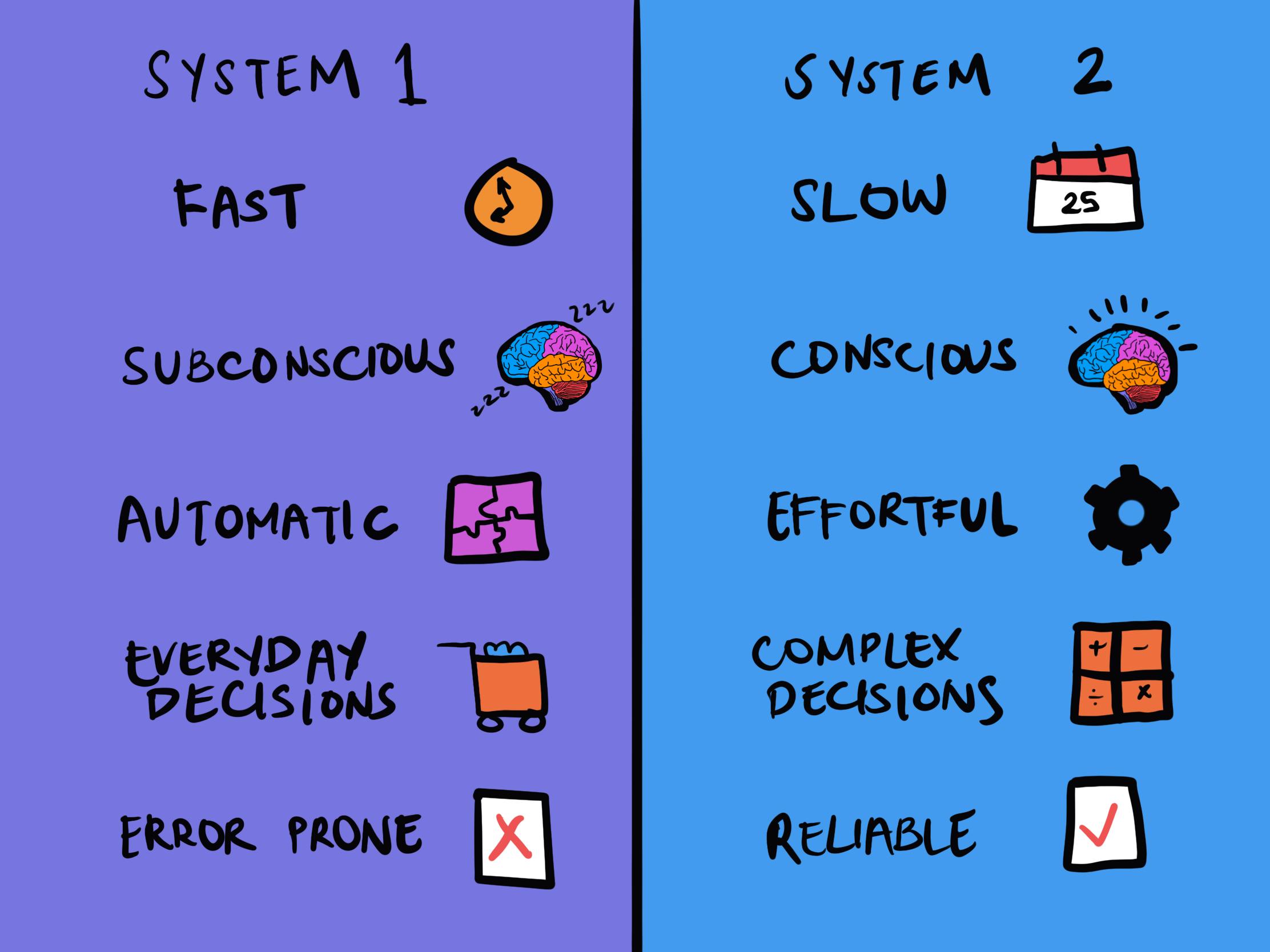
- System 1 is the fast, intuitive, and emotional thinking process. It operates automatically and unconsciously, handling everyday decisions and learned responses, like recognizing a friend's face or understanding a simple sentence. It's your mental autopilot.
- System 2 is the slow, deliberate, and logical thinking process. It requires conscious effort and attention. You use it for complex tasks like solving a math problem, learning to drive, or analyzing a difficult situation. It's the pilot who takes control when the situation is new, complex, or requires careful navigation.
The following image provides a great visual summary of the characteristics of each system.
To see these two systems in action with more examples, let's watch a short video.
Mastering Both Your Brains | System 1 vs System 2
This video from Future IQ offers clear, practical examples that bring the two systems to life. The presenters use a conversational style to explain the concepts.
Watch the segment from the beginning, which contrasts an easy, automatic task (judging a facial expression) with a difficult, effortful one (a multiplication problem). Then, continue watching the next segment from the detailed explanation, where the presenters break down the specific attributes of each system, such as their speed and whether they are conscious or unconscious.
An Analogy for the Systems Engineer
Given your background as a systems engineer, you might think of this in terms of processing paths.
- System 1 is like the "fast path" in a network device or operating system. It uses heuristics, cached information, and established rules to handle the vast majority of routine traffic or tasks with minimal overhead. It's incredibly efficient but isn't designed for novel or exceptional cases.
- System 2 is the "slow path." When a task is new, complex, or flagged as an exception by the fast path, it gets sent for deeper, more resource-intensive processing by the central CPU. This path is more flexible and powerful but consumes significantly more energy and time.
Our brain operates similarly. It defaults to the energy-saving System 1 and only engages the costly System 2 when necessary. One of your goals is to identify hidden assumptions, and these often arise because System 1 makes a quick, "good enough" decision that is never passed to System 2 for verification.
Not Two Brains, but Two Processes
It's crucial to understand that "System 1" and "System 2" are just labels—an analogy to describe interacting processes, not physically separate parts of your brain. They work in tandem, constantly influencing each other. The next reading clarifies this point and debunks some common misconceptions.
System 1 and System 2 Thinking
This second excerpt from the same article adds important nuance, explaining that the two systems are not a literal division of the brain but an integrated partnership.
Please read the sections titled FACT 1 and FACT 2. This will clarify how the two "systems" are really just different types of mental processing that cooperate.
As the reading explains, the systems are complementary. System 1 continuously generates suggestions for System 2: impressions, intuitions, and feelings. If System 2 endorses them, these intuitions turn into beliefs and impulses turn into voluntary actions. When System 1 runs into difficulty, it calls on System 2 to support it with more detailed and specific processing that may solve the problem of the moment. This hand-off is the critical moment where conscious thought can begin.
Conclusion
In this introductory lesson, we have laid the groundwork for our entire course. You've learned to distinguish between the two primary modes of thought that govern your mind.
Key Takeaways:
- System 1 is your fast, automatic, intuitive, and unconscious mode of thinking. It's efficient for everyday tasks but prone to biases and systematic errors.
- System 2 is your slow, deliberate, analytical, and conscious mode of thinking. It is effortful and resource-intensive, but it can handle complex logic and override the faulty intuitions of System 1.
- These are not two separate brains but rather labels for two types of interconnected processes. Most of our daily thinking is a collaboration between the two.
You now have the basic vocabulary to talk about thinking itself. This is the first step toward the self-awareness required to challenge your own thought patterns.
In our next lesson, we will build directly on this foundation to recognize situations where automatic thinking leads to errors that deliberate thinking could avoid. We will begin exploring the predictable mistakes System 1 makes and how to spot them, moving us closer to your goal of identifying and overcoming hidden biases.