Welcome to the first lesson of your course on integrating game-based learning with Generative AI. Our journey begins by establishing a clear and solid foundation. In this session, you will learn to distinguish generative AI from the broader fields of traditional artificial intelligence and machine learning. Mastering this distinction is the essential first step before you can design effective learning experiences for others. It will allow you to position GenAI correctly, manage learner expectations, and build a curriculum that is both technically accurate and pedagogically sound.
We'll start by mapping out the landscape of AI to see where each technology fits. Then, we will zoom in on the core functional difference between models that predict and models that create. Finally, we'll ground these concepts in a domain you're passionate about—gaming—to see how these different forms of AI manifest in practice.
The Big Picture: A Hierarchy of Concepts
To understand Generative AI, we first need to place it on the map. The terms AI, Machine Learning (ML), Deep Learning (DL), and Generative AI are often used interchangeably, but they represent a clear hierarchy of concepts, with each term being a specialized subset of the previous one.
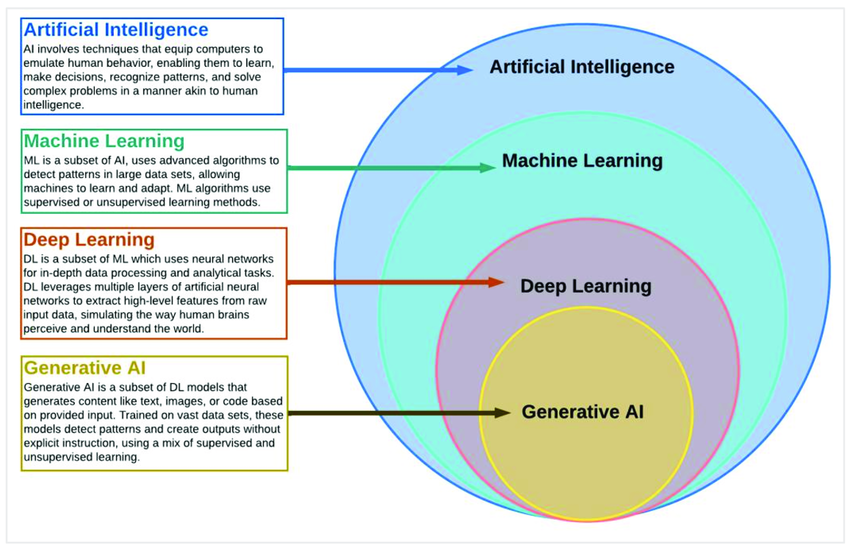
Artificial Intelligence (AI) is the oldest and broadest term, originating in the 1950s. It encompasses any technique that enables computers to mimic human intelligence, using logic, if-then rules, decision trees, and machine learning. As a computer science professional, you can think of early AI as systems built on complex, explicitly programmed rules—like intricate expert systems or the logic governing non-player characters (NPCs) in classic video games.
Machine Learning (ML) is a subset of AI that emerged later. Instead of being explicitly programmed with rules, ML systems learn patterns directly from data. You provide the machine with a large dataset of examples, and it develops its own logic for making predictions or decisions. This is the paradigm shift from writing the rules yourself to letting the machine derive the rules from experience.
Deep Learning (DL) is a further subset of ML that uses complex, multi-layered neural networks to learn from vast amounts of data. These "deep" networks are inspired by the structure of the human brain and are particularly effective at identifying intricate patterns in unstructured data like images, sound, and text.
To get a clear overview of how these concepts are related, the following video provides an excellent summary.
AI, Machine Learning, Deep Learning and Generative AI Explained
This video from IBM Technology, "AI, Machine Learning, Deep Learning and Generative AI Explained," offers a concise walkthrough of the hierarchy.
Please watch from the beginning until the end of the main explanation. Pay close attention to how the speaker defines each term and places it on a historical timeline. The music analogy used to explain generative AI is particularly helpful for grasping the idea of creating "new" content from existing components.
This brings us to Generative AI, a subset of deep learning that has captured widespread attention. While other AI models are designed to recognize patterns and make predictions, generative models are designed to create new content.
The Core Distinction: Prediction vs. Creation
The most crucial difference between traditional ML and Generative AI lies in their primary function. This is often described as the difference between discriminative and generative models.
-
Discriminative Models (Classic ML): These models are trained to discriminate between different types of data. They learn the decision boundary that separates one category from another. Given an input, their goal is to predict a label or a value.
- Example: A spam filter is a classic discriminative model. It learns the features that separate spam from non-spam emails and classifies incoming messages accordingly. It answers the question: "Is this email spam or not?"
- Function: — it learns the probability of an output (the label, e.g., "spam") given an input (the email content).
-
Generative Models (GenAI): These models go a step further. Instead of just learning the boundary between classes, they learn the underlying probability distribution of the data itself. This enables them to generate new, synthetic data samples that are statistically similar to the original dataset.
- Example: An image model like Midjourney or DALL-E can generate a brand-new picture of a "cyberpunk city at sunset" that has never existed before. It answers the request: "Show me what a cyberpunk city at sunset looks like."
- Function: — it learns the joint probability of the input and output , allowing it to create new instances.
The following image provides a clear visual comparison of this difference.

The next video from Google Cloud Tech offers a more technical but very clear explanation of this exact distinction.
In the video "Introduction to Generative AI," the speaker clearly breaks down the difference between discriminative and generative models.
Watch the segment from the explanation of discriminative versus generative models. Then, continue watching the next section, from the summary, which provides a simple but powerful heuristic: if the output is a number or a class, it's likely traditional ML; if the output is unstructured content like text or an image, it's generative AI.
To solidify this, let's explore a practical guide on when to use each approach. As an educator, knowing the right tool for the job is critical.
Machine learning and generative AI: What are they good ...
This article from MIT Sloan provides a clear, application-focused perspective on the differences between traditional ML and generative AI.
Start by reading the section "What is machine learning?" to review the core concept. Then, read the definition of generative AI. Next, focus on the practical advice in the sections "When traditional machine learning is the better option" and the concise summary at the very end, Ramakrishnan's main takeaway. This will help you frame the distinction in terms of use cases, which is invaluable for teaching.
Concrete Examples in Game Development
Given your interest in game-based learning and your background in coding, let's apply this distinction to the world of game development. This domain provides some of the clearest examples of the evolution from traditional AI to generative AI.
Traditional AI in Games (Discriminative/Rule-Based)
For decades, AI in games has been about creating believable behavior. This typically involves systems that react to player actions or environmental state changes based on pre-defined logic.
- Pathfinding: Algorithms like A* are used to find the most efficient path for an NPC to navigate a level. This is a problem-solving task, not a creative one.
- Behavior Trees & State Machines: These are programming patterns used to define enemy behavior. For instance, an enemy might be in a "patrol" state, switch to an "alert" state if it sees the player, and then to an "attack" state if the player gets close. This is a system of classification and reaction. The AI discriminates which state it should be in based on inputs.
- Difficulty Scaling: A game might analyze player performance (accuracy, speed) and adjust the number or toughness of enemies. This is a predictive model that outputs a numerical difficulty value.
Generative AI in Games (Creative)
More recently, generative AI has begun to transform game development from a purely human-authored craft to a collaborative one between human and machine. Here, the AI is not just reacting; it's creating parts of the game world.
Generative AI in Game Design: Enhancing Creativity or Constraining Innovation? - PMC
This research paper delves into how GenAI is being used in game design, offering excellent real-world examples that highlight its creative capabilities.
First, read the section that discusses the central role of GenAI in game development. Pay attention to the specific tools mentioned (Stable Diffusion, Midjourney, ChatGPT) and the example of No Man's Sky, a game famous for its procedurally generated universe. Next, read the following section, which distinguishes traditional AI in games from modern generative techniques. It explicitly contrasts NPC behavior with technologies like Procedural Content Generation (PCG), GANs, and LLMs, reinforcing the concepts we've discussed.
As the article illustrates, generative AI is used for:
- Procedural Content Generation (PCG): In games like No Man's Sky, algorithms generate entire planets, creatures, and ecosystems. The developers create the system for generation, and the AI creates the near-infinite content.
- Asset Creation: Tools like Midjourney are used to generate concept art, textures, and 2D sprites, drastically accelerating the art production pipeline.
- Narrative and Dialogue: Ubisoft's Ghostwriter tool assists writers by generating first drafts of NPC dialogue. The AI creates narrative content that writers then refine.
In all these cases, the AI's primary role is creation, not just classification or prediction. This is the fundamental leap from traditional AI to generative AI.
Conclusion
In this introductory lesson, we have established the foundational distinction between Generative AI and its predecessors.
Key Takeaways:
- Hierarchy: Generative AI is a specialized subfield within a broader hierarchy: AI > Machine Learning > Deep Learning > Generative AI.
- Core Function: Traditional ML models are primarily discriminative—they classify data or predict outcomes (e.g., "Is this a cat?"). Generative AI models are generative—they learn the underlying patterns of data to create new, original content (e.g., "Generate a picture of a cat.").
- Application: This difference is evident in real-world applications. A spam filter predicts a label, while a tool like ChatGPT creates text. In gaming, traditional AI powers reactive NPC behavior, while GenAI creates worlds, art, and stories.
As a first, small step in your course design project, consider this "starter quest": Brainstorm a simple learning activity for your future students that would allow them to experience the difference between a discriminative and a generative model firsthand. For example, you could have them use a tool like Google's Teachable Machine to train a simple image classifier (discriminative), and then use a public image generation tool to create new images (generative). There's no need to build it out yet—just sketch out the idea.
In our next lesson, we will dive deeper into the world of Generative AI. We will categorize the different types of generative models by the kind of content they produce—text, images, code, and more—and identify the major tools associated with each. This will give you the vocabulary and landscape needed to start designing specific learning objectives for your course.