Welcome back! In our previous lesson, we focused on the crucial system design skill of articulating and defending architectural decisions based on trade-offs in scalability, latency, and cost. You learned that in an elite interview, the why is often more important than the what.
Today, we bring that same level of rigor and structured thinking back to the world of algorithms. As promised, this lesson is designed to simulate a full-length, advanced coding interview. Knowing data structures and algorithms is the price of admission; performing under pressure is what sets you apart. Our goal is to equip you with a robust strategy for tackling complex, multi-part problems within the tight time constraints of a real interview.
By the end of this lesson, you will have experienced the entire lifecycle of an advanced algorithm problem, from initial clarification to implementing an optimized solution and its follow-up, all while learning how to manage your time and communicate your thought process effectively.
The Anatomy of a High-Pressure Coding Interview
In a top-tier interview, you're evaluated on more than just arriving at the correct answer. The interviewer is assessing your entire problem-solving process. A structured approach is non-negotiable.
This six-step framework is your roadmap:
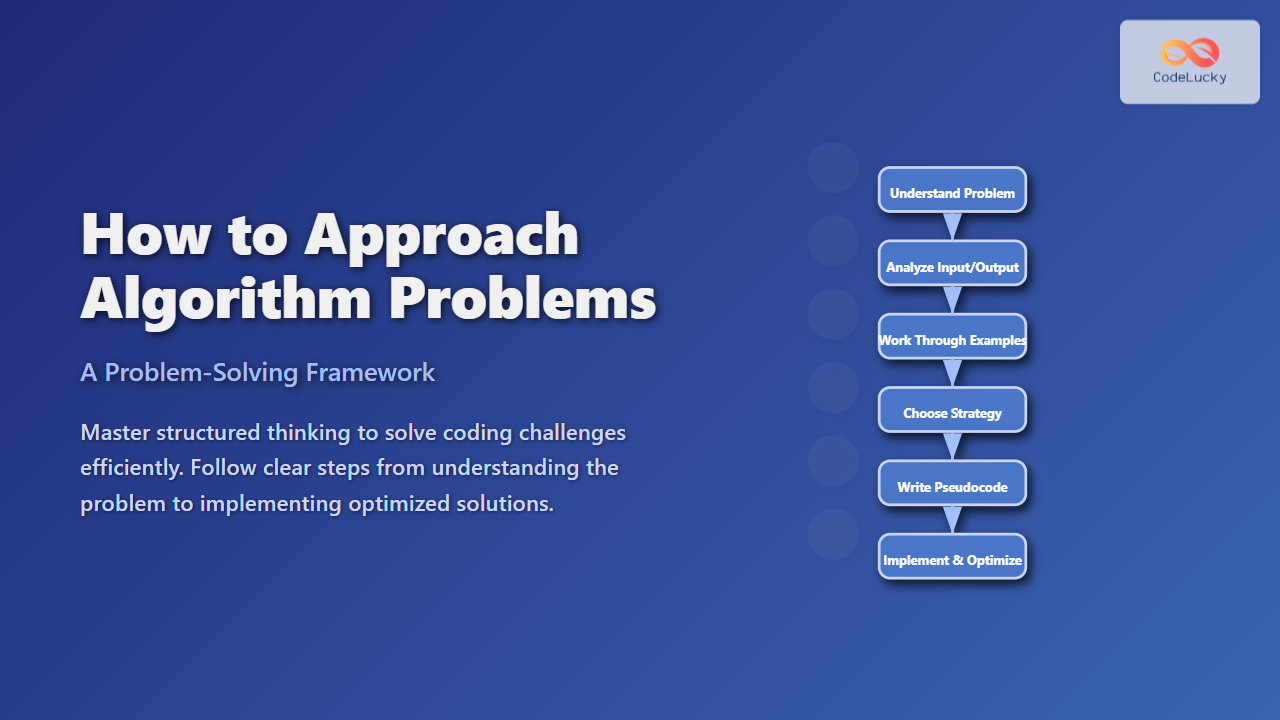
To execute this under pressure, you must manage the clock effectively. Here is a typical timeline for a 35-40 minute problem:
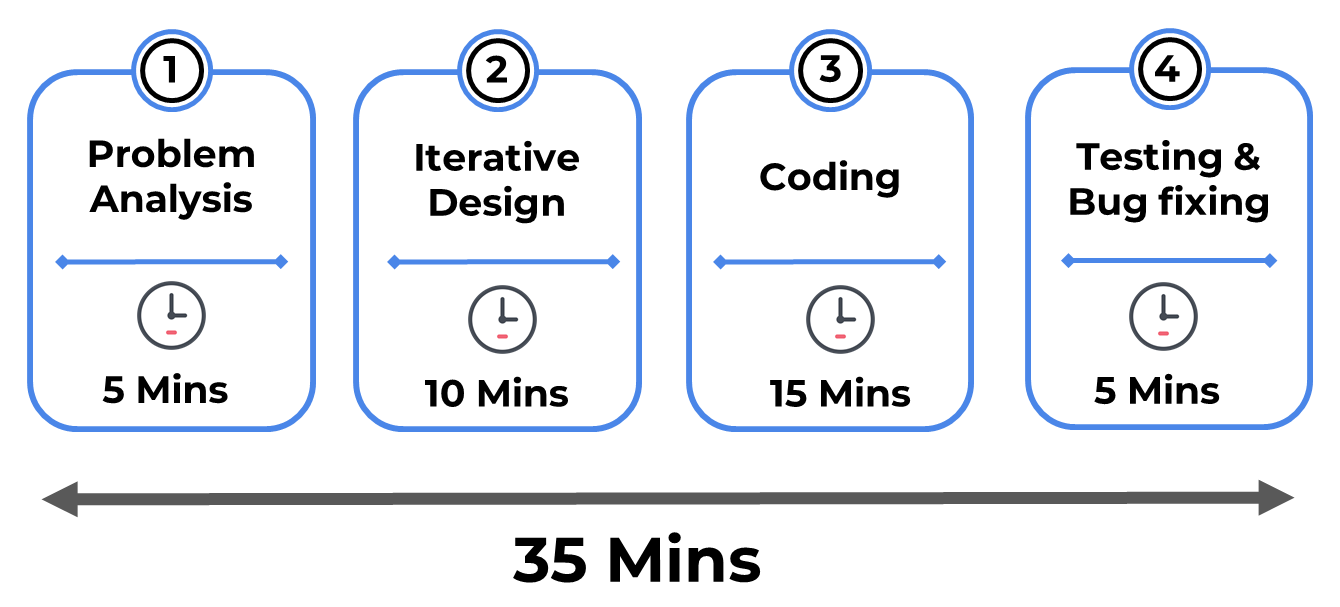
Let’s break down how the framework maps to the timeline:
-
Problem Analysis & Examples (5-7 minutes):
- Goal: Deeply understand the problem. Do not start coding.
- Action:
- Restate the problem in your own words.
- Ask clarifying questions about constraints, edge cases, and input/output formats. As noted in the article "My favorite coding question to give candidates," great candidates ask questions to resolve ambiguity before writing a single line of code.
- Manually work through 1-2 small, non-trivial examples to solidify your understanding.
-
Strategy & Design (10 minutes):
- Goal: Articulate a plan, starting with a simple approach and moving toward an optimal one.
- Action:
- Brute-Force First: Always start by mentioning the most straightforward (often inefficient) solution. For example, "My first thought is a nested loop approach, which would be , but we can likely do better." This establishes a baseline and shows you can identify complexity issues.
- Identify the Bottleneck: Pinpoint why the brute-force approach is slow (e.g., a linear search inside a loop).
- Propose an Optimal Strategy: Suggest the right data structure or algorithm to solve the bottleneck. "To improve the search from to , we can use a hash map."
- Talk Through Trade-offs: Discuss the time and space complexity of your proposed solution. "This approach improves time complexity to at the cost of space for the hash map."
-
Implementation & Testing (20-25 minutes):
- Goal: Write clean, correct code and verify it.
- Action:
- Code: Translate your strategy into code. Narrate your implementation as you go.
- Test: Once finished, don't just say "I'm done." Manually trace one of your earlier examples through your code line by line. This is the best way to catch off-by-one errors or logical flaws.
Now, let's apply this framework in a realistic mock interview scenario.
Mock Interview: The Problem
(Tutor acting as Interviewer)
"Hi, thanks for coming in today. Let's jump right into a problem. I'd like you to design a data structure that supports the following three operations, all in average constant time, :"
insert(val): Inserts a value into the collection. You can assume the collection does not contain the value already.remove(val): Removes a value from the collection. You can assume the collection contains the value.getRandom(): Returns a random element from the current collection of elements. Each element must have an equal probability of being returned.
Let's begin.
Your Turn: Applying the Framework
(Tutor guiding you through the process)
1. Analysis and Initial Strategy (Your first 10-15 minutes)
Before diving into code, what are your initial thoughts? Which data structures come to mind for each operation?
insert(val)in ? A hash set or hash map is a natural fit.remove(val)in ? Again, a hash set or hash map excels here.getRandom()in ? This is the tricky one. To get a truly random element in constant time, we typically need to access it by an index. This points towards an array or a dynamic array (list in Python).
We have a conflict: hash maps are great for insertion and removal but bad for random access, while arrays are great for random access but bad for removing an arbitrary element (which is an operation).
The first step is to see what happens if we choose one of these simple data structures and accept its weakness. This is our "brute-force" or initial thought.
Mock Google Coding Interview with a Meta Intern
Let's watch how a candidate in a mock Google interview tackles this exact initial dilemma. He starts by considering a hash-based data structure and immediately identifies the complexity issue with getRandom.
Watch from 01:44 to 12:26. Pay close attention to: (01:44 - 04:36): The clarifying questions the candidate asks. This is a model of how to start an interview problem. (05:34 - 12:26): His initial proposal to use a set. He correctly identifies that insert and remove are O(1) but converting the set to a list to get a random element makes getRandom O(n). This is a perfect example of starting with a simple solution and articulating its trade-offs.
2. The Key Insight: Combining Data Structures
The bottleneck is clear: we need the lookup of a hash map and the indexed access of an array. The logical next step is to use both!
Let's propose a design:
- A dynamic array (list) to store the elements. This gives us
getRandom(). - A hash map to store each element and its index in the array:
value -> index. This gives us lookups to find where an element is.
With this hybrid structure:
insert(val): Append the value to the list. This takes amortized time. Then, store the value and its new index (the current size of the list) in the hash map. This is also .getRandom(): Pick a random index from0tolen(list) - 1and return the element at that index. This is .remove(val): This is where the magic happens. A standard array removal is because of the need to shift all subsequent elements. How can we make it ?
Metaphor for Removal:
Imagine a full row of seats in a cinema, and you need to remove someone from the middle. Making everyone shift down one seat is slow. A much faster way is to find the person in the very last seat, have them move into the now-empty seat in the middle, and declare the last seat empty. No one else had to move.
This is the core trick: to remove an element at index i, we swap it with the last element in the array and then pop the end of the array.
Let's watch the candidate in the mock interview discover and articulate this exact strategy.
Mock Google Coding Interview with a Meta Intern
This clip shows the 'aha' moment. The interviewer prompts the candidate to think about when array removal is constant time, leading to the swap-and-pop insight.
Watch from 12:26 to 17:57. Focus on the logical steps: The candidate realizes an array is needed for O(1) getRandom. The interviewer points out that remove is now O(n). The candidate identifies that removal from the end of an array is O(1). This leads to the solution: swap the element to be removed with the last element, then pop.
3. Implementation and Verification
Now, let's solidify this with code and walk through an example.
import random

class RandomizedSet:
    def __init__(self):
        """
        Initializes the data structure.
        self.data_list: Stores the elements for O(1) random access.
        self.data_map: Maps element values to their indices in data_list.
        """
        self.data_list = []
        self.data_map = {}

    def insert(self, val: int) -> bool:
        """
        Inserts a value to the set. Returns true if the set did not already contain the specified element.
        """
        if val in self.data_map:
            return False

        # Add the element to the map, with its index being the end of the list
        self.data_map[val] = len(self.data_list)
        # Append the element to the list
        self.data_list.append(val)
        return True

    def remove(self, val: int) -> bool:
        """
        Removes a value from the set. Returns true if the set contained the specified element.
        """
        if val not in self.data_map:
            return False

        # The core trick: swap with the last element and pop
        last_element = self.data_list[-1]
        index_to_remove = self.data_map[val]

        # Move the last element to the position of the element to be removed
        self.data_list[index_to_remove] = last_element
        # Update the map for the moved element
        self.data_map[last_element] = index_to_remove

        # Remove the last element from the list (which is now a duplicate of the removed element or the original last element)
        self.data_list.pop()
        # Remove the target value from the map
        del self.data_map[val]

        return True

    def getRandom(self) -> int:
        """
        Get a random element from the set.
        """
        return random.choice(self.data_list)
Let's trace remove(3) on the state: data_list = [10, 20, 3, 40], data_map = {10:0, 20:1, 3:2, 40:3}.
val = 3. It's indata_map.last_elementis40.index_to_removeis2.self.data_list[2] = 40. The list becomes[10, 20, 40, 40].self.data_map[40] = 2. The map is updated:{10:0, 20:1, 3:2, 40:2}.self.data_list.pop(). The list becomes[10, 20, 40].del self.data_map[3]. The final map is{10:0, 20:1, 40:2}.
The data structures are now consistent, and the operation was .
To see this process live, including the candidate coding and then debugging their own logic with a dry run, watch the next segment.
Mock Google Coding Interview with a Meta Intern
Watching someone else code and test their solution is an invaluable way to learn. Observe how the candidate translates the logic into Python and then meticulously verifies it.
Watch from 17:57 to 29:32. This covers the full implementation and testing phase. Note how writing down the state of the list and map makes the dry run much easier to follow. This is a best practice you should adopt.
Mock Interview: The Follow-up
(Tutor acting as Interviewer)
"That's a great solution. Now, for a follow-up: what if we allow duplicates in the collection? How would you modify your design? The insert, remove, and getRandom operations should still be on average."
(Tutor guiding you through the process)
This is a classic follow-up that tests your ability to adapt an existing design. Let's think about what breaks:
- Our
data_mapmapsvalue -> index. If we have duplicates, a value can map to multiple indices.
The immediate fix is to change the map's structure to value -> collection_of_indices.
What kind of collection?
- A list of indices?
insertis .remove(of a specific index) could be where is the number of duplicates. - A set of indices?
insertandremoveare both . This seems more robust.
So the new design is:
data_list: Same as before.data_map: A hash map wherevalue -> set_of_indices.
Let's see how the operations change:
insert(val): Same logic as before. Append to list, then add the new index to the set atdata_map[val].remove(val):- Get any index for
valfrom its set of indices. Let's say we pop one index,idx_to_remove. - Get the last element in
data_list,last_val. - Perform the swap: Put
last_valatidx_to_removeindata_list. - Update the map for
last_val: remove its old index (the end of the list) and addidx_to_remove. - Remove
idx_to_removefrom the set forval. - Pop from
data_list. - Delete the original
valkey from the map only if its set of indices is now empty.
- Get any index for
This is more complex, but the time complexity remains .
Mock Google Coding Interview with a Meta Intern
Let's see the candidate work through this exact follow-up. Observe how he adapts his mental model and data structures to accommodate the new requirement.
Watch from 29:32 to 42:07. This is a rich segment that shows: The candidate immediately identifying that the map's value needs to be a collection (29:32). The implementation using a defaultdict(set) for cleaner code (32:28). The challenges of updating the map correctly during the swap and the process of debugging that logic (36:54).
The Debrief: How Performance is Judged
Solving the problem is the primary goal, but how you solve it is what earns you a "strong hire." An interviewer assesses you on several axes.
Let's use the framework that Google interviewers often use, as explained by Clément Mihailescu, and see how the candidate in the mock interview performed.
-
Problem Solving & Algorithms:
- Clarifying Questions: The candidate started by clarifying inputs and expected behavior. (Excellent)
- Brute-Force to Optimal: He identified a simple
set-based solution, analyzed its complexity, and then worked towards the optimal solution when prompted. (Excellent) - Adaptability: He successfully adapted his solution for the follow-up question, showing he could generalize his design. (Excellent)
-
Coding:
- Implementation: The code was functional and followed the agreed-upon logic.
- Cleanliness: Variable names were clear (
data_list,data_map). - Self-Correction: He was able to walk through his code, find a bug in his logic, and correct it. This is a huge positive signal.
-
Communication:
- Verbalizing Thought Process: He constantly explained what he was thinking, from data structure choices to the swap-and-pop logic. (Excellent)
- Receiving Hints: He took the interviewer's prompt about "when is array removal O(1)?" and used it to find the solution. This shows coachability.
- Testing: He did a thorough dry run of his code with an example, making it easy for the interviewer to follow and verify correctness. (Excellent)
The video "Google Coding Interview With A Normal Software Engineer" provides a fantastic debrief (starting at 49:02) that outlines these same principles. Your goal in any interview is to score highly across all these categories, not just to write working code.
Conclusion
Today you've gone through a comprehensive mock interview for a multi-part, advanced algorithm problem. You've learned that success isn't just about knowing the answer, but about demonstrating a structured, communicative, and robust problem-solving process.
Key Takeaways:
- Have a Framework: Always follow a structured process: clarify, design, code, test. Don't rush into coding.
- Communicate Everything: Verbalize your assumptions, the trade-offs of your approach (time vs. space), and your implementation logic.
- Start Simple, Then Optimize: Proposing a brute-force solution first is a sign of maturity. It shows you can analyze complexity and provides a foundation to improve upon.
- The Swap-and-Pop Trick: The core technique of swapping with the last element to achieve removal from an array is a classic pattern you should now have in your toolkit.
- Test Your Own Code: Proactively walking through an example with your finished code is one of the strongest positive signals you can send to an interviewer.
This lesson marks the end of your formal curriculum. You've journeyed from the foundational building blocks of computer science to the advanced patterns used to design and analyze systems at massive scale. You have built a formidable toolkit. Now, the path forward involves continuous practice, building real projects, and applying these principles to solve new and challenging problems. Good luck in your interviews—you are well-prepared.