Welcome to your fifth lesson in the System Design: Scalability, Caching, and Storage module. In our last lesson, we built a highly efficient LRU cache, a critical component for speeding up a single server. We achieved O(1) performance by cleverly combining data structures.
However, modern systems rarely live on a single server. They are distributed across multiple machines, data centers, and even continents. This distribution introduces a new, fundamental set of challenges. What happens if the network connection between two data centers is severed? Do you prioritize keeping your service online, or do you prioritize ensuring every user sees the exact same data? You can't always do both.
Today, we explore the CAP Theorem, a foundational principle of distributed systems that governs this exact trade-off. Understanding the CAP theorem is non-negotiable for designing scalable, resilient systems and is a cornerstone of system design interviews at elite companies.
1. The Core Concepts: Consistency, Availability, and Partition Tolerance
The CAP theorem, formulated by computer scientist Eric Brewer, states that a distributed data store can only provide two of the following three guarantees simultaneously: Consistency, Availability, and Partition Tolerance.
To understand the trade-offs, let's first define each term precisely.
CAP Theorem in System Design Interviews
To start, let's get a clear and concise definition of each component of the CAP theorem. This video from Hello Interview provides an excellent introduction.
Watch the segment from 00:36 to 01:17. This will introduce the three properties and set the stage for the core conflict.
Let's break these down further.
C: Consistency (specifically, Strong Consistency)
- Technical Explanation: Every read from the database receives the most recently written value or an error. In a consistent system, once a write completes, all subsequent reads from any node will reflect that write.
- Metaphor for a 5-Year-Old: Imagine a single, shared whiteboard. When someone writes a new number on it, everyone in the room sees that new number immediately. There is only one version of the truth, and it's always up-to-date for everyone.
A: Availability
- Technical Explanation: Every request to a non-failing node in the system receives a response (not an error), without the guarantee that it contains the most recent write. The system is always "on."
- Metaphor for a 5-Year-Old: Imagine a global chain of pizza shops that promises to always answer the phone. Even if the main kitchen with the newest recipes is on fire (a network partition), your local shop will still take your order and sell you a pizza based on the recipes it has. You get your pizza, even if it's not the fancy new one.
P: Partition Tolerance
- Technical Explanation: The system continues to operate even if the network fails, dropping some messages between its nodes. A "partition" is a communication break between groups of nodes.
- Metaphor for a 5-Year-Old: Imagine our pizza shops are connected by a single phone line between America and Europe. A ship's anchor cuts the line. The American shops can still talk to each other, and the European shops can still talk to each other, but the two continents are partitioned. The system must be able to handle this split.
2. The Inevitable Trade-off: Why You Must Choose
In any real-world distributed system that communicates over a network (like the internet), partitions are not a possibility; they are a certainty. Networks fail. Routers crash. Backhoes cut fiber optic cables.
Because you cannot build a wide-area distributed system that is not partition-tolerant, the CAP theorem's "2 out of 3" choice really boils down to this:
When a network partition (P) occurs, you must choose between Consistency (C) and Availability (A).
This is the fundamental dilemma of distributed system design.
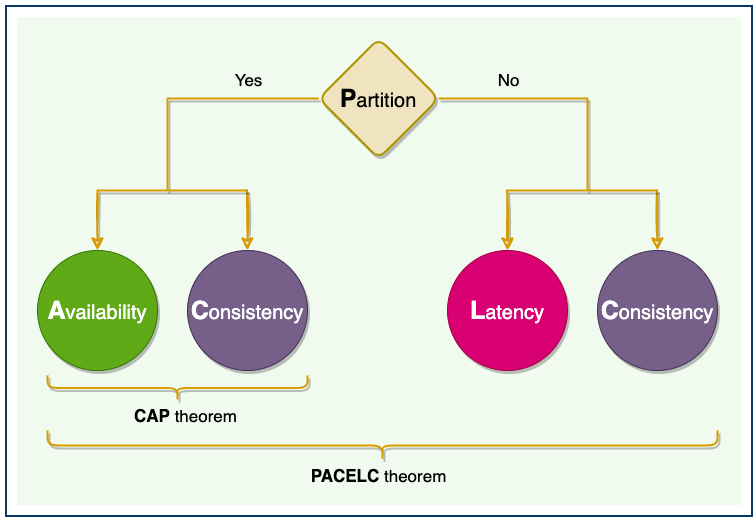
Let's make this concrete with a scenario. Imagine a system with two data centers, one in the US and one in Europe, that replicate data between each other.
- A user in the US updates their profile name from "Alex" to "Alexandra". The write succeeds on the US server.
- Before this update can be replicated to Europe, the transatlantic network cable is severed—a partition occurs.
- A user in Europe now tries to read that same profile.
What should the European data center do?
- Prioritize Consistency (CP System): To guarantee consistency, the European server cannot respond with the stale data ("Alex"). It knows it's cut off and can't verify the latest version. It must return an error or wait indefinitely. It sacrifices Availability.
- Prioritize Availability (AP System): To remain available, the European server responds with the best data it has: the old name, "Alex". The user gets a response, but it's stale data. It sacrifices strong Consistency.
3. Real-World Architectures: CP vs. AP Systems
This choice directly dictates the architecture of your system and the technologies you choose. Your job as an engineer is to understand the business requirements to make the right trade-off.
CAP Theorem in System Design Interviews
Let's watch how this trade-off plays out with real-world examples. This part of the "Hello Interview" video contrasts systems where consistency is critical with those where availability is paramount.
Watch the segment from 02:19 to 06:43. Pay close attention to the examples of ticket booking and financial systems (CP) versus social media and content platforms (AP).
CP (Consistency + Partition Tolerance)
These systems choose to remain consistent at the cost of availability during a partition.
- When to use: When data accuracy is mission-critical and stale data is catastrophic.
- Industry Examples:
- Financial Systems: Banking transactions, stock exchanges. You cannot show an incorrect account balance.
- Inventory Management: E-commerce sites like Amazon must have an accurate count of items in stock to avoid selling the same last item to two different people.
- Reservation Systems: Airline and hotel booking. Double-booking a seat is a major failure.
- Technology Choices: Traditionally, relational databases (RDBMS) like PostgreSQL, MySQL, and MS SQL Server configured for synchronous replication fall into this category. Distributed SQL databases like Google Spanner are also designed as CP systems.
AP (Availability + Partition Tolerance)
These systems choose to remain available for reads and writes, even if it means serving or accepting stale data during a partition. They typically rely on a model of eventual consistency, where the data will converge to a consistent state once the partition heals.
- When to use: When system downtime is unacceptable and temporary inconsistency can be tolerated.
- Industry Examples:
- Social Media Feeds: If you don't see a friend's latest post on Twitter for a few seconds, or the "like" count is slightly off, the service is still perfectly usable.
- Content Delivery: Netflix wants you to be able to watch a movie even if its systems can't fetch the absolute latest description. Availability for the core function (streaming) is key.
- E-commerce Product Listings: Displaying a slightly outdated product review is better than the entire product page failing to load.
- Technology Choices: Many NoSQL databases are built with this philosophy. Amazon's DynamoDB and Apache Cassandra are prime examples, designed for high availability and massive scale.
Conceptually, the logic for this trade-off can be represented as a simple decision in your application code.
// This is a conceptual Node.js snippet illustrating the CAP trade-off logic.
// In a real system, this logic is handled by the database or distributed consensus protocols.

const fetchData = async (key) => {
    // A function that detects if this node is isolated from the primary data source.
    if (detectNetworkPartition()) {
        // PRIORITIZE AVAILABILITY: Return data from a local, possibly stale cache.
        return fetchFromLocalCache(key); // An AP choice
    } else {
        // PRIORITIZE CONSISTENCY: Fetch directly from the primary, consistent data source.
        return fetchFromDatabase(key); // A CP choice
    }
};
4. Advanced Topic: The PACELC Theorem
The CAP theorem is crucial, but it only describes the trade-off during a partition. What about when the system is operating normally? This is where the PACELC theorem comes in, extending CAP for a more complete picture.
PACELC states:
- If there is a Partition, a system must choose between Availability and Consistency. (This is the CAP part).
- Else (if the system is running normally), it must choose between Latency and Consistency.
The "Else" part is the key extension. Even with no network failures, a trade-off exists:
- To ensure strong consistency on a write, you might have to wait for that write to be replicated to several nodes before you acknowledge success to the user. This waiting adds latency.
- To achieve lower latency, you could acknowledge the write immediately after it hits one node and replicate it in the background. This risks a brief period of inconsistency if a read request goes to a node that hasn't received the update yet.
Referring back to the decision tree image, PACELC is the 'No' branch of the 'Partition' decision.
5. Case Study: How Google's Spanner "Bends" the Rules
Google's Cloud Spanner is a globally distributed SQL database that claims to provide both strong consistency and high availability (99.999%+). This sounds like it violates the CAP theorem. How is this possible?
This is a subtle but critical point often discussed in senior-level interviews.
Inside Cloud Spanner and the CAP Theorem
To understand this apparent paradox, let's read the explanation from the creator of the CAP theorem himself, Eric Brewer, in this official Google Cloud blog post.
Read the sections titled 'In terms of CAP...' and 'Inside Spanner'. Focus on why Spanner is technically a CP system but acts like a CA system in practice.
As you read, the key takeaway is that Spanner is technically a CP system. If a true partition happens, it will sacrifice availability to maintain consistency. However, Google has invested billions in its private global network with multiple layers of redundancy to make partitions incredibly rare. So, while Spanner will choose C over A, the situation that forces that choice almost never happens.
From a practical standpoint, it delivers such high availability that users can treat it as a CA (Consistent and Available) system, even though theoretically, CA systems cannot exist in the real world across a wide area network.
Test your understanding! (Interview-Style Question)
You are designing a new feature for a ride-sharing app like Uber. The feature allows users to see where their driver is on a map in real-time. Another part of the system is responsible for calculating the final fare and processing the payment. How does the CAP theorem influence your architectural choices for these two different components?
Show answer
This question tests your ability to apply CAP trade-offs to different parts of a single, complex system.
-
Driver Location Tracking (Real-time Map):
- Choice: This system should be an AP (Available and Partition-Tolerant) system.
- Justification: Availability is paramount. The user must always be able to see the map, even if the driver's location is a few seconds out of date. If the system chose consistency (CP), a network hiccup could cause the map to freeze or show an error, which is a terrible user experience. A slightly stale location is far better than no location at all. Eventual consistency is perfectly acceptable here.
-
Fare Calculation and Payment Processing:
- Choice: This system must be a CP (Consistent and Partition-Tolerant) system.
- Justification: Data consistency is non-negotiable. The system must have the authoritative, correct details of the ride (start time, end time, distance) to calculate the fare. You cannot risk double-charging a user, missing a payment, or calculating a fare based on stale or incorrect data. If there is a network partition that prevents verification of the final ride details, the system must halt payment processing (sacrificing availability) until it can guarantee consistency.
This nuanced approach—applying different CAP trade-offs to different microservices based on their business function—is a hallmark of sophisticated system design.
Conclusion
You've now grappled with one of the most fundamental laws of distributed computing. The CAP theorem isn't just a theoretical concept; it's a practical framework that forces critical design decisions in any system that operates at scale. Recognizing which part of the trade-off your application can afford to make is a key engineering skill.
Key Takeaways:
- A distributed system can only guarantee two of three properties: Consistency, Availability, and Partition Tolerance.
- Because network Partitions are a fact of life, the real choice is between Consistency and Availability.
- CP systems (e.g., banking) prioritize data correctness over uptime during a partition.
- AP systems (e.g., social media) prioritize uptime over immediate data consistency during a partition, typically using eventual consistency.
- The PACELC theorem extends CAP by noting that even without a partition, there is a trade-off between Latency and Consistency.
Next Lesson Preview
We've established that large-scale systems are composed of many servers. But when a user request comes in, how do we decide which server should handle it? How do we distribute the traffic evenly to prevent any single server from becoming overwhelmed? In our next lesson, we will dive into load balancing strategies, designing the traffic cops of our distributed system.