Welcome to your seventh lesson in the System Design: Scalability, Caching, and Storage module. In our previous lesson, we designed the "traffic cop" of our system—the load balancer—to intelligently distribute incoming requests across our servers. We saw how moving from simple Round-Robin to dynamic algorithms like Least Connections and Power of Two Choices makes a system more resilient.
Now that we can reliably route traffic to our application servers, we must address a more fundamental question: where and how does the data live? This lesson tackles the persistence layer, the foundation of any stateful application. We will dissect one of the most critical decisions in system design: choosing between SQL and NoSQL databases. You will learn not just what they are, but why they exist, how they work under the hood, and how to select the right one for a specific engineering problem. This is a cornerstone topic for any system design interview at an elite company.
1. The Core Distinction: Schema and Data Model
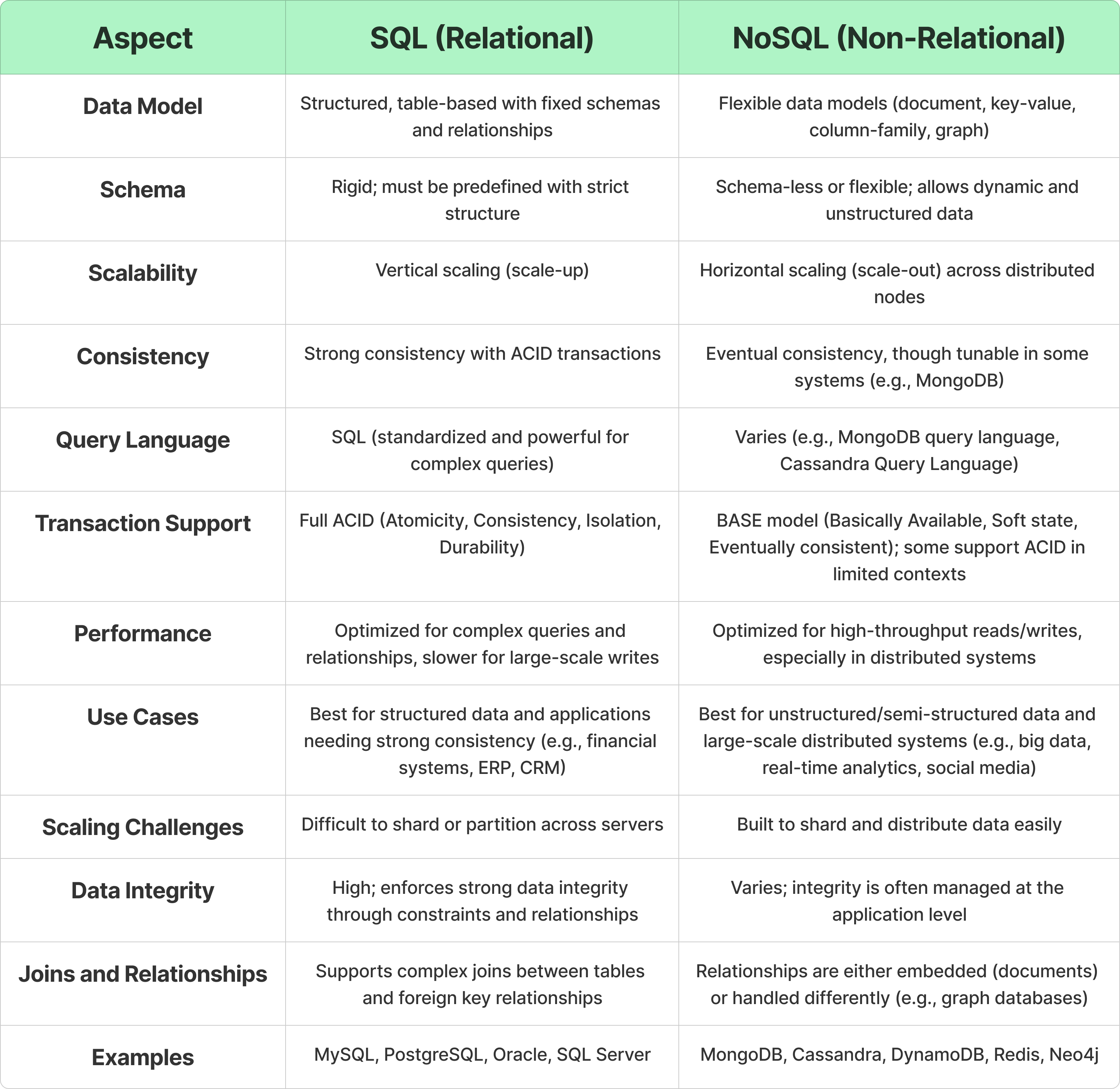
The most fundamental difference between SQL and NoSQL databases lies in how they structure data. This single difference has cascading effects on flexibility, performance, and scalability.
-
Technical Explanation:
- SQL (Relational Databases): These databases, like PostgreSQL and MySQL, are built on the relational model proposed by E.F. Codd. Data is organized into tables (relations) with predefined columns and data types, known as a fixed schema. Each row in a table represents a single entity, and relationships between entities in different tables are enforced using
PRIMARY KEYandFOREIGN KEYconstraints. This rigid structure guarantees data integrity and consistency. - NoSQL ("Not Only SQL"): This is a broad category of databases designed for flexibility. They generally use a dynamic schema, meaning records (e.g., documents) do not need to conform to a predefined structure. This is ideal for semi-structured or unstructured data. There are four main types:
- Key-Value Stores (e.g., Redis): Data is stored as a simple dictionary or hash map.
- Document Stores (e.g., MongoDB): Data is stored in documents, typically JSON or BSON, which can have nested structures.
- Wide-Column Stores (e.g., Cassandra): Data is stored in tables with rows and columns, but different rows in the same table can have different columns.
- Graph Stores (e.g., Neo4j): Data is modeled as nodes and edges, representing entities and their relationships.
- SQL (Relational Databases): These databases, like PostgreSQL and MySQL, are built on the relational model proposed by E.F. Codd. Data is organized into tables (relations) with predefined columns and data types, known as a fixed schema. Each row in a table represents a single entity, and relationships between entities in different tables are enforced using
-
Metaphor for a 5-Year-Old:
- A SQL database is like filling out a pre-printed tax form. Every form has the exact same boxes (First Name, Last Name, Address), and you must fill them in correctly. You can't add a new box for "Favorite Color."
- A NoSQL database is like a filing cabinet full of folders. Each folder can hold anything you want. One folder might contain a typed letter, another might have a drawing and a photograph. They are all in the same cabinet, but they don't have to look the same.
-
Python Data Model Representation: While we can't implement a database in a few lines, we can represent their data models.
# SQL: Data is structured and uniform, like a list of tuples.
# Represents a 'users' table with (id, name, email).
sql_users = [
    (1, "Alice", "alice@example.com"),
    (2, "Bob", "bob@example.com"),
    # (3, "Charlie", "charlie@example.com", 28) # -> This would cause a schema error!
]

# NoSQL (Document): Data is flexible, like a list of dictionaries.
# Represents a 'users' collection where documents can have different fields.
nosql_users = [
    {"user_id": 1, "name": "Alice", "email": "alice@example.com"},
    {"user_id": 2, "name": "Bob", "email": "bob@example.com", "followers": 150},
    {"user_id": 3, "name": "Charlie", "social_handles": {"twitter": "@charlie"}},
]
2. The Consistency Guarantee: ACID vs. BASE
The next major distinction is the promise each database makes about the reliability of transactions, a trade-off directly related to the CAP Theorem.
- Technical Explanation:
- SQL -> ACID Properties: Relational databases are built to provide transactional integrity through ACID guarantees. This makes them the default choice for systems where correctness is non-negotiable (e.g., financial systems). In the context of the CAP Theorem, they often prioritize Consistency over Availability (CP systems).
- Atomicity: All operations in a transaction succeed, or none do. No partial states.
- Consistency: A transaction brings the database from one valid state to another, upholding all rules.
- Isolation: Concurrent transactions produce the same result as if they were run serially.
- Durability: Once a transaction is committed, it will remain so, even in the event of a power loss or crash.
- NoSQL -> BASE Philosophy: Many NoSQL databases, designed for high availability and scale, adhere to the BASE philosophy. They prioritize Availability over immediate Consistency (AP systems).
- Basically Available: The system guarantees availability.
- Soft State: The state of the system may change over time, even without input, due to eventual consistency.
- Eventually Consistent: If no new updates are made, all replicas will eventually converge to the same value. There's a window where reads might return stale data.
- SQL -> ACID Properties: Relational databases are built to provide transactional integrity through ACID guarantees. This makes them the default choice for systems where correctness is non-negotiable (e.g., financial systems). In the context of the CAP Theorem, they often prioritize Consistency over Availability (CP systems).
Database Design Tips | Choosing the Best Database in a System Design Interview
To see how these concepts drive your initial database choice in a system design interview, watch this video. It presents a simple flowchart to guide your decision based on data structure and ACID requirements.
Watch the segment from 11:11 to 14:01. Focus on the two key questions: 'Is my data structured?' and 'Do I need ACID guarantees?'. This is the first filter you should apply when selecting a database.
- Metaphor for a 5-Year-Old:
- ACID is like a vending machine. You put your money in and press the button. You are guaranteed to either get your snack AND your change, or you get all your money back. The machine will never just take your money and give you nothing.
- BASE is like a group chat. You post a message. Your friends in New York might see it instantly, but your friend in London with a slow connection might see it a few seconds later. The chat is always available for you to post, but for a moment, not everyone has the same view of the conversation. Eventually, everyone sees your message.
3. Under the Hood: Write-Optimized vs. Read-Optimized Architectures
This is where we get into the deep mechanics that you highlighted as a key interest. The way a database writes data to disk fundamentally determines its performance characteristics.
-
Technical Explanation: The core architectural trade-off is often between two data structures: B-Trees and Log-Structured Merge-Trees (LSM-Trees).
- B+Trees (Read-Optimized - Common in SQL):
- How it works: A B+Tree is a self-balancing tree optimized for disk-based storage. To update a record, the database must traverse the tree to find the correct page on disk, lock it, and modify it in-place. This involves random disk I/O, which is relatively slow.
- Result: Reads are extremely fast because the index points directly to the data's location. Writes, especially random writes, can become a bottleneck under heavy load. To ensure durability, changes are first written to a Write-Ahead Log (WAL) before being applied to the tree.
- LSM-Trees (Write-Optimized - Common in NoSQL):
- How it works: An LSM-Tree never modifies data in-place. A write is an append-only operation:
- The write is first appended to a commit log on disk (like a WAL).
- The data is then added to an in-memory table called a Memtable. This is extremely fast.
- When the Memtable is full, it's flushed to disk as a new, immutable, sorted file called an SSTable (Sorted String Table).
- A background process called Compaction periodically merges these SSTables to discard old/deleted values and keep read performance in check.
- Result: Writes are incredibly fast because they are sequential appends. Reads are more complex, as the database may need to check the Memtable and multiple SSTables to find the latest version of a record.
- How it works: An LSM-Tree never modifies data in-place. A write is an append-only operation:
- B+Trees (Read-Optimized - Common in SQL):

Cassandra Deep Dive w/ a Ex-Meta Staff Engineer
Let's see this in action with Cassandra, a classic LSM-Tree database. This video explains its write and read path, which perfectly illustrates the LSM-Tree concept.
Watch the section from 18:15 to 24:02. Pay close attention to the roles of the commit log, memtable, and SS tables. Understand why this architecture makes writes 'so fast' (sequential appends) and what the implications are for reads.
4. Scaling Strategies: Vertical vs. Horizontal
How a database handles growth is another critical differentiator, flowing directly from its data model and consistency guarantees.
-
Technical Explanation:
- Vertical Scaling (Scale-Up - The SQL way): The traditional approach for relational databases is to increase the resources of a single server: add more CPU, more RAM, or faster SSDs. This is simple to manage but hits physical and financial limits. A single server, no matter how powerful, can only get so big.
- Horizontal Scaling (Scale-Out - The NoSQL way): NoSQL databases are typically designed from the ground up to scale horizontally. This means adding more commodity servers (nodes) to a distributed cluster. The database automatically partitions the data and spreads the load across the cluster. This is more complex to manage but is more cost-effective and can theoretically scale infinitely.
- The Connection: Horizontal scaling (sharding) is difficult for relational databases because of joins and transactional consistency across tables that may live on different machines. NoSQL's self-contained data model (e.g., a single document holds all user info) makes it much easier to distribute data across a cluster.
-
Metaphor for a 5-Year-Old:
- Vertical Scaling is like replacing your small delivery van with a giant 18-wheeler truck to carry more packages. It's still one truck, just a much more powerful (and expensive) one.
- Horizontal Scaling is like keeping your small delivery van but just buying more of them when you have more packages to deliver. You can end up with a whole fleet of vans working together.
5. Making the Choice: Use Cases & Polyglot Persistence
The "SQL vs. NoSQL" debate is outdated. The modern, elite engineering approach is to use the right tool for the job, a concept known as polyglot persistence.
- Technical Explanation: Query-Driven vs. Entity-Driven Design
- SQL (Entity-Driven): You first model your data entities and their relationships through normalization (e.g.,
Users,Posts,Commentstables). You then writeJOINqueries to combine this normalized data as needed. This is excellent for data integrity and flexible, ad-hoc querying. - NoSQL (Query-Driven): You first identify the specific queries your application will need to run. You then design your data model—often by denormalizing and duplicating data—to make those queries as fast as possible. The primary goal is performance for known access patterns, not data normalization.
- SQL (Entity-Driven): You first model your data entities and their relationships through normalization (e.g.,
An In-Depth Analysis of Relational and NoSQL Databases
For a rigorous, in-depth understanding of the architectural differences and when to apply each type of database, this article is an excellent resource. It synthesizes many of the concepts we've discussed.
This is a comprehensive read. Skim Sections 1 and 2, as they reinforce what we've already covered on ACID/BASE and B-Tree/LSM-Tree. Focus your deep reading on Section 3 (Strategic Application and Use Cases), Section 5 (The Evolution of Databases), and Section 6 (Conclusion). Pay close attention to the 'Database Architectural Decision Matrix' and the concept of 'Polyglot Persistence'.
- Real-World Application: The Netflix Stack
Netflix is a prime example of polyglot persistence. They don't use just one database; they use several, each for a specific purpose.- User Viewing History & Recommendations (NoSQL): This involves a massive volume of write operations ("user X watched video Y") and needs to scale horizontally to hundreds of millions of users. They famously use Cassandra (a wide-column NoSQL database) for this. Eventual consistency is perfectly acceptable.
- Billing and Subscriptions (SQL): This system requires absolute transactional integrity. You cannot risk charging a customer twice or failing to record a payment. This workload is a perfect fit for a traditional ACID-compliant RDBMS like MySQL or PostgreSQL.
This hybrid approach leverages the strengths of both paradigms within a single ecosystem.
Test your understanding! (Interview-Style Question)
You are designing the backend for a platform like Instagram. You need to store user data, photos, and the "social graph" (who follows whom). When a user opens the app, they see their feed, which is a list of photos from people they follow.
Which database(s) would you choose for these components, and why? Justify your answer based on data model, consistency needs, and expected workload.
Show answer
A strong answer would recommend a polyglot persistence approach, acknowledging that different parts of the system have different needs.
-
User Profiles & Authentication (SQL Database - e.g., PostgreSQL):
- Reasoning: User data (username, hashed password, email) is highly structured and requires strong consistency. You cannot have a situation where a user changes their password and can sometimes log in with the old one (violates ACID). The data volume per user is small, and the relationships are well-defined. An RDBMS provides the necessary integrity and security guarantees for this critical data.
-
Photo Metadata & Feeds (NoSQL Wide-Column Store - e.g., Cassandra):
- Reasoning: This is the "big data" problem. There will be billions of photos and trillions of "feed" entries.
- Workload: This is extremely write-heavy (users uploading photos) and read-heavy (users scrolling feeds).
- Scalability: Horizontal scaling is a must. A wide-column store like Cassandra excels here.
- Data Model: This is a classic "query-driven design" problem. Instead of calculating a user's feed on the fly with expensive
JOINs, you would pre-generate it. When User A posts a photo, a background process pushes that photo's ID into the "feed tables" of all of User A's followers. The data is denormalized and duplicated for fast reads. Eventual consistency is acceptable; if a new photo takes a few seconds to appear in a follower's feed, the user experience is not significantly impacted.
-
The Social Graph (NoSQL Graph Database - e.g., Neo4j):
- Reasoning: The core of this problem is the relationships: "who follows whom." Finding things like "followers of my followers" or suggesting new people to follow involves traversing these complex relationships.
- Data Model: A graph database is purpose-built for this. Users are
nodes, and the "follows" relationship is anedge. - Performance: Answering queries like "find mutual followers between User A and User B" is extremely slow and complex in a relational database (requiring multiple self-joins) but is a fast, native traversal in a graph database.
This multi-database architecture uses the best tool for each specific job, which is a hallmark of sophisticated system design.
Conclusion
Today, you've gone deep into one of the most foundational trade-offs in building large-scale systems. You've moved beyond surface-level definitions to understand the core architectural principles that differentiate SQL and NoSQL databases.
Key Takeaways:
- The choice is not "SQL vs. NoSQL," but "Which tool is right for this specific problem?"
- SQL (Relational): Best for structured data requiring strong ACID consistency and complex, ad-hoc queries. They are read-optimized (B-Trees) and traditionally scale vertically.
- NoSQL (Non-Relational): Best for unstructured/semi-structured data requiring high availability and massive horizontal scale. Many are write-optimized (LSM-Trees) and work on the principle of eventual consistency (BASE).
- Data modeling is key: SQL uses an entity-driven, normalized approach, while NoSQL uses a query-driven, denormalized approach.
- Polyglot Persistence: Elite systems (like Netflix, Google, Amazon) use multiple types of databases, leveraging the unique strengths of each for different parts of their application.
Next Lesson Preview
We've established that SQL databases are hard to scale horizontally, a process known as sharding. While NoSQL databases often handle this automatically, sharding a relational database is a complex but necessary task for many large-scale applications that still require ACID guarantees. In our next lesson, we will tackle this head-on, designing database sharding strategies and exploring the critical role of consistent hashing in making distributed systems scalable and resilient.