Welcome to your next lesson in the "Scalable Data Processing and Platforms" module.
In our last lesson, we designed batch, streaming, and hybrid data pipelines, focusing on the trade-offs between latency, throughput, and cost. We established that while hybrid models offer the best of both worlds, they operate under a key assumption: the structure of the data remains constant. Today, we confront the reality that data structure always changes.
This lesson directly addresses the learning outcome: Manage schema evolution in data pipelines using strategies like schema-on-read and schema registries. Uncontrolled schema changes, or "schema drift," are a primary cause of pipeline failures and silent data corruption in large-scale systems. Mastering these management strategies is a non-negotiable skill for architects at Google, Meta, or any company operating at scale.
We will deconstruct this complex topic into five interconnected concepts, moving from foundational strategies to the robust, industry-standard enforcement mechanisms.
- The Inevitability of Change: Understanding Schema Evolution
- Strategy 1: Schema-on-Write (The Gatekeeper)
- Strategy 2: Schema-on-Read (The Investigator)
- Enforcing Schemas: Serialization and Registries
- Governing Evolution: Schema Compatibility Rules
1. The Inevitability of Change: Understanding Schema Evolution (Easy)
-
Technical Explanation:
A schema is the blueprint for your data. It defines the field names (user_id,event_type), their data types (INT,STRING), and their structure. Schema evolution (or schema drift) is the natural, unavoidable process of this blueprint changing over time.Common causes include:
- New Features: Adding a
discount_codefield to anorderevent. - Source System Changes: A partner API stops sending a
user_locationfield. - Bug Fixes: Changing a
pricefield from aSTRINGto aFLOATto fix calculation errors. - Data Optimization: Renaming
user_idtouidfor brevity.
If not managed, these changes can cause catastrophic pipeline failures (e.g., a
TypeErrorwhen a string is expected but an integer is received) or, even worse, silent data corruption where data is misinterpreted or lost without any errors. - New Features: Adding a
-
Metaphor for a 5-Year-Old:
Imagine you and your friend have a secret code to build a LEGO car. The code (schema) says you need 4 wheels, 1 body, and 1 steering wheel. One day, your friend decides the car should have a driver and just starts adding a LEGO person to the box of parts. When you try to build the car using the old code, you're left with an extra piece you don't know what to do with. What if they removed the steering wheel instead? Your building process would break! Schema evolution is about having rules for how to change the code so you can both keep building cars without everything falling apart. -
Python Code Snippet (The Breakage):
This script shows how a simple change can break a downstream consumer that has a hardcoded schema assumption.# V1 of our event data from a producer event_v1 = {"user_id": 123, "event_name": "login", "timestamp": "2023-10-29T10:00:00Z"} # The consumer is built to expect V1 def process_event(event): # This consumer assumes 'user_id' exists and is an integer print(f"Processing event for user: {event['user_id']}") # It also expects 'event_name' if event['event_name'] == 'login': print(" -> User logged in.") print("Processing V1 event (works fine):") process_event(event_v1) # --- Time passes, the producer team changes the schema without telling the consumer team --- # V2 of our event data: 'user_id' is renamed to 'uid', 'event_name' is removed event_v2 = {"uid": 123, "type": "login", "timestamp": "2023-10-29T11:00:00Z"} print("\nProcessing V2 event (will fail):") try: process_event(event_v2) except KeyError as e: print(f"!!! KABOOM: The pipeline broke! It was looking for the key {e}, which no longer exists.")
2. Strategy 1: Schema-on-Write (The Gatekeeper) (Easy)
-
Technical Explanation:
The Schema-on-Write approach dictates that data must be validated, cleaned, and forced to conform to a predefined schema at the moment of ingestion—before it is written to storage. If incoming data does not match the schema, it is either rejected or routed to a dead-letter queue for inspection. This is the traditional model used in data warehouses (ETL).- Pros:
- High Data Quality: The data in your storage system is guaranteed to be clean, structured, and reliable.
- Fast Query Performance: Data is already in a structured, optimized format, making queries fast.
- Simple Consumers: Downstream applications don't need complex parsing logic; they can trust the data's structure.
- Cons:
- Inflexible: It's difficult and slow to change the schema.
- Potential Data Loss: If an incoming event has a new, unexpected (but valuable) field, it will be dropped if it's not in the schema.
- Slow Ingestion: Validation adds latency to the write path.
- Pros:

-
Metaphor for a 5-Year-Old:
This is like a shape-sorting toy. You have a box with holes for a square, a circle, and a triangle. If you try to put a square block through the square hole, it fits perfectly and goes into the box (storage). If you try to put a star-shaped block through any of the holes, it won't fit and is rejected. Only perfectly shaped blocks get into the box. -
Python Code Snippet (Conceptual Validation):
This function acts as a "gatekeeper," only allowing dictionaries that match a predefined schema.# The predefined schema our system expects REQUIRED_SCHEMA = { "order_id": str, "customer_id": int, "amount": float } def write_with_schema_validation(data_to_write): """Implements schema-on-write logic.""" print(f"\nAttempting to write data: {data_to_write}") # Validation Step for key, expected_type in REQUIRED_SCHEMA.items(): if key not in data_to_write: print(f" -> REJECTED: Missing required key '{key}'.") return if not isinstance(data_to_write[key], expected_type): print(f" -> REJECTED: Key '{key}' has wrong type. Expected {expected_type}, got {type(data_to_write[key])}.") return # If we get here, validation passed print(" -> ACCEPTED: Data conforms to schema. Writing to storage.") # In a real system, this would write to a database/warehouse. # A valid record valid_record = {"order_id": "A-123", "customer_id": 456, "amount": 99.99} write_with_schema_validation(valid_record) # An invalid record (wrong type for customer_id) invalid_record = {"order_id": "B-456", "customer_id": "user-789", "amount": 25.50} write_with_schema_validation(invalid_record)
3. Strategy 2: Schema-on-Read (The Investigator) (Medium)
-
Technical Explanation:
The Schema-on-Read approach takes the opposite stance. It prioritizes ingestion speed and flexibility by storing data in its raw or semi-structured format. The responsibility for parsing, interpreting, and enforcing a schema is shifted to the consumer at the moment the data is read for analysis. This is the model that enables data lakes and the ELT (Extract, Load, Transform) paradigm.- Pros:
- Maximum Flexibility: You can easily handle new and evolving data sources without changing the ingestion pipeline.
- No Data Loss: Every piece of raw data is captured, even if its structure is unknown. You might find a use for it later.
- Fast Ingestion: Writing raw data is extremely fast as there is no validation overhead.
- Cons:
- "Data Swamp" Risk: Without governance, the data lake can become a messy, unusable mess.
- Slow Query Performance: Queries often need to parse and transform large volumes of raw data (e.g., JSON logs) on the fly, which is slow.
- Complex Consumers: Each consumer application must implement its own logic to handle messy, inconsistent data, leading to duplicated effort and potential for error.
- Pros:
-
Metaphor for a 5-Year-Old:
This is like taking every toy you own and throwing them all into one giant toy chest without sorting them. It's super fast to clean up your room (ingestion). But later, when you want to find your favorite red LEGO brick (reading data), you have to dump the whole chest on the floor and sift through everything to find it (applying a schema). -
Python Code Snippet (Conceptual Investigation):
This function reads a list of "raw" records and applies its own schema during the read process, gracefully handling inconsistencies.# A collection of raw records from a data lake. Note the inconsistencies. raw_records = [ {"id": "A-123", "user": 456, "price": "99.99"}, # price is a string {"id": "B-456", "user": 789, "price": 25.5, "new_field": "val"}, # has an extra field {"id": "C-789", "price": 150.0} # is missing the 'user' field ] def read_with_schema_on_read(): """Implements schema-on-read logic.""" print("Reading raw records and applying schema...") processed_records = [] for record in raw_records: try: # Apply the schema and transformations at read time processed_record = { "order_id": record.get("id"), "customer_id": record.get("user"), # Use .get() to avoid KeyErrors "amount": float(record.get("price", 0.0)) # Cast to float and provide default } processed_records.append(processed_record) print(f" -> Successfully processed: {processed_record}") except Exception as e: print(f" -> Failed to process record {record}: {e}") return processed_records read_with_schema_on_read()
4. Enforcing Schemas: Serialization and Registries (Hard)
While Schema-on-Read offers flexibility, Schema-on-Write is crucial for building reliable, high-quality data platforms. The key question is: how do you implement Schema-on-Write efficiently in a distributed system with many producers and consumers?
The answer lies in two technologies working together: Schema-based Serialization Formats and a Schema Registry.
First, let's understand why text-based formats like JSON are inefficient for this.
Google SWE teaches systems design | EP43: Data Serialization (Protocol Buffers, Thrift, Avro)
To understand the need for specialized formats, let's first review the limitations of JSON for high-performance data pipelines. This video provides a great overview.
Watch the section from 00:49 to 04:06. Focus on the problems with language-specific serialization and the issues with JSON/XML, such as verbosity (sending field names repeatedly) and lack of strong typing.
To solve these problems, the industry relies on binary serialization formats like Protocol Buffers (Protobuf), Thrift, and Apache Avro. These formats encode data into a compact binary representation based on a formal schema definition.
Apache Avro is particularly important in the big data ecosystem (especially with Kafka) because of its excellent support for schema evolution.
Schema evolution in Avro, Protocol Buffers and Thrift
Martin Kleppmann's classic article provides a masterful 'under the hood' look at how these formats work and how they handle schema evolution. We will focus on Avro's unique approach.
Please read the section on 'Avro'. Pay close attention to these key ideas: There are no tag numbers like in Protobuf; the schema is required to parse the data. The concept of a 'writer's schema' and a 'reader's schema'. How Avro resolves differences between the two schemas by matching field names. The requirement for default values when adding/removing fields.
This leads to the final piece of the puzzle: if Avro needs the writer's schema to read data, where do you get it from? Sending it with every tiny message is inefficient.
This is the problem solved by a Schema Registry.
A Schema Registry is a centralized, versioned repository for all schemas in your organization. In a Kafka pipeline:
- Producer: Before sending a message, the producer checks its schema against the registry. If the schema is new, it registers it and gets back a schema ID. If it's an evolution of an existing schema, the registry checks if the change is compatible (more on this in a moment). The producer then sends the compact binary data prefixed with the small schema ID.
- Consumer: The consumer receives the message. It sees the schema ID, and if it doesn't have that schema cached, it requests it from the registry. It then uses the writer's schema (from the registry) and its own expected schema to correctly deserialize the data.
Confluent Schema Registry | Apache Kafka 101 (2025 Edition)
The Confluent Schema Registry is the de-facto standard for Kafka. This video explains its role and operational flow perfectly.
Watch the sections 'How does this work?' (01:38 - 04:24) and the discussion on supported formats (06:06 - 07:34). Focus on: The interaction between Producer, Consumer, Kafka, and the Schema Registry. The role of the Schema ID in the message. How the registry acts as a central source of truth for schemas.
5. Governing Evolution: Schema Compatibility Rules (Harder)
A Schema Registry's most powerful feature isn't just storing schemas; it's enforcing rules about how they can change. These are called compatibility modes. They prevent a producer from publishing data with a schema change that would break consumers.
Let's explore the most important compatibility types.
Critical Schema Compatibility: The Key to Preventing Data ...
This article offers an excellent, code-driven explanation of the different compatibility modes. We will use it as our guide.
Read the sections on Backward Compatibility, Forward Compatibility, and Full Compatibility. For each section, focus on: The definition: Which schema can read which data? The allowed changes (e.g., adding an optional field vs. deleting one). The required upgrade order (e.g., 'Upgrade Consumers First'). Study the Python code examples using fastavro to see the concepts in action.
Here’s a summary of the core concepts you need to know for an interview:
| Compatibility | Definition | Allowed Changes | Upgrade Order | Metaphor |
|---|---|---|---|---|
| BACKWARD | A consumer with the new schema can read data produced by an old schema. | Add new optional fields. Delete existing fields. | Consumers first. | Your new phone (consumer) can still play old video games. |
| FORWARD | A consumer with an old schema can read data produced by the new schema. | Add new fields. Delete optional fields from the past. | Producers first. | Your old TV (consumer) can still display a signal from a new Blu-ray player, it just won't show 4K. |
| FULL | Both BACKWARD and FORWARD compatible. |
Only add or remove optional fields. | Any order. | The most robust mode, ensures maximum decoupling. |
| NONE | No rules enforced. | Anything. | Synchronized "big bang" or expect breakage. | The wild west. Use with extreme caution. |
This summary table provides a high-level view of the rules for different compatibility types.
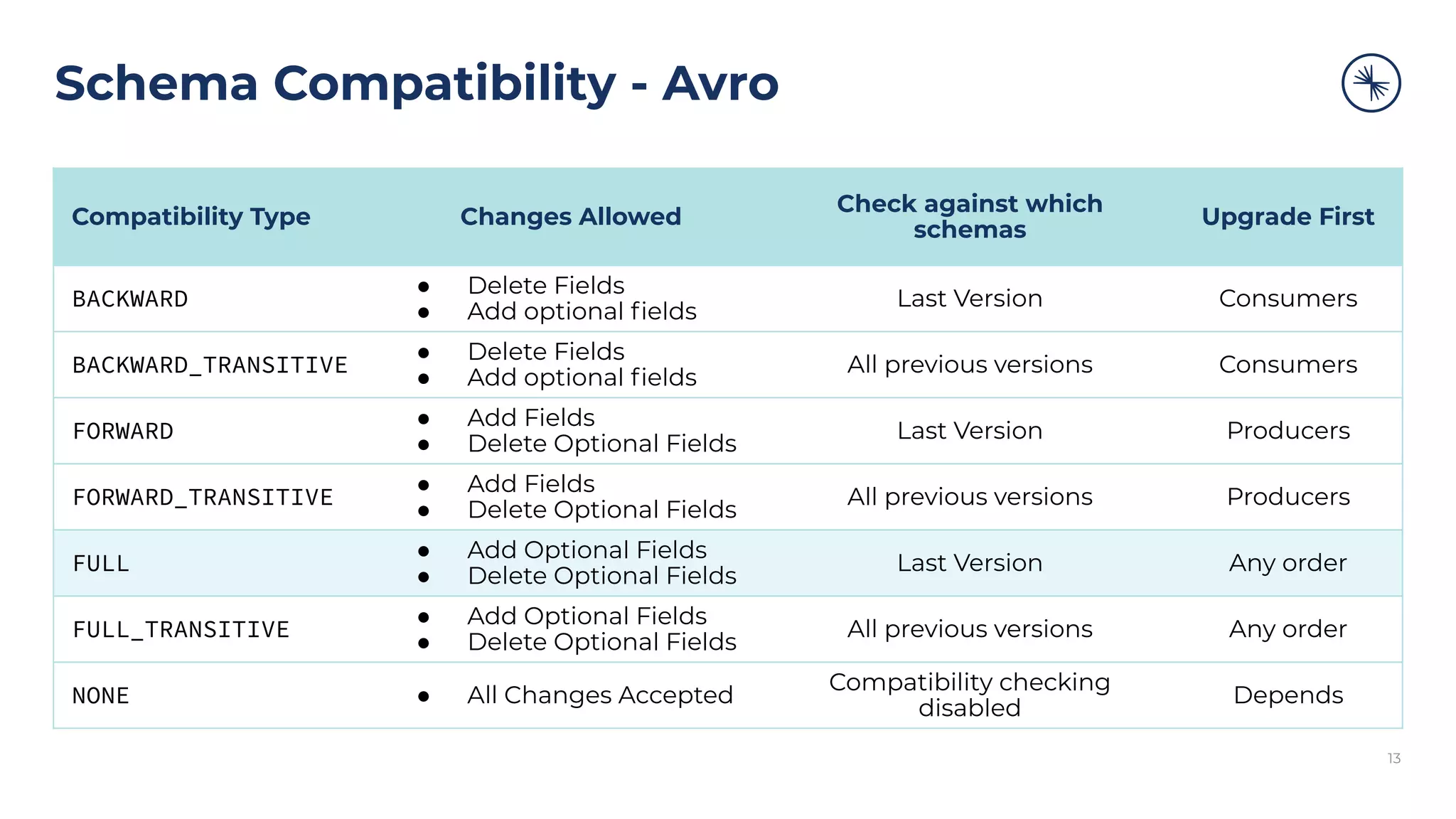
Test your understanding! (Interview-Style Question)
Your team manages a critical user_profile topic in Kafka, consumed by dozens of other teams across the company. The current Avro schema is: {name: "user_id": string, name: "email": string}.
The product team wants to add a new, non-essential feature to track the user's selected theme. You need to add a theme field (e.g., "dark" or "light"). You cannot coordinate a simultaneous rollout with all consumer teams.
Which compatibility mode should the topic be configured to? What would the new schema look like? What is the safe rollout procedure?
Show answer
The best choice here is BACKWARD compatibility. We are introducing a new feature, and we need to ensure that existing consumers don't break. This mode is ideal for adding new, optional information.
1. Compatibility Mode:
BACKWARD. This ensures that new consumers can read old data (without the theme field) and that we can evolve the system by deploying consumers first.
2. New Schema:
To maintain backward compatibility when adding a field, the new field must have a default value. In Avro, this is typically done by making it a union with null.
{
  "type": "record",
  "name": "UserProfile",
  "fields": [
    {"name": "user_id", "type": "string"},
    {"name": "email", "type": "string"},
    {
      "name": "theme",
      "type": ["null", "string"],
      "default": null
    }
  ]
}
The default: null is critical. It tells a consumer with this new schema what value to use for theme when reading an old record that doesn't contain the field.
3. Safe Rollout Procedure (for BACKWARD compatibility):
The rule for BACKWARD is "Consumers first."
- Deploy updated Consumers: Roll out new versions of all consumer applications that are built with the new schema. These consumers now know about the
themefield but can gracefully handle its absence by using the default value (null). Older producers are still writing records without thethemefield, and everything continues to work. - Deploy updated Producers: Once all consumers are updated and stable, you can roll out the new producer code that starts writing records including the
themefield. The updated consumers will now be able to process this new field.
This two-phase rollout ensures zero downtime and no data processing failures. Choosing FORWARD would be incorrect, as it allows deleting optional fields, which is not what we are doing. FULL would also work, as it's a stricter superset of BACKWARD, but BACKWARD is the most direct and common choice for adding new optional fields.
Conclusion
You now have a comprehensive framework for managing one of the most challenging aspects of data engineering: schema evolution. In large-scale systems, this is not an afterthought but a foundational architectural concern.
Key Takeaways:
- Schema Evolution is Unavoidable: Plan for it from day one.
- Schema-on-Write vs. Schema-on-Read: This is a fundamental trade-off between data quality/performance (Write) and flexibility/speed of ingestion (Read). Most robust platforms use a
Schema-on-Writeapproach for their core data streams. - Serialization Formats Matter: Binary formats like Avro are purpose-built for efficiency and schema evolution, providing capabilities that JSON cannot.
- Schema Registry is the Pillar of Governance: It acts as a centralized source of truth and an enforcement mechanism, preventing breaking changes before they enter the system.
- Compatibility Rules are Key: Understanding BACKWARD, FORWARD, and FULL compatibility dictates your deployment strategy and is essential for maintaining a stable, decoupled architecture.
Next Lesson Preview
We've learned how to enforce the structure of our data. But what about the values within that data? What if a price field is a valid float, but it's negative? What if a user's signup_date is in the year 3000? In our next lesson, we will cover how to implement data quality gates and anomaly detection within a data pipeline to catch these logical errors.