Hello! Welcome back to our course.
In the last lesson, you implemented a complete Binary Search Tree, including the search, insert, and delete operations. We established that the time complexity for all these core operations is , where is the height of the tree.
This lesson dives into the critical implications of that fact. Our goal is to analyze the time complexity of BST operations in balanced vs. unbalanced scenarios. Understanding this distinction is fundamental to developing an architectural mindset. It’s not enough to know how a data structure works; an architect must understand its performance guarantees and failure modes to make informed design decisions. This lesson will show you why a "vanilla" BST, while elegant, carries a significant performance risk in real-world applications.
1. The Height of the Tree: Best vs. Worst Case
The performance of every BST operation is directly tied to its height. The shape of the tree, which is determined by the order of insertions, dictates this height. This leads to two dramatically different scenarios: balanced and unbalanced trees.
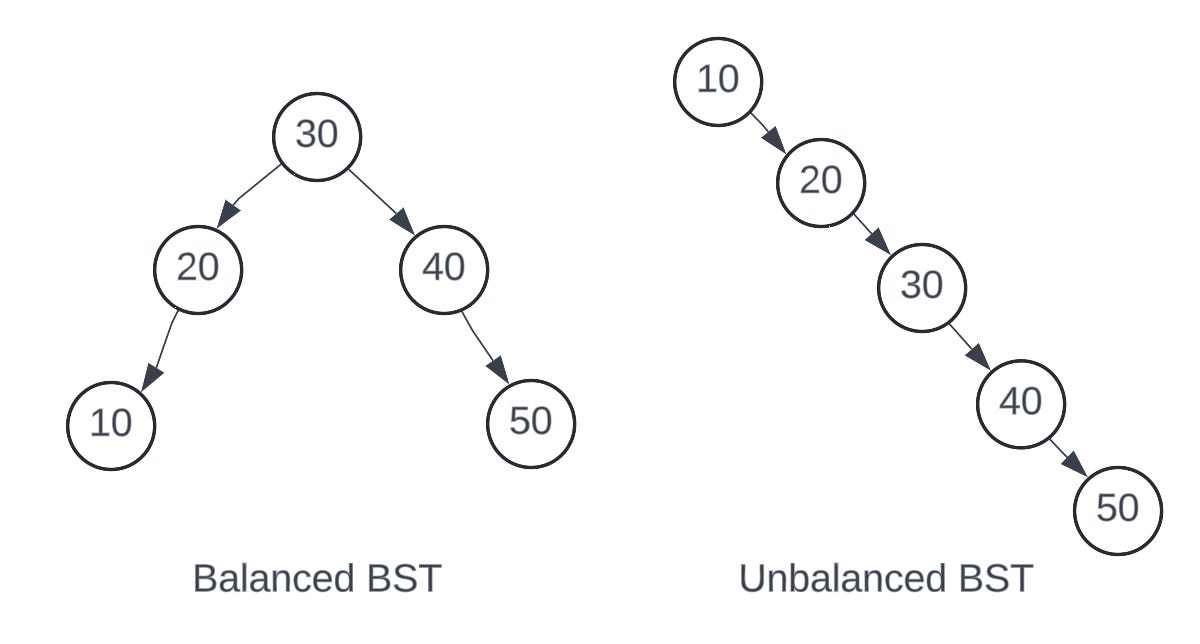
Balanced BST (The Best Case)
A tree is considered balanced if, for every node, the heights of its left and right subtrees are roughly equal. This creates a "bushy" structure, as seen on the left of the image above.
- Height: In a perfectly balanced tree with nodes, the height is .
- Complexity: Operations that traverse the tree from the root to a leaf take time. This is extremely efficient. For a million items, is only about 20 steps!
Unbalanced BST (The Worst Case)
An unbalanced tree occurs when insertions are skewed, causing one side of the tree to be much deeper than the other. The most extreme version is a degenerate or skewed tree, which essentially becomes a linked list.
- Height: In a degenerate tree with nodes, the height is .
- Complexity: Operations degrade to time. Searching this tree is no better than linearly scanning a list. For a million items, this could mean a million steps.
So, how does a tree become so unbalanced? The most common cause is inserting items that are already sorted.

2. Analyzing the Impact on Operations
Let's watch a couple of short video clips that excellently summarize how tree structure affects performance.
First, this clip from an MIT OpenCourseWare lecture confirms that all the operations we care about are dependent on the height, .
Lecture 5: Binary Search Trees, BST Sort
Professor Srini Devadas from MIT explains that BST operations like insertion and finding min/max are O(h), and raises the critical question of what happens when the tree isn't balanced.
First, watch from 25:34 to 35:52, where the professor establishes that insertion and other operations take O(h) time. Then, jump to the conclusion from 51:31 to 52:41, where he demonstrates how inserting a sorted list leads to a worst-case scenario where h becomes O(n).
Next, let's get a more formal analysis of the best, worst, and average cases.
1.11 Best Worst and Average Case Analysis
In this video, Abdul Bari clearly distinguishes between the minimum worst-case time (a balanced tree, O(log n)) and the maximum worst-case time (a skewed tree, O(n)).
Watch the segment from 11:37 to 18:10. Pay close attention to how he defines the best and worst cases for a search and relates the time complexity directly to the height of the tree, which can range from log(n) to n.
With this foundation, let's summarize the complexities in a table.
| Operation | Balanced BST (Best/Average Case) | Unbalanced BST (Worst Case) | Justification |
|---|---|---|---|
| Search | The search path length is the tree's height. | ||
| Insert | Dominated by the search to find the correct insertion point. | ||
| Delete | Dominated by finding the node and/or its in-order successor. | ||
| Find Min/Max | Requires traversing to the leftmost or rightmost node. |
This table clearly illustrates the performance risk: without a mechanism to ensure balance, you cannot guarantee the performance that makes BSTs attractive.
3. A Deeper Look at Each Operation's Complexity
To reinforce these ideas, the following article provides a fantastic, intuitive breakdown of the complexity for each major BST operation, clearly explaining why the best case is and the worst is .
Demystifying Binary Search Trees Through Visual Intuition ...
The article 'Demystifying Binary Search Trees' by Rajneesh Chaudhary uses great analogies and clear C++ examples to walk through the complexity of each operation.
Read the sections covering the 'Optimized Approach' for Search, the 'Complexity Breakdown' for Find Min/Max, and the 'Complexity' section for Deletion. For each one, notice the consistent pattern: Best Case (Balanced) is O(log n), and Worst Case (Skewed) is O(n).
Test your understanding!
You are designing a backend service for an e-commerce platform. To speed up lookups for products by their price, you decide to store all products in a BST, using the price as the key. A junior developer on your team suggests a feature: "a 'Sort by Price' button on the frontend should fetch all products from the database, sorted by price, and then insert them one-by-one into the BST."
What is the critical performance flaw in this plan? What would the time complexity be for inserting products this way?
Show answer
The flaw is that the products are fetched in a pre-sorted order (by price). Inserting these sorted items one-by-one into a standard BST will create a degenerate, right-skewed tree (assuming ascending price).
Each insertion will traverse the entire height of the tree at that moment. The first insertion takes , the second , the third , and so on, up to the -th insertion taking . The total time complexity for inserting all products would be the sum , which is . This is extremely inefficient and would cause the system to hang or crash when loading a large number of products.
Conclusion
In this lesson, we dissected the performance of Binary Search Trees, moving beyond the simple to understand what it truly means in practice. This is a perfect example of where an architectural mindset diverges from a purely implementation-focused one. A simple BST implementation works, but an architect must foresee the scenarios where it fails catastrophically.
Key Takeaways:
- The time complexity of BST operations (
search,insert,delete) is fundamentally tied to the tree's height, . - In the best and average cases, a BST is balanced, with , yielding an efficient performance.
- In the worst case, typically caused by inserting sorted data, the tree becomes skewed, with . This degrades performance to , which is no better than a linked list.
- Relying on a standard BST is risky for systems where the input data order isn't guaranteed to be random.
This naturally leads to our next question: If a standard BST is unreliable, how can we guarantee that it remains balanced?
In our next lesson, we will begin to answer this by exploring our first self-balancing tree. We will explain the rebalancing mechanism of an AVL tree using rotations. This is the engineering solution to the problem we've just analyzed.