Hello! Welcome to our new module, "Database Architecture & Design." In the previous module, we focused on code-level design, culminating in how to select and justify design patterns. We are now moving up a level of abstraction to system-level architectural principles. These concepts are the bedrock of designing large-scale, resilient, and scalable applications.
Today's lesson addresses a fundamental law of distributed systems: the CAP Theorem. Our goal is to explain the CAP Theorem (Consistency, Availability, Partition Tolerance) and its implications for distributed databases. Understanding this theorem is not just theoretical; it forces you to make critical, real-world trade-offs that define the behavior and reliability of your entire system. This is a vital first step in cultivating the "architectural mindset" you're aiming for.
1. Defining the CAP Theorem
Let's start with a clear and simple introduction to the three core properties of the CAP Theorem.
The video 'CAP Theorem Simplified' from ByteByteGo provides a very accessible overview. Watch this first segment to get a clear definition of each component.
Watch the video from the beginning until 01:23. Focus on understanding the definitions of Consistency, Availability, and Partition Tolerance.
To reinforce what you just watched, let's break down the three properties:
-
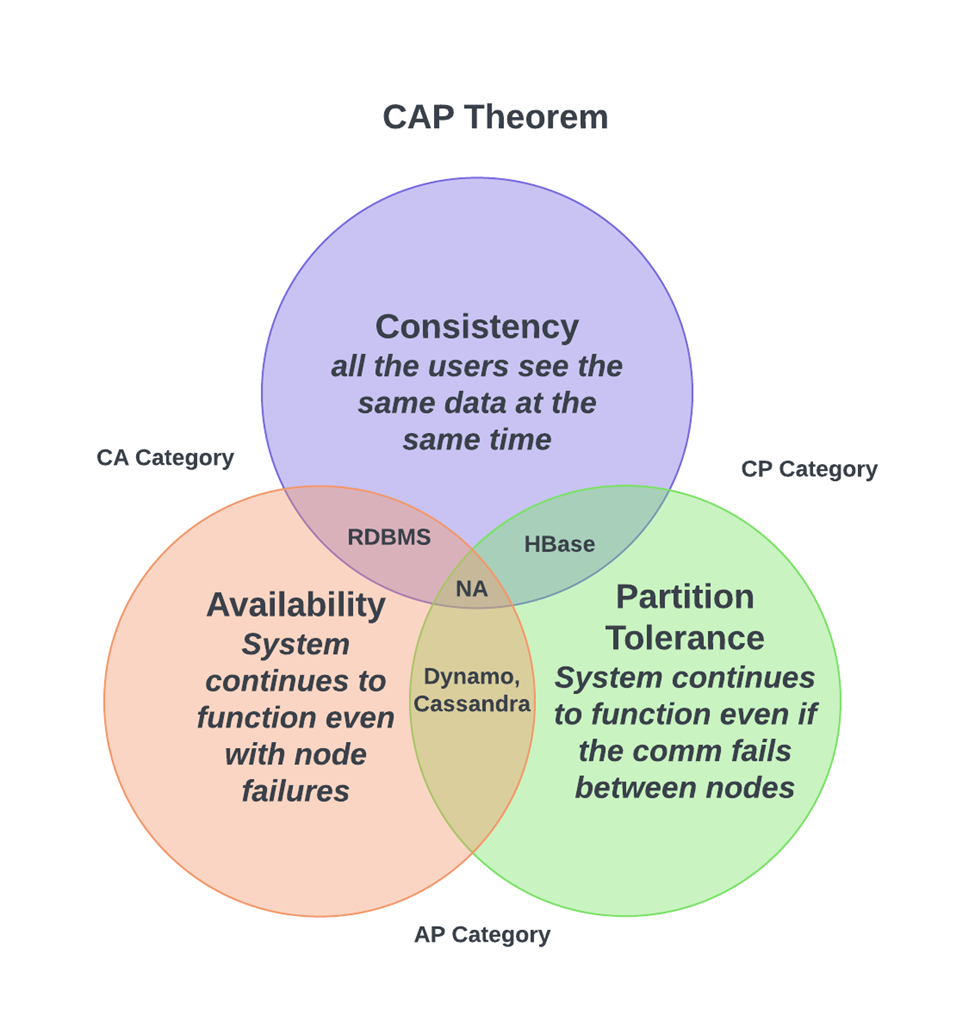
Consistency (C): This means that all clients connected to the database cluster see the same data at the same time, no matter which node they connect to. When a write operation completes, any subsequent read operation from any node will return that new value. This is a very strong guarantee, often called linearizability.
-
Availability (A): This guarantees that every request receives a response, without fail. The system is always up and running, and it will always return some data. However, there's no guarantee that the response contains the most recently written data.
-
Partition Tolerance (P): This ensures the system continues to operate even if there is a "network partition." A partition happens when nodes in a distributed system lose the ability to communicate with each other due to network failure. The system doesn't grind to a halt; it keeps functioning despite this internal communication breakdown.
The theorem, first conjectured by Eric Brewer, states that a distributed data store can only provide two of these three guarantees simultaneously.
2. The Real-World Choice: P is a Given
The idea of "picking two out of three" is a bit misleading in practice. In any distributed system that communicates over a network (which is virtually all modern systems), network failures are not a possibility; they are a certainty.
This means you don't really have a choice about Partition Tolerance. A system that is not partition-tolerant will fail entirely if there's a communication glitch between its nodes. Therefore, any serious distributed system must tolerate partitions.
Lesson 111 - CAP Theorem Illustrated
This clip from 'Software Architecture Monday' explains why Partition Tolerance isn't really optional. This is a key insight that simplifies the theorem's practical application.
Watch the segment from 01:19 to 02:17. Note the argument based on the 'Fallacies of Distributed Computing' about network reliability.
Since we must design for Partition Tolerance (P), the CAP theorem boils down to a more direct choice: In the event of a network partition, do you sacrifice Consistency or Availability?
This leads to two primary categories of systems:
- CP (Consistent and Partition-Tolerant): The system prioritizes consistency. If a partition occurs, it may become unavailable to some clients to avoid returning stale or incorrect data.
- AP (Available and Partition-Tolerant): The system prioritizes availability. During a partition, all nodes remain available for reads and writes, even if it means some data might be stale.
3. CP vs. AP: Concrete Examples and Use Cases
Understanding the trade-off is easiest with examples. The choice between CP and AP depends entirely on the business requirements of your application.
Let's return to the 'CAP Theorem Simplified' video, which provides excellent, intuitive examples of this trade-off in action.
Watch the sections explaining the banking ATM example (01:23 - 02:48) and the social media example (02:48 - 03:29). Contrast why one system chooses consistency while the other chooses availability.
Let's analyze these scenarios:
-
CP (Banking System): If two ATMs can't communicate due to a partition, the system must choose consistency. It's better to make one ATM unavailable for withdrawals than to allow a customer to withdraw the same money twice, resulting in a negative balance. The system returns an error (becomes unavailable) to preserve its integrity.
-
AP (Social Media): If a user in Europe can't see a comment just posted by a user in the US because of a partition, that's usually acceptable. It's better for the platform to remain available and show slightly out-of-date content than to show an error page. The data will become consistent eventually—a model known as eventual consistency.
To broaden your understanding, let's explore more use cases.
CAP Theorem for System Design Interviews
This article, 'CAP Theorem for System Design Interviews,' provides clear, practical lists of scenarios for prioritizing either consistency or availability.
Read the sections 'When to Choose Consistency' and 'When to Choose Availability'. Think about the potential consequences of stale data in each example.
Test your understanding!
You are designing two different features:
- An inventory management system for an e-commerce site.
- A user activity feed that shows recent actions (e.g., "User X liked a product").
During a network partition, which property (Consistency or Availability) would you prioritize for each feature, and why?
Show answer
-
Inventory Management System (Choose CP): You must prioritize Consistency. If the system is not consistent during a partition, you could sell the same last item to two different customers, leading to an oversold state. It is better to make the checkout process unavailable or show an error than to sell an item you don't have.
-
User Activity Feed (Choose AP): You should prioritize Availability. If the feed is temporarily inconsistent and a user doesn't see the absolute latest activity for a few seconds or minutes, the impact is minimal. It is far better for the user experience to keep the feed accessible and showing slightly stale data than to have it fail to load entirely.
4. Architectural and Technological Implications
Your choice between CP and AP has a profound impact on your system's architecture and the technologies you choose.
CAP Theorem for System Design Interviews
Let's continue with the same article, which does a great job of connecting the CAP choice to concrete design decisions.
Read the section 'CAP Theorem in System Design Interviews'. Pay close attention to the different design patterns and technology choices associated with prioritizing consistency versus availability.
Here is a summary of the implications for your design:
| If you prioritize... | Your design might include... | Technology choices might lean towards... |
|---|---|---|
| Consistency (CP) | Single master databases, distributed transactions (e.g., two-phase commit), synchronous replication. | Traditional RDBMS like PostgreSQL, MySQL; NewSQL like Google Spanner; or NoSQL in strong consistency mode (e.g., DynamoDB). |
| Availability (AP) | Multiple read replicas, asynchronous replication, eventual consistency models, conflict resolution logic. | NoSQL databases like Cassandra, Riak; or systems in multi-region configurations (e.g., DynamoDB, Redis). |
As a full-stack developer familiar with SQL and NoSQL, you can see how this theorem formalizes the fundamental differences you've likely experienced. Traditional relational databases were often designed as single-node systems, making consistency straightforward. Many modern NoSQL databases were built from the ground up to be distributed and highly available, thus embracing the AP model.
5. Beyond CAP: The Latency vs. Consistency Tradeoff
The CAP theorem is a powerful mental model, but it's focused on what happens during a failure (a partition). What about during normal operation? This is where the discussion gets more nuanced and moves closer to the cutting edge of system design.
In a replicated system (which is required for high availability), every write must be propagated to multiple nodes. This propagation takes time. This creates a new trade-off, one that exists even when the network is perfectly healthy: the trade-off between Latency and Consistency.
- To ensure strong consistency, a write operation might have to wait for acknowledgment from multiple replicas before it can return a success message to the client. This increases latency.
- To ensure low latency, a write operation might return success as soon as the data is written to one node, with replication happening asynchronously in the background. This risks a subsequent read from another node returning stale data, thus reducing consistency.
Dr. Daniel Abadi extended the CAP theorem with this idea to create the PACELC theorem.
Consistency Tradeoffs in Modern Distributed Database System Design
The following paper is a foundational text in modern database theory. It introduces the PACELC theorem, which provides a more complete framework for understanding these trade-offs. This is an advanced but crucial concept for an aspiring architect.
This is a more academic resource. Focus on the core ideas: Read the introduction ('CAP IS FOR FAILURES') to understand the critique that CAP only applies during rare partition events. Read 'CONSISTENCY/LATENCY TRADEOFF' to grasp why replication forces a choice between latency and consistency during normal operation. Finally, read 'PACELC' to see the unified theorem. Don't worry about understanding every detail of every database mentioned; focus on the high-level framework.
The PACELC theorem states:
If there is a Partition, the system must trade off Availability and Consistency.
Else (during normal operation), the system must trade off Latency and Consistency.
This framework gives you a much more complete lens for analyzing databases. For example:
- DynamoDB is often classified as PA/EL: It prioritizes Availability during a partition and low Latency during normal operation (at the cost of strong consistency by default).
- A traditional ACID RDBMS is PC/EC: It prioritizes Consistency during a partition (by becoming unavailable) and Consistency during normal operation (by accepting higher latency to ensure writes are durable and consistent).
Conclusion
Today, you've unpacked one of the most important principles in distributed systems design. This isn't just an abstract theorem; it's a practical tool that forces critical conversations about what a system should do under stress.
Key Takeaways:
- The CAP Theorem states that a distributed system can only guarantee two of three properties: Consistency, Availability, and Partition Tolerance.
- In practice, Partition Tolerance (P) is mandatory, so the real choice is between Consistency (CP) and Availability (AP) when a partition occurs.
- The choice is dictated by business needs: financial systems choose CP, while many user-facing web services choose AP. This decision has direct architectural and technological implications.
- The more advanced PACELC theorem extends CAP by acknowledging the ever-present trade-off between Latency (L) and Consistency (C) during normal operation.
Preview of the Next Lesson:
This lesson provides the perfect foundation for our next topic: "Compare SQL vs. NoSQL database models from an architectural perspective." We will see how different database systems are living embodiments of the CAP and PACELC trade-offs you learned about today, and we'll analyze how their design choices regarding schema, scalability, and consistency models stem from these fundamental principles.