Hello! Welcome to the final lesson in our module on SOLID design principles.
In our previous lessons, we've built a solid foundation. We started with SRP and OCP, learning to create focused classes and design for extension. Then, with LSP and ISP, we dove into crafting correct abstractions and lean, role-based interfaces. You've learned what makes a good abstraction; now it's time to learn how to use those abstractions to structure your entire application.
This lesson tackles the fifth and final SOLID principle: the Dependency Inversion Principle (DIP). This is arguably the most impactful principle for achieving a flexible, loosely-coupled architecture. We'll explore how it fundamentally changes the way we think about dependencies between our code modules.
By the end of this lesson, you will be able to explain the Dependency Inversion Principle and refactor code to use Dependency Injection, the primary technique for implementing it.
Distinguishing DIP from DI
First, let's clarify two terms that are often confused but are distinct:
- Dependency Inversion Principle (DIP): This is the high-level design principle. It states that high-level modules should not depend on low-level modules; both should depend on abstractions. We'll unpack this shortly.
- Dependency Injection (DI): This is a specific design pattern or technique. It's the process of providing a component with its dependencies from an external source, rather than having the component create them itself. DI is the most common way to achieve Dependency Inversion.
Think of it this way: DIP is the goal (decoupling), and DI is the mechanism to get there.
1. The Problem: Tight Coupling and Its Consequences
In a traditional, layered architecture, it's common to see high-level modules (which contain your core business logic) directly depending on low-level modules (which handle implementation details like database access, network calls, or logging).
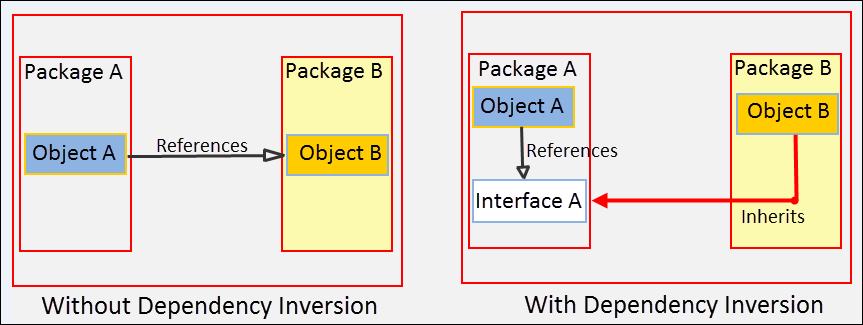
This tight coupling creates several problems:
- Rigidity: Changing a low-level detail (e.g., swapping a MySQL database for PostgreSQL, or changing an SMS provider) forces you to modify the high-level business logic that depends on it. This violates the Open/Closed Principle.
- Fragility: Changes in low-level modules can have unexpected, cascading effects on high-level ones.
- Poor Testability: It's very difficult to test a high-level module in isolation if it's responsible for creating its own low-level dependencies. You can't easily swap in a mock or fake object for a test.
Let's see a concrete example of this problem.
Dependency INVERSION vs Dependency INJECTION in Python
The following video from ArjanCodes presents a clear, code-driven scenario. It starts with a PaymentProcessor that is tightly coupled to an SMSAuthorizer. Pay close attention to why this makes testing so difficult.
Watch from the beginning to 06:40. Dependencies and Coupling (00:14 - 01:09): The video begins by defining what a dependency is in OOP, which sets the stage. The Problematic Code (01:57 - 06:40): Focus on the PaymentProcessor class. Notice that it creates its own SMSAuthorizer instance inside the pay method. Then, observe the 'Tests' section where the author explains why testing this pay method is so difficult.
As you saw, the PaymentProcessor's responsibility is to handle payments (high-level logic), but it's also responsible for creating the SMSAuthorizer (a low-level detail). This coupling makes it nearly impossible to test the payment logic without also running the real authorization logic, which requires user input.
2. Dependency Injection: The Mechanism for Decoupling
The first step to solving this is to apply the Dependency Injection pattern. Instead of letting the PaymentProcessor create its own dependency, we will "inject" it from the outside.
There are several ways to do this, but the most common is Constructor Injection, where dependencies are provided through the class constructor.
Let's continue with the same video to see how this simple change dramatically improves the code.
Dependency INVERSION vs Dependency INJECTION in Python
Now, watch how the author refactors the code to use Dependency Injection and see the immediate benefit it brings to testability.
Watch from 06:40 to 11:22. First, the video briefly defines Dependency Injection as an Inversion of Control technique (01:09 - 01:33). Then, observe the refactoring (06:40 onwards). The SMSAuthorizer is no longer created inside the pay method. Instead, it's passed into the PaymentProcessor's constructor and stored as an instance variable. Pay close attention to how this enables writing clean, effective unit tests for both the success and failure cases of the payment process.
By simply inverting the control of object creation, we've made our PaymentProcessor much more testable. We can now create a mock authorizer in our test setup, control its behavior (e.g., force it to succeed or fail), and inject it into the PaymentProcessor to verify its logic in isolation.
However, we are not done yet. Our PaymentProcessor is still dependent on the concrete SMSAuthorizer class. We have improved testability, but we haven't achieved true architectural decoupling. To do that, we need to apply the Dependency Inversion Principle.
3. The Dependency Inversion Principle: Inverting the Dependency Flow
Now we arrive at the core principle. As formulated by Robert C. Martin, DIP states:
A. High-level modules should not depend on low-level modules. Both should depend on abstractions (e.g., interfaces, abstract classes).
B. Abstractions should not depend on details. Details should depend on abstractions.
This means we need to introduce an abstraction that both our high-level PaymentProcessor and our low-level SMSAuthorizer will depend on. The PaymentProcessor will only know about the abstraction, and the SMSAuthorizer will be one possible implementation of that abstraction.
To fully grasp this from an architectural standpoint, let's explore what "high-level," "low-level," "abstractions," and "details" really mean.
Dependency Inversion: What, Why & How? | By Example
This video from the 'About Clean Code' channel provides a superb architectural perspective on DIP, connecting it directly to your goal of developing an 'architectural mindset'.
Watch from 00:56 to 05:32. Definitions (00:56 - 02:14): Get a clear understanding of high-level modules (business rules) vs. low-level modules (implementation details). The 'Why' (02:14 - 04:08): The video explains why it's a problem for your most valuable code (business logic) to depend on less relevant details like a specific database framework. Inverting the Dependency (04:08 - 05:32): See how the ownership of the contract (the interface) is shifted to the high-level module.
The key insight here is that your core business logic should define the contracts (interfaces) it needs, and the implementation details (like databases, UI frameworks, or payment gateways) should conform to those contracts.
Let's see this final refactoring step in our code example.
Dependency INVERSION vs Dependency INJECTION in Python
Continuing with the ArjanCodes example, watch how an abstraction is introduced to fully satisfy the Dependency Inversion Principle.
Watch from 11:22 to 14:30. Also, re-watch the definition of DIP from 01:33 - 01:57. The author introduces an abstract Authorizer class. This is the abstraction. The PaymentProcessor is changed to depend on this abstract Authorizer, not the concrete SMSAuthorizer. The SMSAuthorizer is changed to implement this abstract class.

4. The Payoff: A Truly Flexible and Extensible System
What have we gained from all this? By making our high-level module depend on an abstraction, we have created a "pluggable" architecture. We can now create new implementations of our abstraction and plug them in without ever modifying the high-level module. This perfectly adheres to the Open/Closed Principle.
Let's see the final payoff in our running example.
Dependency INVERSION vs Dependency INJECTION in Python
This final clip demonstrates the power and flexibility of the new design by adding a completely new feature without changing any existing business logic.
Watch from 14:20 to 17:13. The author adds a new RobotAuthorizer class. Notice that the PaymentProcessor class does not need to be changed at all. The new functionality is simply 'plugged in' where the application is composed together.
This is the essence of a well-designed, decoupled system. Your core business logic is stable and protected from changes in implementation details. You can swap out databases, payment providers, or notification systems just by providing a different concrete implementation of the required interface.
Test your understanding!
You are building a ReportGenerator service for your company. Your first version looks like this (in pseudocode):
class PdfExporter {
  export(data) {
    // Logic to create a PDF file
    print("Exporting data to PDF...");
  }
}

class ReportGenerator {
  private pdfExporter;

  constructor() {
    this.pdfExporter = new PdfExporter(); // Direct dependency creation
  }

  generateMonthlyReport(reportData) {
    // ... complex business logic to generate data ...
    this.pdfExporter.export(reportData);
  }
}
- Why does this design violate the Dependency Inversion Principle?
- How would you refactor this using an interface (
IReportExporter) and Dependency Injection to comply with DIP? - What is the main benefit of your refactored design if, next month, you are asked to add functionality to export reports as CSV files?
Show answer
-
It violates DIP because the high-level module (
ReportGenerator) depends directly on a low-level, concrete implementation (PdfExporter). The business logic is tightly coupled to the detail of how the report is exported. -
You would refactor it as follows:
- Define an abstraction: Create an
IReportExporterinterface with anexport(data)method. This interface is "owned" by the high-level logic.
interface IReportExporter { export(data); }- Implement the detail: Make
PdfExporterimplement this interface.
class PdfExporter implements IReportExporter { export(data) { print("Exporting data to PDF..."); } }- Inject the dependency: Modify
ReportGeneratorto depend on the interface and receive the concrete object via its constructor.
class ReportGenerator { private reportExporter; // Depends on the abstraction! constructor(exporter: IReportExporter) { // Dependency is injected this.reportExporter = exporter; } generateMonthlyReport(reportData) { // ... complex business logic ... this.reportExporter.export(reportData); } } - Define an abstraction: Create an
-
The main benefit is extensibility (Open/Closed Principle). To add CSV export functionality, you simply create a new
CsvExporterclass that implementsIReportExporter. You do not need to modify theReportGeneratorclass at all. At the application's entry point, you can now choose whether to inject aPdfExporteror aCsvExporterinto theReportGenerator.
Conclusion
Congratulations on completing the SOLID principles! The Dependency Inversion Principle is a fitting finale, as it leverages the other principles to achieve a truly robust and maintainable architecture. It's the key to building systems where business logic and implementation details are cleanly separated.
Key Takeaways:
- DIP is a Principle of Ownership: High-level modules should own the abstractions (interfaces) that define the services they need. Low-level modules then implement these abstractions.
- Dependency Direction is Inverted: Instead of high-level code depending on low-level code, both now depend on a shared abstraction, "inverting" the dependency arrow.
- DI is the Mechanism: Dependency Injection (especially constructor injection) is the pattern used to supply a high-level module with the concrete implementation of an interface it needs.
- The Benefits are Architectural: Applying DIP leads to a system that is highly decoupled, testable, flexible, and extensible, fulfilling the promise of the Open/Closed principle.
Preview of the Next Lesson:
With our understanding of SOLID complete, we'll move on to another fundamental concept in object-oriented design: Composition over Inheritance. You will see how the principles you've just learned, especially DIP, make it far easier to build flexible systems by composing objects with different behaviors rather than locking them into rigid inheritance trees.