Hello! Welcome to the first lesson of your software engineering course.
Given your goal to develop an "architectural mindset," we're starting with the most fundamental tool for evaluating and comparing different software solutions: performance analysis. Before you can decide which architectural pattern or algorithm is best, you need a common, objective language to describe how they perform. This lesson is all about learning that language.
Today, we will focus on Asymptotic Notations. By the end of this lesson, you will be able to define and use Big-O, Big-Theta, and Big-Omega notations to classify an algorithm's performance based on its growth rate. This is the first step in moving from thinking about "how to code it" to "what are the trade-offs of this approach."
1. Why Do We Need a Special Notation?
Imagine you have two different algorithms to solve the same problem. How do you decide which one is "better"?
You could run them both on your machine and time them. However, this approach has problems:
- The results depend on your specific hardware (CPU, RAM).
- The programming language, compiler, and even the operating system can affect the speed.
- The results might change for small inputs versus very large inputs.
To make objective comparisons, we need to analyze performance in a way that is independent of the environment. We do this by counting the number of fundamental operations an algorithm performs as its input size, which we'll call n, grows. Asymptotic analysis focuses on how the runtime or memory usage scales for very large values of n. This gives us a high-level understanding of an algorithm's efficiency and scalability.
The three notations we will learn—Big-O, Big-Omega, and Big-Theta—are the tools we use for this analysis.
2. Big-O Notation: The Upper Bound
Big-O is the most common notation you'll encounter. It describes the upper bound on an algorithm's growth rate. In simple terms, it tells us that the algorithm's performance will be no worse than a certain function, as the input size becomes large.
To build a strong intuition for this, let's start with a video that explains the concept visually.
Asymptotic Notations 101: Big O, Big Omega, & Theta (Asymptotic Analysis Bootcamp)
The following video from the Back To Back SWE channel provides an excellent visual and intuitive explanation of Big-O notation. It focuses on the core idea of finding a bounding function that always 'wins' or stays above the function representing our algorithm's actual work.
Watch the first 14 minutes and 56 seconds of the video (from 00:00 to 14:56). Focus on: What 'asymptotic' behavior means. The formal definition of Big-O involving the constants 'c' and 'n₀'. The visual demonstration of how choosing a constant 'c' allows a function like n or n² to act as an upper bound. The difference between a 'tight' and a 'loose' upper bound.
Key Concepts from the Video
As the video explains, the formal definition of Big-O is:
A function
f(n)isO(g(n))if there exist positive constantscandn₀such thatf(n) ≤ c * g(n)for alln ≥ n₀.
Let's break this down:
f(n): The function representing our algorithm's actual number of operations (e.g.,2n + 3).g(n): A simpler function representing a class of growth (e.g.,n,n²). This is what goes inside theO(...).c: A constant factor we can choose. This is our "secret weapon" that lets us scaleg(n)up to make sure it stays abovef(n).n₀: A point on the x-axis (input size). The upper bound rule only has to apply for allnafter this point. We don't care about small input sizes.
The Practical Shortcut
While the formal definition is important, in practice, you can find the Big-O of a polynomial function like f(n) = 4n² + 100n + 50 by following two simple rules:
- Drop lower-order terms: The term with the highest exponent grows fastest and will dominate all others as
nbecomes large. So,4n²is what matters. - Drop constant factors: The constant
cin the formal definition shows that we can ignore constant multipliers. So,4n²becomesn².
Therefore, the Big-O complexity of f(n) = 4n² + 100n + 50 is O(n²).
Test your understanding!
What is the Big-O complexity of the function f(n) = 10n³ + 500n² + 2000n + 9876? Is O(n⁴) also a correct (though not ideal) upper bound for this function?
Show answer
The tightest Big-O complexity is O(n³). We find this by taking the highest-order term (10n³) and dropping the constant (10).
Yes, O(n⁴) is also a technically correct upper bound. The definition of Big-O only requires f(n) to grow no faster than c * g(n). Since n³ grows more slowly than n⁴, it certainly satisfies the condition. However, this is a "loose" bound. In software engineering, we always aim to provide the "tightest" possible bound.
3. Big-Omega (Ω) and Big-Theta (Θ): Lower and Tight Bounds
While Big-O gives us an upper bound (it won't get worse than this), we also have notations for the lower and tight bounds.
- Big-Omega (Ω) describes the lower bound. It tells us an algorithm will perform no better than a certain growth rate.
- Big-Theta (Θ) describes a tight bound. This is the most precise classification, indicating that the algorithm's growth rate is bounded both from above and below by the same function family.
The next video provides clear, formal definitions for all three notations using a consistent example.
1.8.1 Asymptotic Notations Big Oh - Omega - Theta #1
This video from Abdul Bari gives a concise mathematical definition of Big-O, Big-Omega, and Big-Theta. It's a great complement to the previous video's intuition-based approach.
Watch the video from the Big-O definition up to the end of the Big-Theta definition (02:49 to 14:36). Pay attention to how the inequality sign changes for each notation and how Big-Theta combines the other two.
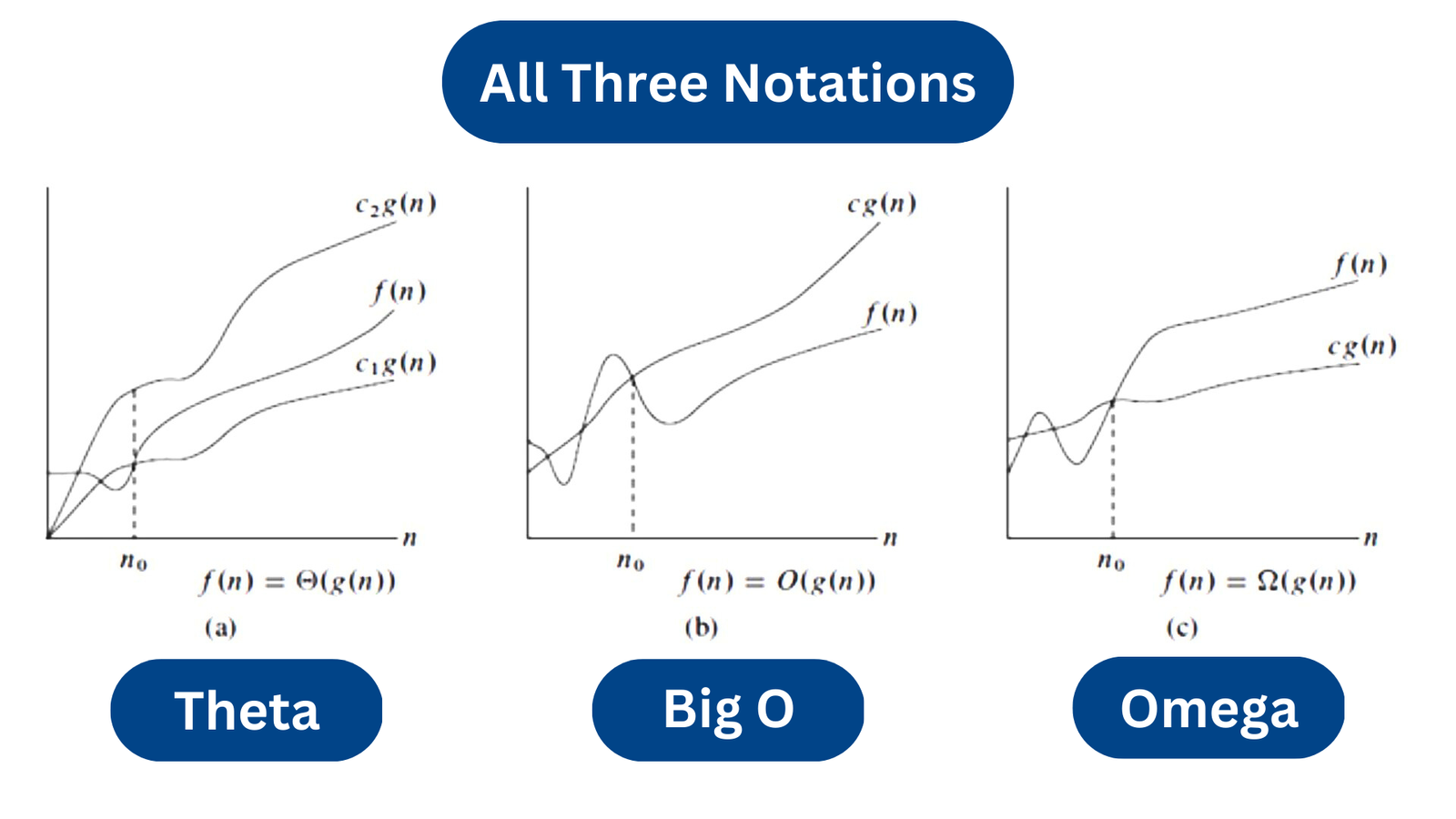
Let's summarize the definitions:
| Notation | Formal Definition | Intuition |
|---|---|---|
| Big-O | f(n) ≤ c * g(n) |
Upper Bound: f(n) grows no faster than g(n). |
| Big-Ω | f(n) ≥ c * g(n) |
Lower Bound: f(n) grows at least as fast as g(n). |
| Big-Θ | c₁ * g(n) ≤ f(n) ≤ c₂ * g(n) |
Tight Bound: f(n) grows at the same rate as g(n). |
For a function to be Θ(g(n)), it must be both O(g(n)) and Ω(g(n)).
A Crucial Clarification: Notations vs. Cases
A very common point of confusion is mixing up asymptotic notations with best/worst/average-case analysis.
- Cases (Best, Worst, Average): Refer to the performance on specific types of input. For a sorting algorithm, the "best case" might be an already-sorted array, and the "worst case" might be a reverse-sorted array.
- Notations (O, Ω, Θ): Are mathematical tools to describe the growth rate of a function.
You can use any notation to describe any case. For example:
- We can say the worst-case performance of an algorithm is
Θ(n²). (This is a tight bound on the worst case). - We can also say the best-case performance is
Θ(n).
This is an important distinction. Let's watch the final part of the Abdul Bari video where he addresses this directly.
1.8.1 Asymptotic Notations Big Oh - Omega - Theta #1
This short clip clarifies the common misconception that Big-O means 'worst case' and Big-Omega means 'best case'.
Watch from 14:36 to 15:47. Focus on the distinction between asymptotic notations and the analysis of algorithm cases (best, worst, average).
4. Common Classes of Complexity
Algorithms are often grouped into common complexity classes. Understanding this hierarchy is crucial for quickly assessing an algorithm's potential performance. Here they are, from most efficient (fastest growing) to least efficient:
O(1)- Constant: Runtime is independent of the input sizen.O(log n)- Logarithmic: Runtime grows very slowly. Typically seen in algorithms that divide the problem in half at each step.O(n)- Linear: Runtime grows directly proportional ton.O(n log n)- Linearithmic: A very common complexity for efficient sorting algorithms.O(n²)- Quadratic: Runtime grows with the square ofn. Often involves nested loops over the input.O(2ⁿ)- Exponential: Runtime doubles with each new element. Quickly becomes unusable for even smalln.O(n!)- Factorial: Runtime grows extremely fast. These algorithms are impractical for all but the tiniest input sizes.
To get a better sense of these, please read the following sections from the GeeksForGeeks article.
Big O Notation Tutorial - A Guide to Big O Analysis
The article 'Big O Notation Tutorial' provides clear examples and code snippets for the most common complexity classes. It also has a useful table comparing O, Ω, and Θ.
Please read two sections from this article. Start at the heading 'Common Big-O Notations' and read through the descriptions and code snippets for all 7 complexity types (Linear, Logarithmic, etc.). Next, review the table under the heading 'Comparison of Big O Notation, Big Ω (Omega) Notation, and Big θ (Theta) Notation'. Focus on associating each complexity class with the type of algorithm it represents (e.g., O(log n) with binary search, O(n²) with bubble sort).
Conclusion
In this lesson, we established the language for analyzing algorithm efficiency. This is a non-negotiable skill for making architectural decisions. When you choose a data structure or design a component, its underlying algorithmic complexity will directly impact your system's scalability and performance.
Key Takeaways:
- Asymptotic notations (
O,Ω,Θ) describe an algorithm's performance as the input sizengrows very large, independent of hardware or language. - Big-O (
O) provides an upper bound (no worse than). - Big-Omega (
Ω) provides a lower bound (no better than). - Big-Theta (
Θ) provides a tight bound (grows at the same rate). - In practice, we determine complexity by identifying the dominant term in the runtime function and ignoring constants.
- These notations are mathematical tools and are distinct from best/worst/average case analysis, although they are used to describe those cases.
In our next lesson, we will put this theory into practice. You will learn how to analyze the time complexity of both iterative and recursive algorithms, including using the powerful Master Theorem for divide-and-conquer style algorithms.