Hello! Welcome to the next lesson in our journey through conformal field theory.
In our previous session, we classified operators as relevant, irrelevant, or marginal. We established that irrelevant operators () have couplings that diminish as we flow to lower energies (the IR), making long-distance physics insensitive to them. This provides the mechanism for one of the most profound principles in physics: universality.
Today, we will formalize this idea. Our learning outcome is to describe the principle of universality classes and their classification by CFTs. We will connect the abstract picture of RG flows to the concrete observation that vastly different physical systems behave identically at their critical points, and we will see how CFTs provide the mathematical language to classify these behaviors.
The Phenomenon of Universality
At a critical point, such as water boiling or a ferromagnet losing its magnetism at the Curie temperature, physical systems exhibit fascinating scale-invariant behavior. A key experimental and theoretical finding is that the details of the microscopic interactions often don't matter. For example, the critical exponents that describe how quantities like magnetization or heat capacity diverge near the critical point are the same for a huge variety of ferromagnets, regardless of their specific chemical composition or lattice structure.
This leads to the concept of a universality class: a collection of many different microscopic physical systems that all share the same long-distance physics and the same critical exponents at their phase transition point. The main properties that determine the class are the dimensionality of space and the symmetries of the system's order parameter.
The Renormalization Group Explanation
The RG framework provides a beautiful explanation for this phenomenon. Recall that we can think of all possible physical theories as points in an infinite-dimensional "theory space," parameterized by all possible coupling constants. An RG flow is a trajectory in this space.
Let's watch a short video that visualizes this process.
Renormalization: Why Bigger is Simpler
This video from the channel Broken Symmetries provides an excellent visual analogy for RG flows in the space of theories. It will help us understand how different starting points can lead to the same outcome.
Please watch from 10:50 to 15:52. Focus on these key ideas: RG Flow: How repeated coarse-graining creates a 'flow' in the parameter space of the theory. Fixed Points: The tendency for these flow lines to converge on specific points or surfaces (the fixed points). Phase Transitions: How boundaries between regions flowing to different fixed points represent phase transitions.
As the video illustrates, the RG flow acts like a funnel. Many different microscopic theories, which correspond to different starting points in the theory space, are driven by the RG flow into the same IR fixed point. The set of all theories that flow to the same fixed point is precisely what defines a universality class.
The long-distance, universal properties of every theory in that class are described by the physics of the fixed point itself. Since irrelevant operators die out along the flow, they represent the microscopic details that are "forgotten" in the IR. The relevant operators, which must be fine-tuned to zero to even reach the fixed point, correspond to the parameters (like temperature) that control which phase the system is in.
Conformal Field Theories as the Classifiers
We have already established that the scale-invariant fixed points of the RG are described by Conformal Field Theories. This leads to the central idea of this lesson:
Universality classes are classified by Conformal Field Theories.
Each distinct IR fixed point corresponds to a unique CFT. Therefore, instead of studying the messy details of every possible microscopic model, we can classify and study the universal behaviors by studying the set of all possible (unitary, interacting) CFTs.
Let's read a short passage that formalizes this crucial link.
EPFL Lectures on Conformal Field Theory in D ⩾ 3 ...
In his lectures, Slava Rychkov succinctly states the connection between the critical point of the Ising model and the Wilson-Fisher fixed point, which is a CFT. This exemplifies the general principle.
Please read the two paragraphs at the end of section 1.1, starting with 'Consider next a theory from statistical mechanics, the Ising model...' and ending with '...the same as the one needed in to reach the Wilson-Fisher fixed point in the λφ⁴ theory.' Focus on the sentence that explicitly identifies the critical theory with the Wilson-Fisher fixed point and the definition of universality that follows.
The reading confirms that the critical theory of the Ising model is the CFT known as the Wilson-Fisher fixed point. This isn't just an analogy; it's an identity. The CFT contains all the universal information of the entire class.
What information defines a CFT?
- The spectrum of scaling dimensions for all primary operators.
- The set of OPE coefficients .
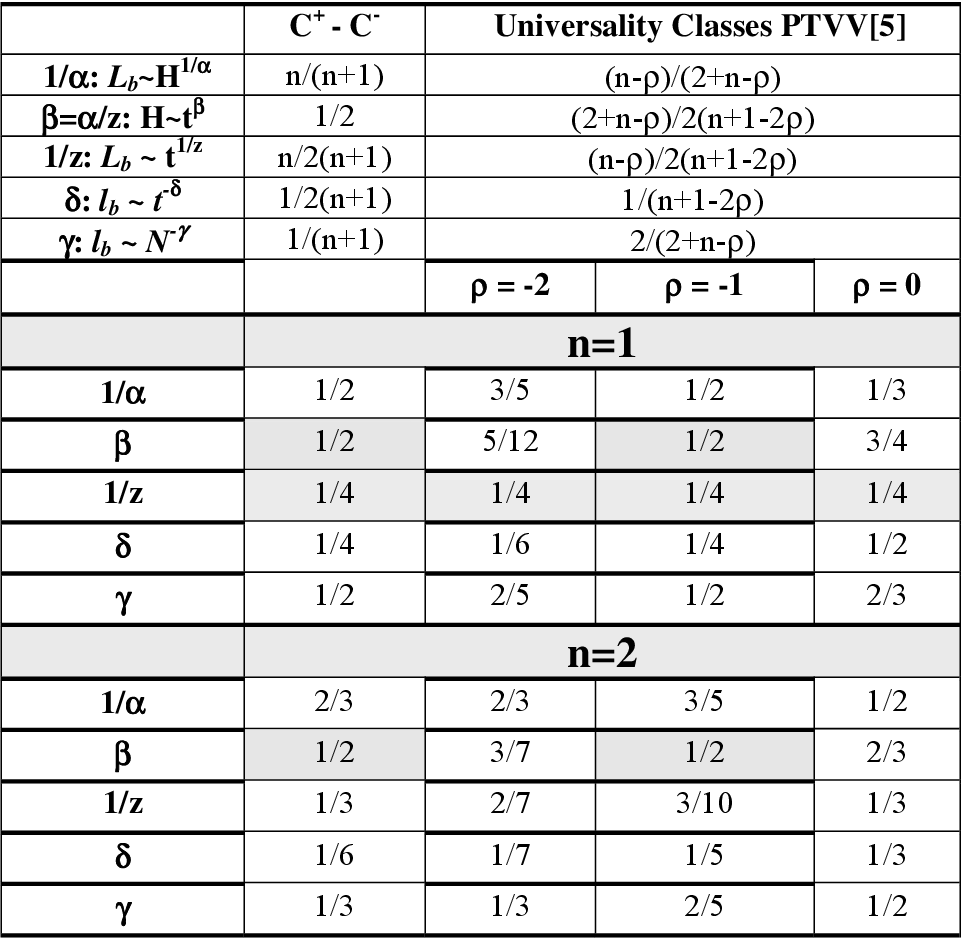
This collection of numbers, often called the "CFT data," is a unique fingerprint for a universality class. Different CFTs (with different data) describe different universality classes. For example, the critical exponents of a statistical system are directly related to the scaling dimensions of operators in the corresponding CFT.
Minimal Models: A Concrete Classification in 2D
The classification of all possible CFTs is a monumental task. However, in two dimensions, the situation is much more constrained due to the infinite-dimensional Virasoro algebra. This leads to a discrete, classifiable set of CFTs known as minimal models. These models are labeled by a single number, the central charge .
This provides an exceptionally clear example of how CFTs classify universality classes. Each allowed value of (for ) corresponds to a distinct universality class, with a unique set of operators and scaling dimensions.
Lectures on Conformal Field Theory
The following text from V.S. Dotsenko's lectures provides a direct link between the mathematical classification of 2D CFTs (the 'minimal models') and specific, well-known universality classes from statistical mechanics.
Read the section titled 'relation of the conformal theories selected above, with various statistical systems...', starting on page 139. Pay attention to how specific values of a parameter (related to the central charge c) are identified with the Ising model, the Z3 Potts model, and other series of statistical models. This demonstrates the classification principle in action.
As you read, for rational values of a parameter related to , the theory "closes" on a finite set of operators. These are the minimal models. For example:
- The theory with is identified with the Ising model universality class.
- The theory with is identified with the 3-state Potts model universality class.
- The theory with is identified with the tricritical Ising model universality class.
Each of these CFTs has a unique, calculable table of operator dimensions (the Kac table), which in turn predicts the critical exponents for any physical system in that class.
Test your understanding!
Suppose two experimental groups are studying second-order phase transitions.
- Group A is studying a thin-film magnetic material with a strong up/down spin anisotropy ( symmetry).
- Group B is studying the liquid-vapor critical point of a specific fluid in a 2D confinement.
Despite the completely different microscopic physics, they find that their measurements of critical exponents are identical. Using the concepts from this lesson, how would you explain this to them?
Show answer
The explanation lies in the principle of universality.
- Both systems, despite their different microscopic constituents (spins on a lattice vs. molecules in a fluid), belong to the same universality class. This is plausible because both are 2D systems and the order parameters for both transitions can be described by a simple scalar field, possessing a symmetry (spin up/down for the magnet, liquid/gas density fluctuation for the fluid).
- According to the Renormalization Group, both systems flow to the same IR fixed point when tuned to their respective critical temperatures/pressures.
- This fixed point is described by a unique Conformal Field Theory. In this case, it is the 2D Ising model CFT, characterized by central charge .
- The universal physical quantities they are measuring, such as critical exponents, are determined by the data of this underlying CFT (specifically, the scaling dimensions of its primary operators). Since both systems are described by the same CFT, their critical exponents must be identical.
In short, they are observing a universal behavior because the long-distance physics at criticality is governed by the properties of the CFT fixed point, which is insensitive to the microscopic details that distinguish the two systems.
Conclusion
Today we have bridged the gap between the formal machinery of the Renormalization Group and the experimental reality of universal critical phenomena.
Key Takeaways:
- A universality class is a set of microscopic systems that share identical long-distance physics at their critical points, characterized by universal critical exponents.
- The RG explains this phenomenon by demonstrating that the flows of all theories within a class converge to the same IR fixed point.
- These fixed points are described by Conformal Field Theories. Therefore, CFTs provide a powerful mathematical framework to classify universality classes.
- The "fingerprint" of a universality class is the data of its corresponding CFT: the central charge, the spectrum of operator dimensions , and the OPE coefficients .
In our next lesson, we will put this all together by performing a detailed analysis of our primary example: we will analyze the critical Ising model as a fixed point of the RG flow described by a specific 2D CFT, the minimal model. This will make the classification we've discussed today fully concrete.