Hello! Welcome to our next lesson.
In our last session, we took a crucial step into the quantum world of 2D conformal theories, discovering how the classical Witt algebra is centrally extended to become the Virasoro algebra. We derived its commutation relations:
We also explored the profound physical meaning of the central charge, .
With the fundamental symmetry algebra established, our next task is to study its representations. Your experience with the representation theory of the Poincaré group, where irreducible representations classify particles by mass and spin, provides a powerful parallel. Here, the irreducible representations of the Virasoro algebra will classify the states and operators of our conformal field theory.
Today, our goal is to construct Verma modules as highest-weight representations of the Virasoro algebra. This is a standard and powerful technique for building representations of Lie algebras, and it forms the bedrock for understanding the spectrum of any 2D CFT.
Highest-Weight Representations and Primary States
To build representations of the Virasoro algebra, we can classify the generators based on their action with respect to . Recall the commutation relation . This means that if we have an eigenstate of with eigenvalue , then is also an eigenstate with eigenvalue .
This suggests a natural interpretation:
- : This is the "energy" operator (in the context of radial quantization). Its eigenvalues, called conformal dimensions, label the states.
- for : These are annihilation or lowering operators, as they decrease the conformal dimension of a state.
- for : These are creation or raising operators, as they increase the conformal dimension.
A fundamental physical principle in any sensible quantum theory is that the energy spectrum must be bounded from below. This prevents the system from cascading down to infinitely negative energy states. In a CFT, this translates to the requirement that the spectrum of must be bounded from below.
This single physical requirement leads directly to the concept of a highest-weight state, which in the context of CFT is called a primary state. A primary state, which we'll denote , is a state that is annihilated by all the lowering operators. It is the state of lowest conformal dimension within a family.
Specifically, a primary state is defined by two conditions:
- It is an eigenstate of :
- It is annihilated by all with : for all .
The pair of numbers — the central charge and the primary's conformal dimension — will label the entire representation we are about to build.
Constructing the Verma Module
Once we have a primary state , we can generate an entire representation space by acting on it with the creation operators () in all possible ways. The resulting space is called a Verma module.
Minimal lectures on two-dimensional conformal field theory
The following text from 'Minimal lectures on two-dimensional conformal field theory' by Sylvain Ribault provides a precise and efficient definition of primary states and the construction of Verma modules.
Please read the latter half of section 2.2, 'Representations', starting from 'Let us consider an irreducible representation...' up to and including Definition 2.5 and the state diagram that follows. Focus on how the assumption of a lowest L₀ eigenvalue leads to the definition of a primary state, and how the Verma module is then constructed from this state.
As you've just read, the Verma module is defined as the vector space spanned by the primary state and all states created by acting on it with sequences of raising operators. These generated states are called descendants.
A state of the form is said to be at level , where . Its conformal dimension is .
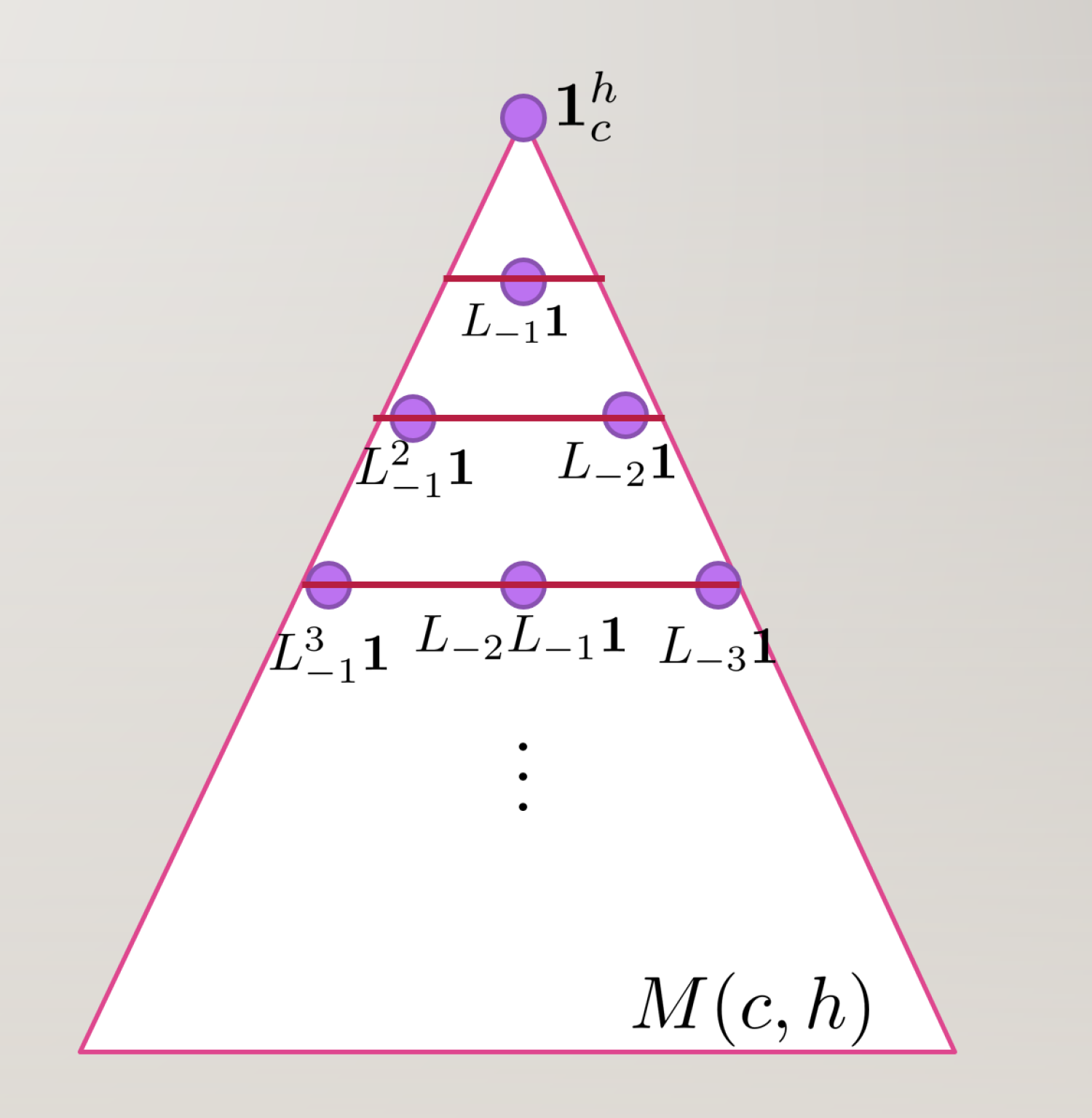
Let's visualize the structure of a Verma module level by level:
- Level 0 (N=0): The primary state itself.
- State:
- Dimension:
- Level 1 (N=1): Apply one creation operator.
- State:
- Dimension:
- Level 2 (N=2): Apply operators whose indices sum to 2.
- States: ,
- Dimension:
- Level 3 (N=3): Apply operators whose indices sum to 3.
- States: , ,
- Dimension:
And so on. The number of linearly independent states at level is given by , the number of ways to partition the integer . We use an ordering convention (e.g., with ) to define a basis, since the operators do not commute.
The image below provides a clear visualization of this hierarchical structure. Here, the highest-weight state is denoted by , where is another common notation for the conformal dimension .
Reducibility and Null Vectors
A crucial question for any representation is whether it is irreducible — that is, whether it contains any non-trivial subrepresentations. Is a Verma module always irreducible?
The answer is no. A Verma module is reducible if and only if it contains a null vector (also called a singular vector).
A null vector is a state that is:
- A descendant (i.e., at some level ).
- Also a primary state.
This means is a non-zero state in the module, not equal to , that is nonetheless annihilated by all with .
If such a state exists, then the set of all its descendants, , forms a proper submodule within the original Verma module. To obtain an irreducible representation, we must "quotient out" this submodule, effectively setting the null vector and all its descendants to zero.
The existence of a null vector is not generic; it only happens for very specific values of the central charge and the conformal dimension .
Minimal lectures on two-dimensional conformal field theory
The reading continues to explore this crucial question of when a Verma module is irreducible. It introduces the concept of a 'null vector' and shows how its existence leads to a reducible representation.
Now, read the first part of section 2.3, 'Null vectors and degenerate representations', up to equation (2.11). Pay close attention to the definition of a null vector and the explicit calculation to find a null vector at level N=1 and N=2. This demonstrates that reducibility is a special condition, not a generic feature.
As the reading shows, by explicitly checking the primary condition for a descendant state , we can derive algebraic conditions on and . Let's re-examine the simplest case, a potential null vector at level 1: .
For to be a primary state, it must be annihilated by all for .
- For , . Since , . The commutator is . So we have . Since , this is zero. So the condition is automatically satisfied for .
- For , we must check . For this to be zero, we must have . Assuming the primary state is not the zero vector, this implies .
So, a null vector exists at level 1 if and only if . This means the Verma module is always reducible. The primary state is typically identified with the CFT vacuum state, . The null state is . In a physical theory, we quotient by this submodule, which enforces the condition . Combined with and , this implies the vacuum is invariant under the full global conformal group.
Test your understanding!
Consider a generic level 2 descendant state , where is a constant. The conditions for this state to be a null vector are and (conditions for are automatically satisfied, try to see why!). The calculation in the text you read (Exercise 2.7) shows this leads to two equations:
Wait, this is incorrect. Let's recompute it using the method from the reading.
The correct calculation leads to:
This is still not quite right. Let's use the result from the reading directly:
From Exercise 2.7 in LINK, the conditions are:
Assume we have a unitary theory where and . If we set , do these equations have a non-trivial solution for ?
Show answer
If we set , the equations become:
From the second equation, since for a non-trivial unitary theory, we must have .
Plugging into the first equation gives , which implies .
This tells us that for , the null vector is not of the form with . Instead, the condition itself signifies the existence of a null vector at level 1, which we already found. The level 2 analysis is for finding a new null vector when one doesn't exist at level 1.
Conclusion
In this lesson, we established the fundamental building blocks for the spectrum of a 2D CFT. By imposing the physical requirement of an energy spectrum bounded from below, we were led directly to the construction of highest-weight representations of the Virasoro algebra.
Key Takeaways:
- Representations of the Virasoro algebra are organized as highest-weight representations, starting from a primary state .
- A primary state is defined by and for all .
- The Verma module is the space spanned by a primary state and all its descendants, which are created by acting with raising operators .
- Verma modules are generally, but not always, irreducible. They become reducible if they contain a null vector — a descendant that is also a primary.
- The existence of null vectors is a special condition that occurs only for specific values of .
We have seen that the question of irreducibility is central to understanding the structure of the representation. The existence of null vectors signals a simplification in the theory's structure. In our next lesson, we will delve deeper into this, introducing the Kac determinant formula, a powerful tool that tells us precisely when null vectors appear. This will be our key to classifying an important family of CFTs known as unitary minimal models.