Hello! Welcome back to our study of Superconformal Field Theory.
In our previous lesson, we established the quantum mechanical framework for global supersymmetry. We saw how supercharge operators $Q_\alpha$ extend the Poincaré algebra and how Wigner's classification method can be adapted to construct supermultiplets—the on-shell particle states of a supersymmetric theory.
Today, we take a significant step forward by combining supersymmetry with conformal symmetry, specifically in two dimensions. This is the foundation of Superstring Theory and a rich topic in its own right. Our objective is to construct the 2D N=1 superconformal algebra and understand its division into two fundamental sectors: the Neveu-Schwarz (NS) and Ramond (R) sectors.
We will move from the global symmetry generators $Q_\alpha$ to a local, position-dependent fermionic symmetry generator, the supercurrent $G(z)$. The algebra it forms with the stress-energy tensor $T(z)$ is the superconformal algebra, which, unlike its finite-dimensional 4D counterpart we will see later, is infinite-dimensional.
1. The Generators of 2D Superconformal Symmetry
In 2D CFT, the Virasoro algebra is generated by the holomorphic stress-energy tensor $T(z)$. This field has a conformal weight of $h=2$ and its modes $L_m$ generate conformal transformations.
To add supersymmetry to this picture, we introduce a new fermionic field, the supercurrent $G(z)$. This field is the generator of local supersymmetry transformations on the 2D worldsheet. For the algebra to close in a way that respects conformal symmetry, $G(z)$ must be a primary field of conformal weight $h=3/2$.
The $N=1$ superconformal algebra is the algebraic structure defined by the operator product expansions (OPEs) between $T(z)$ and $G(z)$.
THE CONFORMAL BOOTSTRAP AND SUPER W-...
The following text from a paper by J. F. Fortin, P. Mathieu, and S. Vinet provides a concise and mathematically precise definition of the N=1 superconformal algebra through its fundamental OPEs. This is the modern, axiomatic way to define the theory.
Please read the subsection 'N = 1 Superconformal Field Theory' at the beginning of Section 2 (page 5). Focus on the three OPEs given in equation (2.1).
The fundamental OPEs that define the algebra are:
Let's analyze these relations:
- The
$T(z)T(w)$OPE is simply the statement that$T(z)$generates the Virasoro algebra, with central charge$c$. - The
$T(z)G(w)$OPE confirms that$G(w)$transforms as a primary field of conformal weight$h=3/2$. - The
$G(z)G(w)$OPE is the most crucial new piece. It shows that the composition of two supersymmetry transformations is related to a conformal transformation, generated by$T(w)$. This is the 2D analogue of the$\{Q, \bar{Q}\} \sim P$relation from global SUSY, beautifully encoded in the operator algebra.
2. Neveu-Schwarz and Ramond Sectors
A key feature of the 2D superconformal algebra, which has profound consequences in string theory, is that it naturally splits into two distinct sectors. The physical origin of this split comes from the possible boundary conditions for worldsheet fermions.
Since you are interested in the physical motivations behind the mathematics, let's turn to the string theory context.
These lecture notes on 'Superconformal String Theory' by F. Ferrari provide an excellent physical explanation for the origin of the NS and R sectors. It traces them back to the boundary conditions imposed on the fermionic fields $\psi^\mu$ on the string worldsheet.
Please read Section 2.5, 'Dirac equation & boundary conditions' (pages 7-9). Pay attention to how requiring the boundary terms to vanish leads to two choices for fermions on a circle (closed string): periodic or anti-periodic. These are the Ramond and Neveu-Schwarz boundary conditions, respectively.
As the text explains, when a fermion field $\psi$ is defined on a cylinder (representing a closed string propagating in time), consistency requires that after one full rotation around the string, the field must return to either itself or its negative. This is because fermions are spinors, and a $2\pi$ rotation can introduce a minus sign.
This leads to two distinct possibilities for the mode expansion of the fermion field:
- Anti-periodic boundary conditions (
$\psi(\sigma+\pi) = -\psi(\sigma)$): This choice leads to a mode expansion with half-integer frequencies. This is the Neveu-Schwarz (NS) sector. - Periodic boundary conditions (
$\psi(\sigma+\pi) = \psi(\sigma)$): This choice leads to a mode expansion with integer frequencies. This is the Ramond (R) sector.
In the operator formalism, this distinction is captured by the monodromy of the supercurrent $G(z)$ around the origin:
- NS Sector:
$G(z)$is anti-periodic. Its Laurent series contains half-integer powers of$z$. - R Sector:
$G(z)$is periodic. Its Laurent series contains integer powers of$z$.
Physically, the NS sector of a superstring will describe spacetime bosons, while the R sector will describe spacetime fermions.
3. The Super-Virasoro Algebra
The final step is to translate the OPE algebra into an algebra of modes. This gives the super-Virasoro algebra. We define the modes of $T(z)$ and $G(z)$ via Laurent expansion:
The indexing of the $G_r$ modes depends on the sector:
- In the NS sector,
$r \in \mathbb{Z} + 1/2$(half-integers:$\dots, -3/2, -1/2, 1/2, 3/2, \dots$). - In the R sector,
$r \in \mathbb{Z}$(integers:$\dots, -1, 0, 1, \dots$).
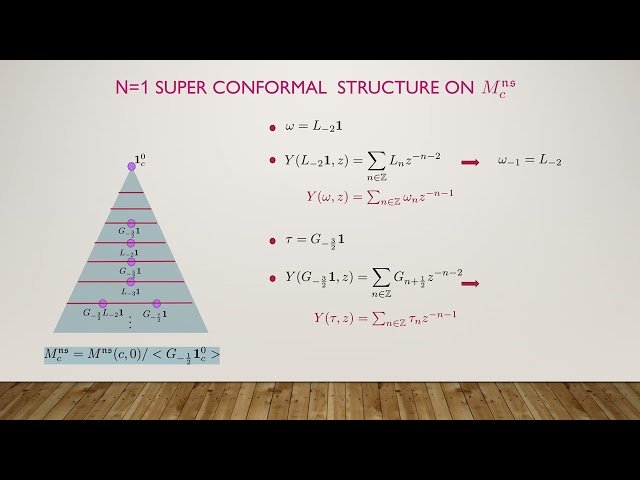
By computing the commutators and anti-commutators of these modes from the OPEs, we arrive at the super-Virasoro algebra.
THE CONFORMAL BOOTSTRAP AND SUPER W-...
Let's return to the paper 'THE CONFORMAL BOOTSTRAP AND SUPER W-...' to see the resulting mode algebra. It presents the commutators and anticommutators in a compact, unified form.
Please read the last part of the subsection 'N = 1 Superconformal Field Theory', focusing on equation (2.8) on page 6. Note how the same algebraic relations apply to both NS and R sectors, with the only difference being the set over which the mode indices r and s are summed.
The N=1 super-Virasoro algebra is given by:
Here, $m, n \in \mathbb{Z}$, while $r, s$ are either both in $\mathbb{Z} + 1/2$ (NS) or both in $\mathbb{Z}$ (R).
A few key points about this algebra:
- The
$[L,L]$commutator is the familiar Virasoro algebra. - The
$[L,G]$commutator confirms that$G_r$acts as a tensor operator under conformal transformations, shifting the "grade" of states. - The
$\{G,G\}$anti-commutator is the heart of the algebra. It shows that two super-generators combine to form a Virasoro generator. - Note the central extension terms, which are quantum anomalies. The specific form
$(r^2 - 1/4)$is chosen so that the subalgebra$\{L_0, L_{\pm 1}, G_{\pm 1/2}\}$in the NS sector is a closed, non-centrally extended Lie superalgebra called$osp(1|2)$. This is the super-analogue of the global$sl(2, \mathbb{C})$conformal algebra.
Test your understanding!
Consider the Ramond sector, where the mode indices $m, n$ for the supercurrent generator $G_r$ (often denoted $F_m$ in this context) are integers. The algebra includes the generator $F_0$ (using the $F_m$ notation for clarity in the R-sector).
What algebra does the $F_0$ operator satisfy by itself? What does this imply about the structure of the ground states in the Ramond sector?
Show answer
We use the super-Virasoro anti-commutator $\{F_m, F_n\} = 2L_{m+n} + \frac{c}{3}(m^2 - \frac{1}{4})\delta_{m+n,0}$ and set $m=n=0$:
The $\delta_{0,0}$ is 1, but the central charge term here is a subtle point. Conventions are often chosen to absorb this constant into a redefinition of $L_0$. The fundamental part of the relation is:
where $a$ is a constant related to the central charge (specifically $c/24$ in common conventions).
This relation $F_0^2 \propto L_0$ means that $F_0$ acts non-trivially on the ground states (the states with the lowest energy/$L_0$ eigenvalue). Since $F_0$ is a fermionic operator, it cannot be diagonalized in general. If $|0\rangle_R$ is a Ramond ground state, then $F_0|0\rangle_R$ is another ground state with the same $L_0$ eigenvalue, but with opposite fermion number. This implies that Ramond ground states must come in degenerate pairs, which can be combined to form a spinor under spacetime Lorentz transformations. This is the worldsheet reason why the Ramond sector describes spacetime fermions.
Conclusion
In this lesson, we have constructed the N=1 superconformal algebra in two dimensions, which is the symmetry algebra governing superconformal field theories like the one describing the superstring worldsheet.
Key Takeaways:
- The 2D N=1 superconformal algebra is generated by the stress-energy tensor
$T(z)$and a fermionic primary field of weight$h=3/2$, the supercurrent$G(z)$. - The algebra is fundamentally defined by the
$T-T$,$T-G$, and$G-G$OPEs. - The theory is naturally divided into two sectors based on the boundary conditions of the worldsheet fermions, which translates to the monodromy of the
$G(z)$operator:- Neveu-Schwarz (NS) Sector:
$G(z)$is anti-periodic, leading to half-integer modes ($G_r, r \in \mathbb{Z}+1/2$). This sector describes spacetime bosons. - Ramond (R) Sector:
$G(z)$is periodic, leading to integer modes ($G_r, r \in \mathbb{Z}$). This sector describes spacetime fermions.
- Neveu-Schwarz (NS) Sector:
- The mode algebra, known as the super-Virasoro algebra, is the same for both sectors, differing only in the indexing of the fermionic generators.
Next Lesson Preview:
Having explored the infinite-dimensional superconformal algebra in 2D, we will now turn our attention to higher dimensions. In the next lesson, we will construct the superconformal algebra in 4D for N=1 supersymmetry and identify its key subalgebras. This finite-dimensional algebra is of central importance for the AdS/CFT correspondence and the study of many interesting quantum field theories.