Hello! Welcome back to our course on conformal field theory.
In our last lesson, we established a foundational principle of supersymmetric theories: the BPS bound. We saw that unitarity—the requirement that all states have a non-negative norm—imposes a lower bound on the scaling dimension $\Delta$ of an operator in terms of its spin and R-charge, schematically $\Delta \ge f(j, R)$. When this bound is saturated, $\Delta = f(j, R)$, the representation "shortens" because some supercharges must annihilate the state, leading to null vectors in the Hilbert space.
Today, we will put this principle into practice. Our goal is to move from the abstract existence of these bounds to the concrete task of identifying BPS operators in simple SCFTs by applying these shortening conditions. We will learn that the statement $\Delta = f(j, R)$ is synonymous with the operator being annihilated by a specific set of supercharges. This property is the key to all the "magic" of BPS states, including their protection from quantum corrections, which makes them invaluable in the study of QFT and the AdS/CFT correspondence.
1. The Defining Trait of BPS Operators
The central idea is that an operator (or more precisely, the state it creates from the vacuum) is BPS if it is "smaller" than a generic state. In the language of supersymmetry, this means it is annihilated by some of the supersymmetry generators.
For a superconformal primary operator $\phi$, which by definition is annihilated by the superconformal generators $S$ and $\bar{S}$, the shortening condition simplifies. The saturation of the unitarity bound becomes equivalent to the primary state $|\phi\rangle$ being annihilated by some of the Poincaré supercharges $Q$ or $\bar{Q}$.
4. Non-renormalization theorems
This idea of 'protected' operators belonging to 'shorter' representations is central to the utility of supersymmetry. Let's begin with a concise introduction to this concept from a paper by Baggio, Niarchos, and Papadodimas on non-renormalization theorems.
Please read the first paragraph of the introduction to Chapter 4. It's very short. Focus on the key sentence: 'This comes about because there are special representations that are “shorter” than generic ones, where the highest-weight state is annihilated by some supercharges.' This is the cornerstone of our lesson today.
So, our task of identifying BPS operators becomes a search for operators that are annihilated by a subset of the supercharges. Different annihilation conditions lead to different types of BPS operators and different degrees of "shortening."
2. A Taxonomy of Shortening Conditions
The specific relationship between the quantum numbers $\Delta, j, R$ and the annihilation condition depends on the superconformal algebra in question. For 4D N=1 SCFTs, which we looked at last time, there is a standard classification of these conditions.
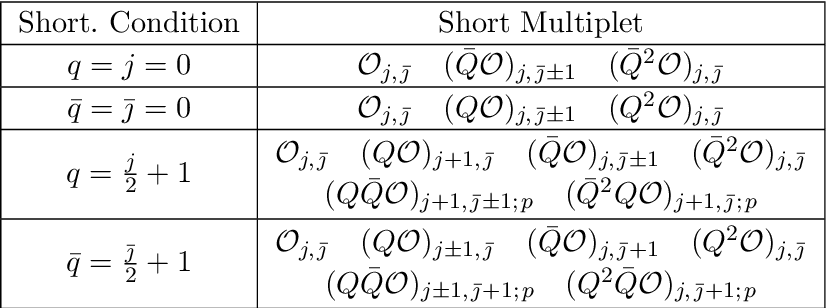
A similar, though more complex, classification exists for all SCFTs. Let's look at the N=2 case in 4D as presented in the resource "Lectures on the Superconformal Index".
Lectures on the Superconformal Index
To bring structure to this idea, let's examine a formal classification of shortening conditions for N=2 SCFTs. This will provide the rigorous framework you appreciate.
Please read the first part of section 2.3, 'Invariance under Recombination', focusing on the list of shortening conditions in equation (2.25). You don't need to worry about the recombination aspect yet. Just focus on the three types of conditions: A1, A2, B1. Notice how each one is a precise relation between the scaling dimension $\Delta$, spin $j_1$, and R-charge $r$, and each implies the existence of a 'Null state'.
This taxonomy gives us a concrete set of criteria. To check if an operator is BPS, we can check if its quantum numbers $\Delta, j_1, j_2, r$ satisfy one of these equations. If they do, we have identified a BPS operator of a specific type.
3. Concrete Examples of BPS Operators
Let's apply these ideas to identify some of the most important BPS operators that appear in the literature.
A. Chiral Primaries in 2D N=(2,2) SCFTs
A foundational example is the chiral primary operator in a 2D theory with N=(2,2) supersymmetry. This is a sub-algebra of the N=(4,4) case discussed in one of our resources.
-
A chiral primary operator
$\phi$is, by definition, an operator annihilated by the right-moving supercharges. In the standard notation with supercurrents$G$and$\bar{G}$for left- and right-movers:This annihilation condition is the shortening condition. It implies a BPS relation between the right-moving conformal weight
$\bar{h}$and theU(1)_Rcharge$\bar{q}$: -
Similarly, an anti-chiral primary operator
$\phi^\dagger$is annihilated by the left-moving supercharges,$G_{-1/2}^\pm \phi^\dagger = 0$, which implies$h = -\frac{1}{2}q$.
These operators are building blocks for many 2D models, including those relevant to string theory. The resource LINK explains how this terminology fits within the larger N=(4,4) algebra.
B. 1/2 BPS Operators in 4D N=4 SYM
This is perhaps the most famous class of BPS operators, central to the AdS/CFT correspondence. The theory is N=4 Super-Yang-Mills theory (SYM), which has an SU(4)_R R-symmetry group.
The 1/2 BPS operators are scalar superconformal primaries ($j_1 = j_2 = 0$).
- The shortening condition is a very simple relation between the scaling dimension
$\Delta$and theirSU(4)_Rrepresentation, which is labeled by an integer$k$(specifically, the Dynkin label[0, k, 0]): - This condition is equivalent to the operator being annihilated by half of the 16 Poincaré supercharges.
- The canonical examples are single-trace operators of the form
$\text{Tr}(\Phi^k)$, where$\Phi$is one of the six complex scalar fields of the theory. For instance,$\text{Tr}(\Phi_1^2)$is a 1/2 BPS operator with$k=2$and thus$\Delta=2$.
4. Non-renormalization theorems
The paper on non-renormalization theorems provides a precise description of these 1/2 BPS operators in N=4 SCFTs.
Please read section 4.4.1, 'Short representations'. Focus on how it defines the 1/2 BPS operators: their Dynkin labels [0, k, 0], their spin (0,0), and the crucial BPS condition $\Delta=k$. Also, note the important clarification that only the highest and lowest weight states of the multiplet are directly annihilated by supercharges.
4. Null Conditions for Multiplet Members
The last point from the reading is crucial. What about operators within a short multiplet that are not the highest or lowest weight state? They are not directly annihilated by a supercharge, yet they are still part of a BPS multiplet and must have special properties. These properties manifest as nullness conditions.
Starting from the annihilation of the highest weight state, e.g., $Q^+ |\phi_{h.w.}\rangle = 0$, we can act with R-symmetry lowering operators. Using the Jacobi identity and the algebra, we can derive relations that must hold for the other members of the multiplet. These relations typically take the form of a "null state condition," where a specific linear combination of descendants vanishes.
For example, a condition like:
means that the state $[G_{-1/2}^+, \phi_{n}] - c [G_{-1/2}^-, \phi_{n+1}]$ is a null state. This is a direct, computable consequence of the shortening condition and a powerful tool for constraining correlation functions.
4. Non-renormalization theorems
This concept of 'nullness conditions' is explained very clearly in the same paper. It's the practical, computational side of representation shortening.
First, read Section 4.1.4, 'Null vectors in short multiplets', to get the general idea behind equation (4.9). Then, see this in action in Section 4.3.1. Equation (4.23) is the explicit nullness condition for an intermediate state in an N=(4,4) multiplet. Finally, your mathematical curiosity will be satisfied by Appendix 4.A.3, which provides a rigorous, step-by-step derivation of these null conditions using the algebra. Please review the derivation for the 2D case, equation (4.80).
Test your understanding!
An operator in a 4D N=1 SCFT is a scalar ($j_1=j_2=0$) and has an R-charge $r = -2/3$. A calculation reveals its scaling dimension to be $\Delta = 1$.
- Does this operator belong to a short multiplet? If so, which one? (You may want to recall the bounds from last lesson, e.g., for a chiral primary
$\Delta = \frac{3}{2}|r|$). - What is the defining annihilation condition for this type of operator?
Show answer
-
Yes, it belongs to a short multiplet. We can check the condition for a chiral primary operator in
N=1SCFT, which is$\Delta = \frac{3}{2}|r|$. Plugging inr = -2/3, we get$\Delta = \frac{3}{2}|-2/3| = \frac{3}{2} \times \frac{2}{3} = 1$. This matches the operator's known scaling dimension. Therefore, this is a chiral primary operator. -
The defining property of a chiral primary operator
$\Phi$inN=1SCFT is that it is annihilated by the anti-chiral Poincaré supercharges$\bar{Q}_{\dot{\alpha}}$. So the annihilation condition is:This is the concrete operator statement that is equivalent to the numerical condition
$\Delta = 1, r = -2/3$.
Conclusion
Today we connected the abstract concept of BPS bounds to the practical task of identifying and characterizing BPS operators.
Key Takeaways:
- Annihilation as the Litmus Test: An operator is BPS if and only if it is annihilated by a subset of the supercharges. The specific annihilation condition defines the type of BPS operator.
- BPS Condition = Annihilation Condition: The numerical relation
$\Delta = f(j, R)$is the manifestation of an underlying operator equation like$\mathcal{Q}|\phi\rangle = 0$. - Famous Examples: We identified two key classes of BPS operators:
- Chiral Primaries (e.g., in 2D
N=(2,2)SCFTs), defined by annihilation by supercharges of one chirality, satisfying relations like$\bar{h} = \bar{q}/2$. - 1/2 BPS Operators (in 4D
N=4SYM), defined by satisfying$\Delta=k$and being annihilated by half the supercharges.
- Chiral Primaries (e.g., in 2D
- Nullness Conditions: Members of a BPS multiplet that are not highest/lowest weight states still satisfy powerful constraints called nullness conditions, which state that certain linear combinations of their descendants are null (zero).
Next Lesson Preview:
We've now established the operator-centric view of BPS states in both 2D and 4D. In our next lesson, we will dive deeper into a unique feature of 2D SCFTs called spectral flow. This is a fascinating automorphism of the superconformal algebra that acts like a symmetry, relating states with different quantum numbers and connecting the two fundamental sectors of the theory: the Neveu-Schwarz (NS) and Ramond (R) sectors. This will provide yet another powerful tool for analyzing the spectrum of 2D SCFTs.