Hello! This course builds toward understanding how a battery energy storage system (BESS) power plant controller manages power at the grid connection. We begin with the quantities a controller must measure and command. In this first module, you will establish what those quantities mean before calculating them or tracing them through the plant.
Today’s goal is to read a power triangle for a balanced three-phase system. By the end, you should be able to distinguish active, reactive, and apparent power; interpret power factor; and explain why a BESS can be delivering active power while also exchanging reactive power.
Three quantities at one measurement point
Imagine measuring a balanced three-phase AC connection: the three phases have equal magnitudes and the same relationship between voltage and current, with their waveforms spaced evenly in time. We can describe the total power at that connection with three quantities:
- Active power, , is the rate of net energy transfer. It is measured in watts (W), often megawatts (MW) for a BESS. Depending on operating direction, that energy may be leaving the battery system or entering it for charging.
- Reactive power, , describes energy exchanged back and forth with electric and magnetic fields in the AC system. It is measured in volt-amperes reactive (var), often MVAr. Its exchange affects current and voltage even though, ideally, it transfers no net energy over a cycle.
- Apparent power, , describes the combined electrical loading associated with and . Its magnitude is measured in volt-amperes (VA), often MVA. It matters when considering the current-carrying capacity of equipment.
For a balanced system, the total powers are the sums of the corresponding powers on all three phases. The triangle describes those three-phase totals, provided all three values refer to the same measurement point.
Watch the opening of 3-Phase Balanced Power Formulas by Zack Hartle for the balanced-system assumption and the triangle, then skip to its brief geometric recap. We will leave the voltage-and-current calculations in between for the next lesson.
3-Phase Balanced Power Formulas
Watch 3-Phase Balanced Power Formulas by Zack Hartle to see how balanced three-phase power is represented by one power triangle.
Watch the introduction for the meaning of “balanced,” the positions of the three powers, and the power-factor angle. Then skip to the triangle relation to see why the side lengths obey the Pythagorean theorem. We will return to the intervening three-phase voltage and current formulas next time.
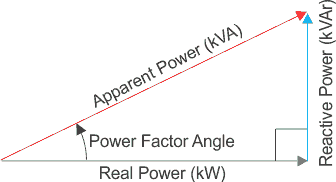
The sides are perpendicular because active and reactive power represent distinct components of AC power. Thus the magnitude of apparent power is not . It is
The angle between the horizontal side and the sloping side is the power-factor angle. For the positive-, positive- triangle pictured,
Power factor is dimensionless: it expresses how much of the apparent-power magnitude is active power. In this simple triangle it ranges from zero to one. At unity power factor, and . As the magnitude of increases while stays fixed, increases and power factor decreases.
For a point with either direction of active-power flow, the nonnegative power-factor magnitude is , as long as . If no apparent power is flowing, that ratio is undefined. A meter may report direction or sign separately, so a displayed power-factor number should not be treated as a complete description of the operating point.
Why the vertical side can point either way
The image draws upward, but that is not the only possible triangle. Reactive power has a direction: equipment can absorb it or supply it. To interpret an upward or downward vertical side, we must first state a sign convention.
Read the selected slides of K. Webb’s Section 2: Three-Phase Power Fundamentals. They distinguish reactive exchange from net energy transfer and show how the triangle represents both leading and lagging cases.
[PDF] SECTION 2: THREE-PHASE POWER FUNDAMENTALS
Read the selected slides from K. Webb’s Section 2: Three-Phase Power Fundamentals for the physical meaning of reactive power and the two possible directions of the power triangle.
In “Reactive & Complex Power,” read the Reactive Power slide numbered 36, from its description of the reactive component of instantaneous power through the final bullet about flow to and from load reactance; focus on the exchange. Then read the Complex Power slides numbered 38–39, beginning with the magnitude of complex power and ending with the power-factor ratio; focus on magnitude and ratio. You can pass over the phasor derivation on slide 37. In “Power Triangle,” read slide 45, then Lagging Power Factor on slide 47 and Leading Power Factor on slide 48. Start where the triangle is introduced and stop after the statement that the leading load supplies reactive power; compare the two directions. Slide 46 provides a short summary between them.
The reading’s leading and lagging descriptions use a load convention: positive power means power absorbed by a load. Under that convention, an inductive load has current lagging voltage and absorbs reactive power, so . A capacitive load has current leading voltage and supplies reactive power, so . Its triangle’s vertical side points downward. Either direction gives the same apparent-power magnitude when and are unchanged.
Sometimes complex power is written
Here marks the reactive component as perpendicular to the active component; it does not mean ordinary arithmetic addition. The apparent power used for the sloping side is the magnitude of .
For a BESS, be careful not to transfer the reading’s load sign labels directly to a plant meter. One meter might call power exported to the grid positive, while another uses positive for power absorbed. Reactive-power signs must likewise be defined for that interface. A power-factor magnitude alone cannot tell you the direction of either exchange. Later in this module, you will translate between explicit meter and inverter conventions.
Reading a BESS operating point
Suppose a balanced three-phase BESS connection has an active-power magnitude of and a reactive-power magnitude of . For now, set aside the signs and look at the triangle’s side lengths:
This says that the connection is operating at of apparent power, with of active-power magnitude. If the reactive exchange reversed direction but retained a magnitude of , the vertical side would reverse while and the power-factor magnitude would remain unchanged.
If instead reactive power fell to zero while active power stayed at , apparent power would be and power factor would be one. This is why reactive-power operation matters to a controller: at a given voltage, exchanging more reactive power generally requires more current and uses some of the electrical capacity available at that operating point. Actual BESS limits depend on its equipment and operating conditions, not solely on a triangle.
There is also an important boundary case. If while , the idealized connection is exchanging reactive power with power-factor magnitude zero. That does not mean “nothing is happening”: AC current still flows. Real equipment also has losses, which this idealized example sets aside.
Key takeaways
For a balanced three-phase connection, measures net energy transfer, measures reactive exchange, and is the magnitude of their combined apparent power. The power triangle gives and, when , a power-factor magnitude of . The triangle’s shape tells you magnitudes; interpreting flow direction requires an explicit sign convention.
Next, you will use line-to-line voltage, line current, and a specified power factor to calculate three-phase active and reactive power.