Welcome to the first lesson of your course on Creative Direction & Brand Strategy. Your strong background in design gives you an intuitive grasp of how aesthetic choices create a certain feeling or identity. This course is designed to connect that intuition to a formal strategic framework, helping you understand why certain brands resonate culturally and how to lead that process yourself.
In this foundational lesson, we will move beyond the tangible elements of a brand, like logos and products, to establish a much deeper, more powerful definition. Our goal is to define a brand as a complex system of meaning that encompasses its core values, the perception it creates in people's minds, and the promise it makes to its audience. Understanding this is the essential first step for any creative director aiming to build a brand with cultural impact.
1. Beyond the Logo: What Is a Brand?
In the world of design, it's easy to use "brand" and "visual identity" interchangeably. While a logo, color palette, and typography are critical expressions of a brand, they are not the brand itself. The brand is something much more intangible: it's the result of all these expressions.
To start, let's clear up some common misconceptions and establish a core definition.
What Is Branding? 4 Minute Crash Course.
The video "What Is Branding?" from The Futur offers a concise and powerful way to reframe our thinking. It's presented by Marty Neumeier, a leading author on brand strategy.
Please watch the first two segments. First, focus on what a brand isn't. Notice how it separates the brand from its tools (logo), its products, and even its marketing messages. Then, pay close attention to the core definition provided at A brand is a result. Neumeier defines a brand as a "customer's gut feeling" or a "reputation."
This idea of a brand as a "gut feeling" is crucial. It places the brand not within the company, but within the mind and heart of the audience. The company doesn't own the brand; it can only influence it. Your job as a creative director is to be the primary architect of that influence.
To build on this, let's look at a more formal definition that encapsulates this concept.
What is a Brand? Definition and Examples | Ramotion
This article from the Ramotion agency blog provides a clear and comprehensive definition that aligns perfectly with our learning goal.
Read the first three parts of the article: "Defining Brand," "What is a Brand?," and "What a Brand is Not." Focus on how the text describes a brand as a "collective perception," the "sum of your identity, values, promises," and most importantly, a "system of meaning."
2. The Pillars of Meaning: Values, Promise, and Perception
Now that we've established a brand is a system of meaning that lives in the consumer's mind, let's deconstruct that system into its three core pillars: values, promise, and perception.
One of the most influential academics in branding, Professor Kevin Lane Keller, provides a clear framework for understanding these concepts.
“Lessons in Building and Managing Strong Brands.” – Kevin Lane Keller of Dartmouth College
In this segment from his lecture, "Lessons in Building and Managing Strong Brands," Professor Keller breaks down the fundamental nature of a strong brand.
Watch the section from the key points. Pay attention to his three main points: A strong brand is a promise: It reduces risk and sets expectations. Think about what this means for a consumer choosing between a known fashion label and an unknown one. Power resides in minds and hearts: This reinforces the "gut feeling" idea, highlighting both rational (head) and emotional (heart) drivers of perception. Great products are at the heart: A brand's meaning cannot be faked; it must be built on a foundation of quality.
Let's organize these ideas:
- Values: These are the guiding principles of the brand—what it stands for. As the Ramotion article noted with its Patagonia example, values are not just marketing copy; they drive a company's behavior, from product development to its public stance on social issues.
- Promise: This is the specific value or benefit that a brand commits to delivering consistently. As Keller explains, this promise simplifies decision-making for customers and builds trust. A brand like Volvo promises safety; a brand like Nike promises inspiration and innovation for athletes.
- Perception: This is the "gut feeling" or reputation that results from the brand's actions, which are guided by its values and its promise. It is the sum total of every interaction and communication a person has with the brand.
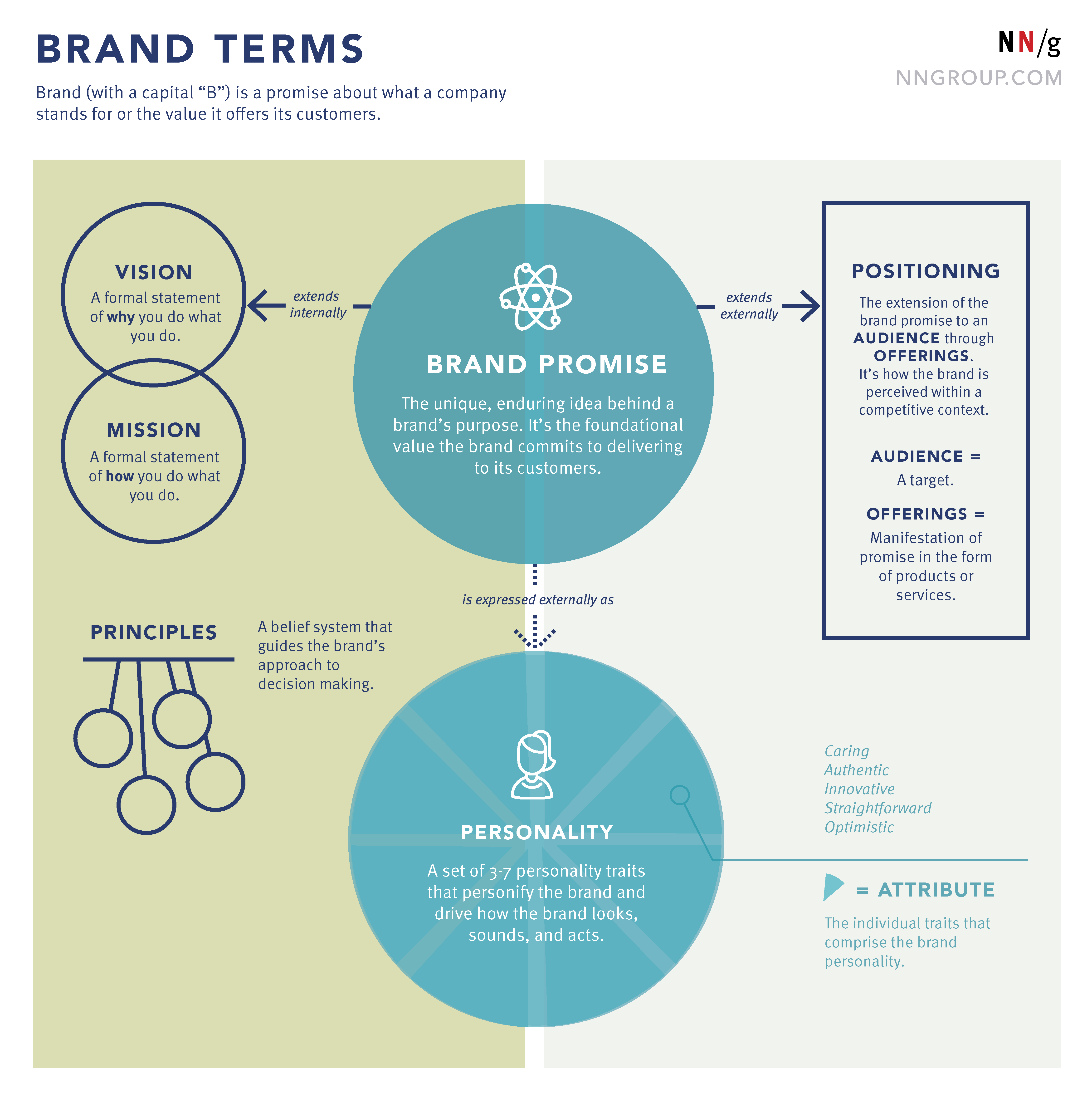
These elements are not separate; they are deeply interconnected. A brand's internal values inform the promise it makes, and the consistent delivery of that promise shapes the external perception.
This diagram helps visualize that flow:
3. Fashion as a System of Meaning
This might all feel a bit abstract. However, your background in fashion and textile design has already given you a deep, practical understanding of how systems of meaning work. Fashion itself is a language.
The academic field of semiotics is the study of signs and symbols and their use or interpretation. When applied to fashion, it reveals how every choice of clothing—from a uniform to a designer label—transmits social signals and creates meaning.
This Wikipedia article provides a concise introduction to the semiotics of fashion, which directly parallels the concept of a brand as a system of meaning.
Read the main body of the article. As you read, consider the following: How a police uniform or a doctor's lab coat functions as a "brand," with its own values (authority, sanitation), promise (security, care), and resulting perception. How designer labels communicate social status and value. The idea that meanings are not fixed but depend on cultural context and change over time (e.g., pants signifying masculinity).
Just as an outfit is a collection of signs (fabric, cut, color, brand) that communicates an identity, a brand is a collection of signs (logo, tone of voice, product design, store experience, advertising) that communicates a larger meaning. A creative director's role is to ensure all these signs are coherent and telling the same powerful story.
Conclusion
In this lesson, we established the strategic foundation for understanding brands. We moved past surface-level definitions to see a brand for what it truly is: a perception in the mind of the audience, carefully cultivated through a coherent system of meaning.
Here are the key takeaways:
- A brand is not a logo or product. It is the "gut feeling," reputation, and collective perception that your audience has about your company, product, or service.
- A brand is a system of meaning. This system is built upon three interconnected pillars:
- Values: What the brand believes in and stands for.
- Promise: The tangible and intangible benefits it consistently delivers.
- Perception: The resulting reputation that lives in the minds and hearts of consumers.
- Creative direction is the orchestration of this meaning. Your role is to ensure that every aspect of the brand, from its products to its communications, works in harmony to build the desired perception.
In our next lesson, we will build directly on this foundation. We will explore the relationship between a brand's internal strategic core (its purpose, vision, and mission) and how that translates into its market strategy (positioning) and creative expression (identity).