Hello! Welcome to your first lesson. We're kicking off your interview preparation by building a solid foundation in ARM architecture, which is at the heart of most modern embedded systems, especially in the automotive world.
This first lesson directly addresses a core topic for any low-level driver developer: understanding the hardware you're writing for. We'll focus on the ARM Cortex-M and Cortex-R processor families, which are the workhorses of the automotive industry. By the end of this lesson, you'll be able to describe their key differences and explain where each one fits within a vehicle's electronic architecture. This knowledge is not just crucial for your interviews but is the starting point for everything we'll cover later, from memory-mapped I/O and interrupts to RTOS concepts.
Let's begin.
1. The Three Faces of ARM Cortex
ARM licenses three main families of processor cores, each designed with a different primary goal in mind. These are the Cortex-A, Cortex-R, and Cortex-M series.

- Cortex-A (Application): These are the most powerful cores, designed to run rich operating systems like Linux or Android. In automotive, you'll find them powering In-Vehicle Infotainment (IVI) systems, digital cockpits, and the high-level "brain" of an ADAS system.
- Cortex-R (Real-time): These cores are optimized for high-performance, safety-critical systems that require determinism—meaning tasks must complete within a predictable, guaranteed timeframe.
- Cortex-M (Microcontroller): These are the smallest, most power-efficient cores, designed for a vast range of embedded control applications.
To get a quick overview of these distinctions, please watch the following short video clips.
Comparison of ARM Cortex A, Cortex R, and Cortex M: Key Differences Explained | ARM Processor
The video 'Comparison of ARM Cortex A, Cortex R, and Cortex M' from Engineering Funda provides a concise introduction to the design goals and key characteristics of each family.
Please watch the series overview from the beginning to about two and a half minutes in. Focus on how the video defines the primary purpose of each series (Advanced performance, Real-time, embedded/low-power).
While we will touch upon Cortex-A, this course will concentrate on Cortex-R and Cortex-M, as they are most relevant for the bare-metal and RTOS-based driver development roles you are targeting.
2. Core Differences: Performance, Determinism, and Safety
The choice between a Cortex-M and a Cortex-R core for an automotive ECU comes down to a trade-off between cost, power efficiency, real-time performance, and functional safety requirements.
To explore these trade-offs, let's look at a detailed comparison.
What are the Differences between ARM Cortex-A, Cortex-R ...
The article 'What are the Differences between ARM Cortex-A, Cortex-R...' provides an excellent, detailed breakdown of the architectural differences between the families.
Please read the comparison table at the top of the page, followed by the sections 'Detailed Explanation of Each Family' (read the family details, focusing on Cortex-R and Cortex-M) and 'When to choose which?' (review the selection guide). Pay close attention to the concepts of MPU, TCM, lock-step, and NVIC.
Based on that reading, let's break down the most critical differentiators for automotive driver development.
Real-time Determinism
In safety-critical systems, "fast" is not enough; you need "predictably fast." This is the core principle of determinism.
-
Cortex-M: Achieves excellent determinism for event-driven tasks through the Nested Vectored Interrupt Controller (NVIC). The NVIC is a standard, tightly integrated hardware block that provides very low and predictable interrupt latency. It can handle nested interrupts and prioritisation with minimal software overhead. We will dive deep into the NVIC in Module 3.
-
Cortex-R: Is designed for systems with continuous, hard real-time control loops (e.g., controlling an electric motor or a fuel injector). Its determinism comes from several features, but a key one is Tightly Coupled Memory (TCM). TCM is a small, dedicated block of SRAM that is connected directly to the processor core, bypassing caches. Placing critical code (like an ISR) and data in TCM guarantees single-cycle access with zero latency, eliminating the unpredictability of cache hits or misses.
The following video offers a great explanation of the practical difference in how Cortex-M and Cortex-R handle interrupts, which is a major factor in their real-time behavior.
Introduction to ARM: Cortex M CPUs | Embedded Systems podcast, in Pyjama!
This clip from the 'Introduction to ARM: Cortex M CPUs' podcast explains the architectural differences in interrupt handling, which is a key factor in determinism.
Starting about 26 and a half minutes in, watch the interrupt mechanisms. The speakers discuss how Cortex-M's integrated vectored interrupt controller provides more deterministic latency compared to the 'trap' mechanism often used with Cortex-R and -A cores.
Functional Safety (ISO 26262)
Your experience with ISO 26262 is highly relevant here. Cortex-R processors are specifically designed to meet high Automotive Safety Integrity Levels (ASIL), such as ASIL-D. They include hardware features to detect and mitigate random hardware faults.
A primary example is dual-core lock-step. In this configuration, two identical Cortex-R cores are paired together. They execute the exact same instruction stream in parallel, and comparison logic checks that their outputs match on every single clock cycle. If a mismatch occurs (e.g., due to a radiation-induced fault), the hardware immediately flags an error, allowing the system to enter a safe state.
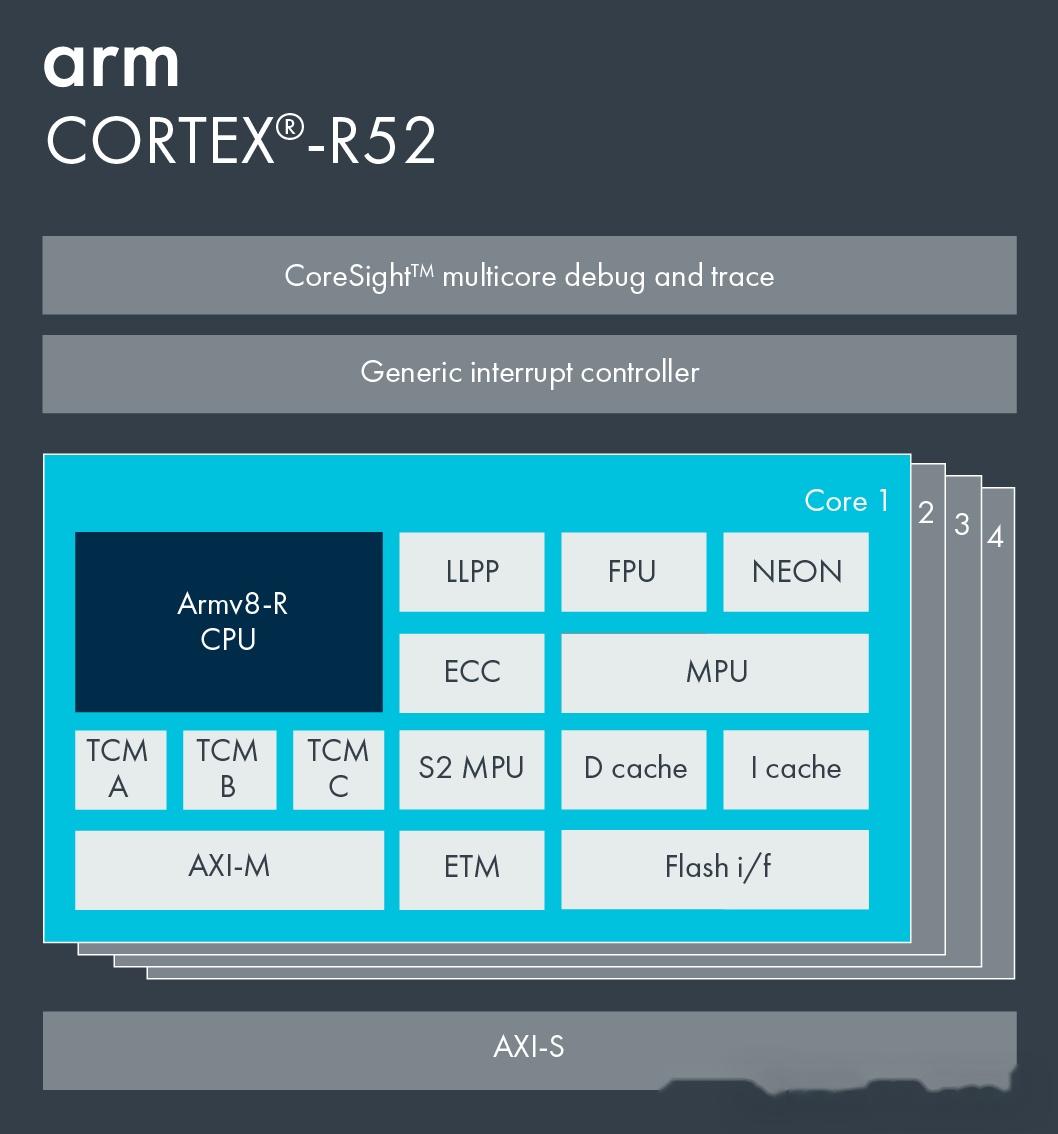
Cortex-M processors can also be used in safety-related applications, typically up to ASIL-B, but they generally lack the advanced hardware fault-detection mechanisms like lock-step found in the Cortex-R family.
Test your understanding!
You are designing the central ECU for a steer-by-wire system, which has an ASIL-D requirement. Your two main architectural options are a high-performance Cortex-M7 microcontroller or a mid-range Cortex-R5. Which one is the more appropriate choice, and what specific hardware features of that processor family justify your decision?
Show answer
The Cortex-R5 is the appropriate choice. While a Cortex-M7 is very powerful, the ASIL-D requirement points directly to the Cortex-R family. The key justifications are the hardware features designed for functional safety:
- Dual-core Lock-step: This is the most critical feature for meeting ASIL-D. It provides an immediate, hardware-level detection mechanism for random hardware faults, which is a core requirement of ISO 26262.
- Tightly Coupled Memory (TCM): Guarantees deterministic execution times for critical control loop and safety monitoring functions, which is essential for proving temporal safety.
- Error Correcting Code (ECC): Cortex-R cores typically have ECC on their caches and TCMs to detect and correct single-bit memory errors.
A Cortex-M7 lacks native lock-step capabilities and relies more on software-based diagnostics, making it extremely difficult (and costly) to certify for ASIL-D in such a critical application.
3. Cortex-R and Cortex-M in Automotive Systems
Now, let's map these processors to their typical homes inside a vehicle. Your experience in ADAS and gateway development provides a great frame of reference for this.
A Starter's Guide to Arm Processing Power in Automotive
This official guide from Arm, 'A Starter's Guide to Arm Processing Power in Automotive', provides a clear mapping of processor families to specific automotive domains.
Please read the introductory table and then the section 'Four Automotive Applications Designed with Arm Processing Power' (starting below the heading, read through the four applications). Focus on the roles of Cortex-R and Cortex-M in ADAS, Powertrain, and Body Electronics.
As the guide illustrates, the modern vehicle is a heterogeneous computing platform where each processor family plays a distinct role:
-
Powertrain & Chassis Control: These are classic Cortex-R domains. Engine control, transmission management, anti-lock braking systems (ABS), and electric power steering all involve high-speed, deterministic control loops and have stringent functional safety requirements (ASIL-C/D).
-
Body Electronics & Low-Level ECUs: This is the primary home for Cortex-M processors. They are used in the vast number of smaller, cost-sensitive ECUs that control things like windows, seats, mirrors, door locks, and climate control sensors. Their low power consumption is critical for functions that must remain active when the car is off ("key-off" state).
-
ADAS & Autonomous Driving: This domain uses a mix of all three families, often in a "Sense -> Perceive -> Decide -> Actuate" pipeline:
- Sense: Simple sensors like ultrasonic park-assist use Cortex-M. More complex sensors like radar and LIDAR often use Cortex-R for real-time signal processing.
- Perceive & Decide: The heavy lifting of sensor fusion, object recognition, and path planning is done on high-performance Cortex-A clusters.
- Actuate: When the decision is made to brake or steer, the command is sent to a Cortex-R based controller that can execute the action with guaranteed timing and safety monitoring. The Cortex-R often acts as a "safety island" or co-processor, validating commands from the Cortex-A complex before they are sent to physical actuators.
-
Gateways & Domain Controllers: Your experience with gateway development fits here. Central gateways often use Cortex-R processors to handle the deterministic routing of real-time CAN traffic, while also managing Ethernet communication.
4. Interview Corner
Here are some common questions related to this topic. Use what you've learned to formulate your answers.
-
"Can you compare the ARM Cortex-R and Cortex-M processor families? When would you choose one over the other in an automotive system?"
- Hint: Start by defining their primary goals (Real-time vs. Microcontroller). Contrast their key features: determinism (TCM vs. NVIC), functional safety (lock-step), and cost/power. Give clear examples: Cortex-R for powertrain/braking, Cortex-M for body control/sensors.
-
"What is Tightly Coupled Memory (TCM), and why is it a key feature of the Cortex-R family?"
- Hint: Define it as a fast, on-chip SRAM that bypasses the cache. Explain that its purpose is to provide deterministic, zero-latency access for critical code (ISRs, control loops) and data, eliminating the timing unpredictability of cache misses.
-
"You're tasked with developing the software for an airbag control unit. What processor architecture would you expect to find, and why?"
- Hint: The answer is Cortex-R. The "why" is the most important part: it requires hard real-time determinism to meet its deployment deadline and high functional safety (ASIL-D), which is supported by features like dual-core lock-step.
Conclusion
Excellent work on completing your first lesson. You've established a strong understanding of the foundational hardware landscape for automotive embedded systems.
Key Takeaways:
- The ARM Cortex family is split into three profiles: A for Application, R for Real-time, and M for Microcontroller.
- Cortex-M processors are optimized for low cost and low power. Their deterministic interrupt response, thanks to the NVIC, makes them ideal for event-driven tasks in body electronics and sensor nodes.
- Cortex-R processors are designed for hard real-time control and high functional safety (ASIL-D). Their key features include Tightly Coupled Memory (TCM) for deterministic code execution and dual-core lock-step for hardware fault detection.
- In automotive systems, Cortex-R is used for powertrain and chassis control, while Cortex-M is ubiquitous in body ECUs. Complex ADAS systems use a heterogeneous mix, with Cortex-A for perception, and Cortex-R for safe actuation.
Next Lesson Preview:
Now that we have a high-level view of the processor families, our next step is to zoom in on the core's internal architecture from a programmer's perspective. In the next lesson, we will explore the ARM register set, processor operating modes (Thread vs. Handler), and privilege levels (Privileged vs. Unprivileged). This is the essential groundwork for writing any C or assembly code for the processor.