Здравствуйте! Welcome to the fifth and final lesson of our module on French pronunciation.
So far, you have built a strong foundation. You've learned:
- The sounds of the French alphabet.
- How to pronounce core vowel sounds, especially the tricky nasal vowels.
- Which letters are typically silent at the end of words.
- How to connect words smoothly using liaison.
Today, we will put all these pieces together. Your goal for this lesson is to read simple French words and sentences aloud with the correct pronunciation. This is the capstone exercise for this module, where you'll transition from learning individual rules to applying them in a practical, integrated way.
1. Consolidating the Rules
Before we start reading, let's quickly organize the key pronunciation rules we've covered. The following video provides a fantastic 10-minute summary of the most important patterns you'll encounter when reading French. Many will be a review, but it also introduces a few new, very useful patterns for letters like 'c', 'g', and the 'qu' combination.
Master French Pronunciation in 10 minutes | 12 Key Rules
Watch this video, 'Master French Pronunciation in 10 minutes', to get a clear and concise overview of the 12 most essential reading rules. This will help systematize what you've learned.
Watch the entire video (about 9.5 minutes). Pay attention to how letters change their sound based on the letters around them, especially: S vs. SS (a 'z' sound vs. an 's' sound) C and G (hard vs. soft sounds) Vowel combinations like au, eau, oi, ou Silent final consonants and the silent -ent verb ending.
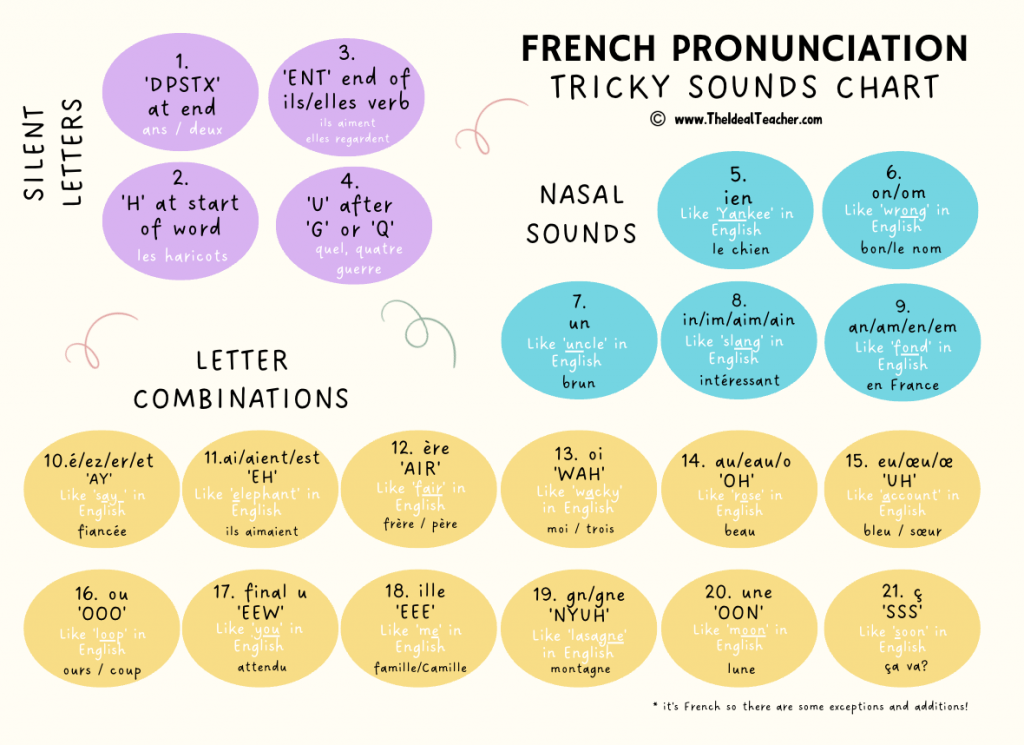
Think of French pronunciation as a system of patterns. Here are the core ideas from the video and our previous lessons, grouped together:
- Vowel Groups: Combinations like
ou("oo"),oi("wa"),au/eau("o"), and the nasal sounds (an,in,on) are read as a single sound. - Consonant Context: The sound of a consonant can change.
cis soft ("s") beforee,i,y. It's hard ("k") otherwise. (e.g., cinéma vs. café)gis soft ("zh") beforee,i,y. It's hard ("g") otherwise. (e.g., manger vs. gâteau)sbetween two vowels sounds like "z". (e.g., maison)
- Word Endings: Most final consonants are silent (except for C, R, F, L - our "CaReFuL" rule). The final
-eis also usually silent but makes the consonant before it audible. - Linking: The liaison rule connects words by pronouncing a normally silent consonant before a word starting with a vowel.
For a more detailed written guide, this webpage is an excellent resource you can bookmark for future reference. It contains many of the rules we've discussed with audio examples.
Test your understanding!
Based on the rules, how would you try to pronounce these words? Identify the main rule for each.
beaucoup(a lot)garage(garage)français(French)
Show answer
beaucoup: Pronounced "boh-koo". Theeaumakes an 'o' sound,oumakes an 'oo' sound, and the final-pis silent.garage: Pronounced "gah-razh". The firstgis hard (before 'a'), thesis not between vowels so it's not 'z', theais pronounced, and the secondgis soft (before 'e'), making a 'zh' sound. The final 'e' is silent. Note: theshere is a typo in the question, the word is garage. The rule forgis the key. In the correct word garage, the firstgis hard, the secondgis soft.français: Pronounced "fron-seh". Theanis a nasal sound. Theç(c-cedilla) always makes a soft 's' sound. The final-sis silent.
2. Reading Workshop: A Guided Practice
Now, let's apply these rules in a real-world reading exercise. We will work through a short A1-level text together, guided by an instructor. This "karaoke-style" exercise is perfect for practicing flow and rhythm.
We will use the video "Learn To Read French With Me" by Learn French With Alexa. The process has three steps: listen, deconstruct, and practice.
Step 1: Just Listen (2 minutes)
First, just listen to the text being read at a normal speed. Don't worry about understanding the words or catching every sound. The goal is to hear the natural rhythm and flow of spoken French.
Learn To Read French With Me | A1/A2 Level French for Beginners
The instructor will now read the text for the first time. Relax and listen.
Watch from 01:02 to 02:53. Follow along with her pen, but focus on listening rather than trying to read yourself.
Step 2: Deconstruct the Sounds (8 minutes)
Now, the instructor will break down the text and highlight how the pronunciation rules apply to specific words. This part is excellent for connecting the theory (the rules) to the practice (the sounds).
Learn To Read French With Me | A1/A2 Level French for Beginners
Let's analyze the text. The instructor will point out examples of nasal sounds, vowel combinations, liaisons, and other patterns we've learned.
Watch from 02:53 to 10:43. The instructor will highlight different sounds in the text. Notice how she points out: Nasal sounds like an in orange and on in garçon. Vowel sounds like oi in boire and ou in jour. A liaison in sept heures. Silent letters, like the -ent ending of the verb durent.
Step 3: Read Along! (10 minutes)
This is your main task. The instructor will now read the text very slowly, phrase by phrase. Your job is to read along with her. This is where you put everything into practice.
Learn To Read French With Me | A1/A2 Level French for Beginners
It's time to read! Follow the instructor in this slow, 'karaoke-style' read-along. This is the most important part of the lesson, so take your time.
Watch from 10:43 to the end. I recommend you pause the video after each short phrase she reads and repeat it out loud. Try to match her pronunciation and intonation. Don't be afraid to try a phrase two or three times. The goal is to build muscle memory.
This kind of active practice—listening and repeating—is one of the most effective ways to improve your accent and confidence.
Conclusion
Congratulations on completing the first module! You have systematically built the foundational skills for French pronunciation, moving from individual letters to the flow of complete sentences.
Your key takeaways from this lesson are:
- French pronunciation is based on a set of consistent rules and patterns for vowel groups, consonant combinations, and word endings.
- Recognizing these patterns is the key to decoding and pronouncing new words correctly.
- Active practice, such as reading along with a native speaker, is crucial for developing a natural accent and rhythm.
You now have the tools to approach any new French word and make a very good attempt at pronouncing it. This is a huge step!
In our next lesson, we will begin Module 2: Basic Greetings and Introductions. Now that you can produce French sounds, we will start using them to communicate. You will learn how to say hello, introduce yourself, and use essential polite expressions.
À bientôt! (See you soon!)