Hello! Welcome to the next lesson in our final module on Monitoring & Continuous Improvement.
In our last session, we built the analytical engine for our content agent. By creating the analyzePerformance function, we can now aggregate raw engagement metrics to identify which topics and formats are resonating with your audience. We have the "what," but now we need the "so what?"
This lesson is where we close the loop. Our learning outcome is to implement a feedback loop that adjusts trend-scoring parameters based on past content performance. We will take the insights from our analysis and use them to automatically guide the agent's future decisions, making the entire system adaptive and self-improving. This step transforms the agent from a static content producer into a dynamic, learning system that optimizes for engagement over time.
1. The Concept of a Self-Improving Agent
Before we dive into the code, let's establish the high-level concept. We are building an "LLM in a loop" system where the agent learns from real-world feedback.
To understand this core idea and its implications, please watch the following video.
LLM in a Loop: Automate feedback with evals
The video 'LLM in a Loop: Automate feedback with evals' by Shaw Talebi provides an excellent overview of using automated feedback to improve LLM outputs. It introduces the core concepts and highlights a crucial risk to be aware of.
Please watch these three segments: Examples of LLM in a loop (02:11 - 04:38): Pay close attention to the example of an X (Twitter) post generator that uses engagement metrics as a feedback signal. This is precisely what we are aiming to build. Real-world data (09:00 - 10:44): This section reinforces why using metrics like click-through rates and user satisfaction is so powerful—they are often the outcomes we ultimately care about. Reward Hacking (23:06 - 25:25): This is a critical concept. Understand what reward hacking is and why naively optimizing for a metric like 'engagement' can lead to undesirable outcomes, such as a toxic but viral agent.
As you saw, a feedback loop is a powerful mechanism, but it requires careful design to avoid unintended consequences like reward hacking. Our goal is to steer the agent toward better content, not just maximize a single number at any cost.
2. A Two-Pipeline Architecture: Creation and Learning
A clean way to structure a self-improving system is to separate the content creation logic from the learning logic. Your experience designing event-driven systems will make this pattern feel familiar. We can think of our agent as having two distinct pipelines that share a knowledge base.
This approach is demonstrated beautifully in a real-world open-source project.
I built a self-learning content agent with LangGraph - two pipelines ...
The Reddit post 'I built a self-learning content agent with LangGraph' describes a project called AutoViralAI. It's a fantastic real-world example of the system we're building and provides a great architectural blueprint.
Read the main post content, focusing on these points: The two-pipeline architecture: Note how the Creation Pipeline runs frequently to generate content, while the Learning Pipeline runs less often to analyze metrics and update the strategy. The shared knowledge base: The pipelines communicate by reading and writing to a shared store. This is how the learning from one cycle informs the next. Multi-signal ranking: Notice that the ranking of new posts uses 'Pattern History'—the cumulative engagement data for a given pattern. This is the exact mechanism we'll be implementing.
Our implementation will mirror this architecture:
- Creation Pipeline: Your existing agent logic for finding trends, generating, and publishing content.
- Learning Pipeline: The logic we'll build now, which runs periodically to analyze performance and update a shared "strategy."
The "strategy" we'll be updating is a set of scores that represent the historical performance of different content topics.
3. Implementing the Learning Pipeline
The learning pipeline's job is to take the output of analyzePerformance from our last lesson and distill it into a persistent, evolving score for each topic.
Step 1: Defining a Persistent Strategy Store
First, we need a place to store our evolving topic scores. In a production system, you'd use a dedicated table in your Postgres database. For our purposes, a simple JSON file will serve as our "knowledge base."
Let's define the structure for our topic strategy in a new file, src/monitoring/strategy.ts:
// src/monitoring/strategy.ts

export interface TopicStrategy {
  topic: string;
  // A score representing historical performance, normalized between 0 and 1.
  performanceScore: number;
  lastUpdatedAt: string; // ISO 8601 timestamp
}
Step 2: Temporal Weighting with Exponential Moving Average (EMA)
If a post about 'GraphQL' goes viral today, our system should favor that topic. But if it was popular six months ago and has since faded, its influence should diminish. We need to weigh recent performance more heavily than past performance. This is called temporal weighting.
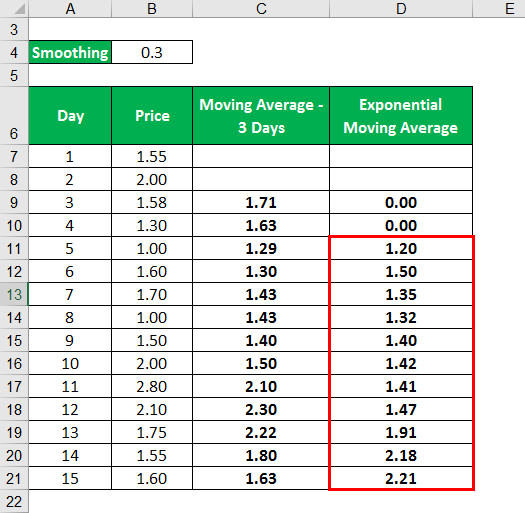
A robust and common technique for this is the Exponential Moving Average (EMA). Unlike a simple moving average, an EMA gives exponentially more weight to recent data points.
The formula for an EMA is:
Where is a smoothing factor between 0 and 1. A higher gives more weight to recent data.
We can adapt this to update our performanceScore. Let's create a function that takes the latest analytics and updates our strategy store using EMA.
// src/monitoring/strategy.ts (continued)
import * as fs from 'fs/promises';
import { PerformanceSummary } from './analysis'; // From previous lesson

const STRATEGY_DB_PATH = './strategy_store.json';
const SMOOTHING_FACTOR = 0.3; // Alpha for our EMA. Higher = more reactive to recent performance.

async function readStrategyStore(): Promise<TopicStrategy[]> {
  try {
    const data = await fs.readFile(STRATEGY_DB_PATH, 'utf-8');
    return JSON.parse(data) as TopicStrategy[];
  } catch (error: any) {
    if (error.code === 'ENOENT') return [];
    throw error;
  }
}

// The core of our Learning Pipeline
export async function updateTopicPerformanceScores(topicAnalysis: PerformanceSummary): Promise<void> {
  const strategyStore = await readStrategyStore();
  const newStrategyStore: TopicStrategy[] = [];

  for (const topic in topicAnalysis) {
    const analysisData = topicAnalysis[topic];
    const existingStrategy = strategyStore.find(s => s.topic === topic);

    // Normalize the current period's weighted score to a 0-1 scale.
    // This is a simple normalization. A more robust method could use min-max scaling across all topics for the period.
    // For now, let's assume a max possible score to normalize against.
    // e.g., a post with 500 likes, 100 comments, 50 shares = 500*1 + 100*3 + 50*5 = 1050
    // Let's cap our per-post score for normalization.
    const maxPossibleWeightedScore = 2000;
    const currentPeriodScore = Math.min(analysisData.weightedEngagementScore / analysisData.postCount / maxPossibleWeightedScore, 1);

    let newPerformanceScore: number;

    if (existingStrategy) {
      // Apply EMA formula
      newPerformanceScore = (currentPeriodScore * SMOOTHING_FACTOR) + (existingStrategy.performanceScore * (1 - SMOOTHING_FACTOR));

      const strategyIndex = newStrategyStore.findIndex(s => s.topic === topic);
      if(strategyIndex > -1) newStrategyStore[strategyIndex].performanceScore = newPerformanceScore;

    } else {
      // If it's a new topic, its initial score is just the current period's score.
      newPerformanceScore = currentPeriodScore;
    }

    newStrategyStore.push({
      topic: topic,
      performanceScore: newPerformanceScore,
      lastUpdatedAt: new Date().toISOString(),
    });
  }

  // Add back any topics from the old store that weren't in the new analysis,
  // but decay their score slightly so they fade over time if not posted about.
  const decayFactor = 0.95;
  for (const oldStrategy of strategyStore) {
    if (!newStrategyStore.some(s => s.topic === oldStrategy.topic)) {
      oldStrategy.performanceScore *= decayFactor;
      newStrategyStore.push(oldStrategy);
    }
  }

  await fs.writeFile(STRATEGY_DB_PATH, JSON.stringify(newStrategyStore, null, 2));
  console.log('Updated topic performance scores in the strategy store.');
}
This updateTopicPerformanceScores function is the heart of your learning pipeline. It runs periodically (e.g., daily), consumes the latest analytics, and intelligently updates the long-term performance score for each topic.
4. Integrating Feedback into Trend Scoring
Now that we have a persistent, evolving performanceScore for each topic, we need to use it in our Creation Pipeline.
Back in Module 3, your agent was designed to identify and rank trends. Let's assume you have a function, rankTrends, that assigns a score to potential topics. We will now modify that function to incorporate our new historical performance data.
This is the "Pattern History" signal from the AutoViralAI project. A trend's final score will be a composite of its current "hype" and its historical "performance."
// This is a hypothetical modification of your trend ranking logic from Module 3.
// Let's assume it lives in `src/analysis/trends.ts`

// Assume Trend has this structure
interface Trend {
  topic: string;
  // Score based on recent velocity, e.g., from HackerNews, Reddit
  rawHypeScore: number;
}

interface RankedTrend extends Trend {
  finalScore: number;
}

// --- MODIFICATION ---
import { readStrategyStore } from '../monitoring/strategy';

export async function rankTrends(trends: Trend[]): Promise<RankedTrend[]> {
  const strategyStore = await readStrategyStore();

  const rankedTrends = trends.map(trend => {
    const topicStrategy = strategyStore.find(s => s.topic === trend.topic);

    // If we have historical data, use it. Otherwise, default to a neutral score (0.5).
    const historicalPerformanceScore = topicStrategy ? topicStrategy.performanceScore : 0.5;

    // --- The Core of the Feedback Loop ---
    // Combine raw hype with historical performance. We can weigh them.
    // Let's say current hype is 60% of the score and past performance is 40%.
    const hypeWeight = 0.6;
    const performanceWeight = 0.4;

    const finalScore = (trend.rawHypeScore * hypeWeight) + (historicalPerformanceScore * performanceWeight);

    return {
      ...trend,
      finalScore: finalScore,
    };
  });

  // Sort by the new finalScore to get the top trend
  return rankedTrends.sort((a, b) => b.finalScore - a.finalScore);
}
With this change, your agent is no longer just chasing whatever is new and trending. It balances novelty with proven success, using real engagement data to guide its topic selection. A topic that is moderately trending but has historically performed very well for your audience might now be ranked higher than a massively trending topic that your audience has ignored in the past.
Just as Facebook assigns different weights to different user interactions, we are now weighting trends based on their value to our specific goals.

Conclusion
Congratulations! You have officially closed the loop and implemented a self-improving agent. By creating a learning pipeline that updates topic scores with an EMA and integrating those scores back into your trend ranking, your system now learns from past content performance.
Key Takeaways:
- Two-Pipeline Architecture: Separating content
CreationfromLearningcreates a clean, maintainable system. - Temporal Weighting is Key: Using an Exponential Moving Average (EMA) ensures your agent adapts to changing audience preferences by weighting recent performance more heavily.
- Composite Scoring: The best decisions come from multiple signals. By combining a trend's current "hype" with its historical "performance," your agent makes more nuanced and effective choices.
- Reward Hacking is a Real Risk: A feedback loop will optimize for the metric you give it. Your sophisticated design, which balances multiple signals and includes decay, helps mitigate this risk compared to a naive "maximize likes" approach.
Preview of the next lesson:
We have successfully taught our agent what topics to prioritize. But what about how it writes about them? In our final lesson, "Design a meta-prompting strategy where an LLM suggests improvements to generation prompts based on engagement data," we will explore how to use AI to reflect on content quality itself, creating a second feedback loop that aims to improve the style, structure, and effectiveness of the generated text.