Welcome back to the course. In our previous lesson, we established a clear causal chain showing how Dincharya maintains dosha equilibrium, which in turn builds vyadhi kshamatva (immunity/resilience). We saw how this ancient wisdom is validated by the modern science of chronobiology.
So far, we have discussed a universal model of Dincharya. However, the true clinical power of Ayurveda lies in its principle of radical personalization. Today, we will transition from this general framework to a tailored approach. The learning outcome for this lesson is to classify individuals based on prakriti, vikriti, and desha for personalized dincharya recommendations.
By the end of this lesson, you will understand how to assess an individual's unique constitutional blueprint (prakriti), their current state of imbalance (vikriti), and their environmental context (desha) to design a Dincharya that is not just beneficial in general, but precisely effective for them.
1. Understanding Prakriti: Your Constitutional Blueprint
As you know from your BAMS studies, Prakriti is our innate, unchanging psycho-physiological constitution, determined at the moment of conception by the predominant doshas. It is our "first nature" and serves as the fundamental blueprint for long-term health maintenance (swasthasya swasthya rakshanam). While a one-size-fits-all Dincharya is good, a prakriti-specific Dincharya is optimal for preventing the diseases to which we are naturally predisposed.
To accurately assess prakriti, a deep understanding of the physical and mental characteristics associated with each dosha is essential.
The Ultimate Guide to Find Your Dosha/ Prakriti | Free Ayurveda Learning Series From the Samhitas |
To refresh and deepen your understanding of these constitutional traits, let's watch selections from 'The Ultimate Guide to Find Your Dosha/ Prakriti' by Dr. Rekha. She provides a detailed, Samhita-based description of the qualities of Vata, Pitta, and Kapha dominant individuals.
Please watch the following segments. As you watch, make a note of the key physical (e.g., skin, hair, build) and mental/behavioral (e.g., memory, emotional tendencies, sleep patterns) characteristics for each type. Introduction to Prakriti (06:47 - 09:11) Vata Prakriti Traits (09:34 - 27:44) Pitta Prakriti Traits (33:12 - 49:26) Kapha Prakriti Traits (49:26 - 57:02)
As the video explains, an individual's prakriti can be one of seven types: Vata, Pitta, Kapha, Vata-Pitta, Vata-Kapha, Pitta-Kapha, or the rare balanced state of Sama Prakriti. A skilled assessment considers the sum total of these lifelong, unchanging traits to determine the constitutional makeup.
2. Differentiating Prakriti from Vikriti: Constitution vs. Current Imbalance
This is one of the most critical distinctions in Ayurvedic clinical practice. While Prakriti is the fixed constitution, Vikriti is the current state of doshic imbalance—what has happened "after creation." It is dynamic, changeable, and acquired through diet, lifestyle, seasons, and other environmental factors.
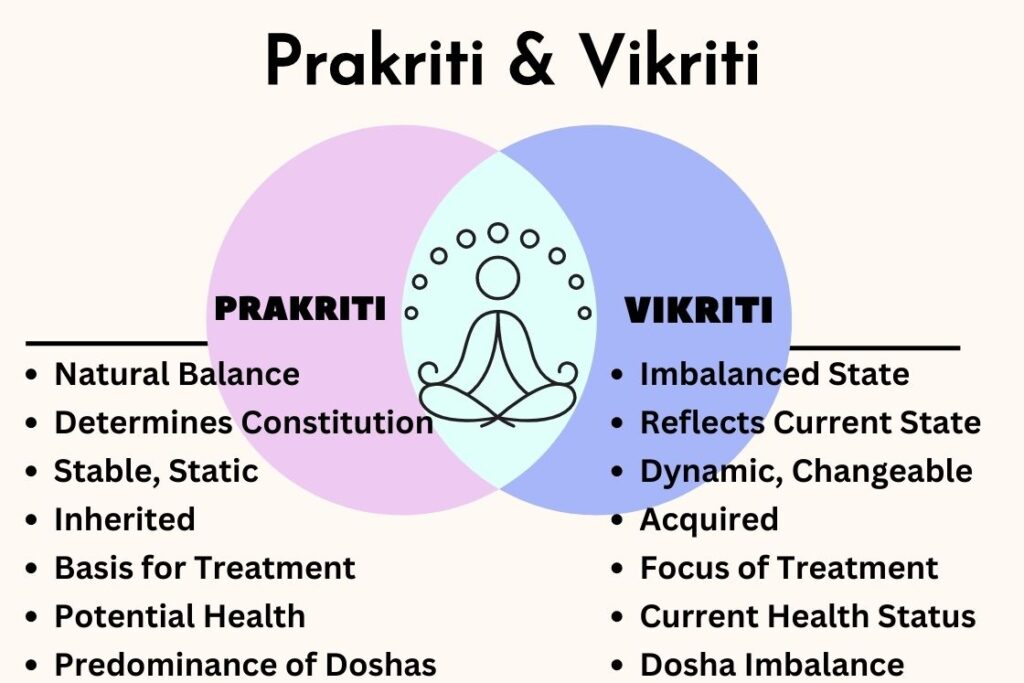
To clarify this crucial difference, let's watch a short, insightful video.
What is Prakruti and Vikruti? | Ayurvedic Constitution | 10 Minutes with Dr. Marc Halpern
Dr. Marc Halpern, in his video 'What is Prakruti and Vikruti?', clearly explains the distinction and the clinical implications of each.
Please watch these key segments: Defining Prakruti (00:34 - 02:42): Understand it as your original, lifelong balance. Defining Vikruti (04:37 - 05:49): Grasp it as the current state of imbalance influenced by your life. Clinical Application (07:34 - 08:30): Pay close attention to the core principle explained here: Vikriti determines the immediate treatment, while Prakriti guides long-term prevention.
The fundamental clinical rule is: Always prioritize pacifying the vikriti. Your immediate recommendations must address the current imbalance, even if it contradicts the general advice for the person's prakriti.
Example:
A person with a classic Pitta-Vata prakriti (intelligent, driven, lean build) moves to a cold city for a sedentary desk job. Over time, they develop weight gain, sluggishness, morning congestion, and a lack of motivation. These are hallmark signs of a Kapha vikriti.
- Wrong Approach: Recommending a Vata-Pitta pacifying Dincharya. This might involve more calming, cooling practices, which would worsen the Kapha imbalance.
- Correct Approach: Designing a Kapha-pacifying Dincharya. This would include:
- Waking before 6 am.
- Vigorous exercise (vyayama) instead of gentle yoga.
- Udvartana (dry powder massage) instead of Abhyanga (oil massage).
- Eating a light, warm breakfast instead of a heavy or cold one.
Once the Kapha vikriti is resolved and the person returns to a state of balance, their Dincharya can then be adjusted to align with their Vata-Pitta prakriti for long-term health maintenance.
Test your understanding!
A patient with a strong Kapha prakriti (calm, heavy build, good stamina) is experiencing severe anxiety, insomnia, and dry, cracking joints after a stressful life event. Which dosha represents their vikriti, and should their initial Dincharya focus on stimulating or grounding practices?
Show answer
The patient's symptoms (anxiety, insomnia, joint dryness) are classic indicators of a Vata vikriti. Despite their Kapha constitution, the immediate need is to pacify the aggravated Vata. Therefore, their initial Dincharya should focus on grounding, warming, and nourishing practices like regular warm oil Abhyanga, a consistent sleep schedule, and gentle, calming yoga, which directly counteract the qualities of the Vata imbalance.
3. The Influence of Desha: The Geographical and Climatic Context
Personalization doesn't stop with the individual; it must also account for their environment. Desha (location/climate) is a critical factor that constantly influences the doshas. Classical texts classify land into three main types:
- Jangala Desha (Arid Land): Dry, windy, and sparsely vegetated. This environment naturally aggravates Vata.
- Anupa Desha (Marshy Land): Humid, watery, and lush with vegetation. This environment naturally aggravates Kapha.
- Sadharana Desha (Moderate Land): A balanced environment where all doshas can remain in equilibrium more easily.
Your Dincharya recommendations must adapt to the desha where the person lives. A person with a Vata prakriti living in a cold, dry, windy city (Jangala type) will need to be far more diligent with Vata-pacifying practices (like Abhyanga) than a Vata person living in a warm, humid, coastal area (Anupa type).
This concept is highlighted in the research paper "The Inter-Relationship between Prakriti, Diet, and Lifestyle".
The Inter-Relationship between Prakriti, Diet, and Lifestyle
To understand how classical texts integrate environmental factors, let's look at a relevant paper. This resource discusses the various factors that influence our constitution and the need for personalized regimens.
Please read the section titled '2.1. Understanding Prakriti'. Focus on the paragraph that begins, "Beyond the factors at conception, Prakriti is also influenced by Jati (race), Kula (familial inheritance), Desha (geographical or agro-climatic location), Kala (seasonal variations and age)..." This reinforces that the environment is a key variable in a holistic assessment.
4. Synthesizing Prakriti, Vikriti, and Desha for a Personalized Dincharya
Now, let's integrate these three layers of assessment—prakriti, vikriti, and desha—to create a truly personalized Dincharya. The hierarchy for clinical decision-making is as follows:
- Address the Vikriti: The current imbalance is the most urgent priority.
- Adapt for Desha & Rutu: The environmental and seasonal context determines the external doshic influences that need to be counteracted.
- Align with Prakriti: The constitutional nature guides the long-term preventive strategy once balance is restored.
The following paper provides excellent, concrete examples of how to modify Dincharya practices based on the predominant dosha.
Prakriti-Specific Dinacharya: A Conceptual Study on the ...
The paper 'Prakriti-Specific Dinacharya' offers practical, tailored routines for each constitutional type. It serves as a great template for creating personalized plans.
Please read the sections titled: 'Dinacharya for Balancing Vata Dosha' 'Dinacharya for Balancing Pitta Dosha' 'Dinacharya for Balancing Kapha Dosha' Notice how specific recommendations for practices like Abhyanga, Nasya, and exercise change for each dosha to introduce opposing qualities.
Based on this paper and other classical principles, here is a summary of key Dincharya modifications:
| Practice | Vata-Dominant | Pitta-Dominant | Kapha-Dominant |
|---|---|---|---|
| Waking Time | Before sunrise, but ensure adequate rest (~8 hrs). Consistency is key. | Wake up before sunrise to utilize the cool morning air. | Wake up early (before 6 am, in Kapha time) to counter sluggishness. |
| Abhyanga | Daily, with warming, heavy oils like sesame or Dhanwantaram Tailam. | Daily, with cooling oils like coconut or Ksheerabala Tailam. | Less frequently; use warming, light oils like mustard or Karpuradi Tailam. Focus on stimulating strokes. |
| Vyayama | Gentle, grounding exercise like slow yoga, walking, tai chi. Avoid overexertion. | Moderate-intensity exercise, preferably during cooler parts of the day. Swimming is ideal. | Vigorous, stimulating exercise to build heat and circulation. Running, cardio, and intense yoga. |
| Snana (Bath) | Warm to hot water to counter coldness. | Tepid or cool water to pacify heat. | Warm water to promote circulation and prevent congestion. |
| Gandusha | Oil pulling with warming oil (e.g., sesame oil) to combat dryness. | Oil pulling with cooling oil (e.g., coconut oil) or bitter/astringent decoctions. | Gargling (kavala) with warm, astringent/pungent liquids (e.g., saltwater, Trikatu water) to clear mucus. |

Conclusion
In this lesson, we have moved beyond a generic Dincharya to a sophisticated, multi-layered approach to personalization. You now have the framework to analyze an individual based on their unique constitution, current imbalances, and environmental context.
Key Takeaways:
- Prakriti is the unchanging constitutional blueprint that informs long-term preventive health strategies.
- Vikriti is the current, dynamic state of imbalance and is the primary target for any therapeutic regimen, including Dincharya.
- Desha provides the geographical and climatic context, which must be considered to counteract external doshic influences.
- A truly effective Dincharya is created by synthesizing these three factors, always prioritizing the pacification of the vikriti first.
In our next lesson, we will continue this theme of personalization by focusing on the dimension of time. We will address the learning outcome: "Assess kala (seasonal and diurnal variations) and its influence on dincharya practice selection." This will add the crucial layer of Rutu charya (seasonal regimen) to your clinical toolkit.