Hello! Welcome to the fifth lesson in our module on Abhyanga.
Introduction
In our last lesson, we explored the extensive and profound benefits of Abhyanga, establishing it as a cornerstone therapy for pacifying Vata, delaying aging (Jarahara), and relieving fatigue (Shramahara). We saw how this ancient practice is validated by modern physiological understanding.
However, a truly skilled practitioner knows not only when to apply a therapy but, more importantly, when to withhold it. The indiscriminate use of even the most beneficial practice can lead to adverse effects. This lesson is dedicated to that critical skill, directly addressing the learning outcome: Recognize absolute contraindications for Abhyanga, including ama (metabolic toxins), acute fever, and indigestion.
We will delve into the Ayurvedic concept of Ama and explore why conditions of low Agni and high Kapha make the nourishing qualities of Abhyanga inappropriate and potentially harmful. Mastering these contraindications is essential for safe and effective clinical practice.
1. The Core Principle: Why is Abhyanga Ever Contraindicated?
At its heart, Abhyanga is a Brimhana (nourishing) and Snehana (oleating) therapy, which falls under the broader category of Santarpana (therapies that build and nourish). The primary contraindications arise in situations where the body requires the opposite: Langhana (lightening), Rukshana (drying), and Deepana-Pachana (therapies to kindle digestive fire and digest toxins).
The most significant factor necessitating this opposite approach is the presence of Ama.
2. Understanding Ama: The Root of Contraindication
Ama is a central concept in Ayurvedic pathology and the primary reason why Abhyanga must sometimes be avoided. Since you have a BAMS background, you'll be familiar with this concept, but let's solidify its clinical relevance to Abhyanga.
UNDERSTANDING AAM IN AYURVEDA & ITS IMPLICATIONS IN CLINICAL PRACTICE
To understand why Ama is a critical contraindication, we first need to be precise about what it is and what it does. This research paper provides a clear and concise explanation.
Please read the sections 'CONCEPT AND NIRUKTI OF AAM' and 'CHARACTERISTICS OF AAM'. Focus on the definition of Ama as incompletely digested matter and its pathogenic properties, especially 'Srotorodhaka' (obstructive to channels).
As the paper highlights, Ama is a sticky, heavy, foul-smelling substance that obstructs the body's channels (Srotas). Now, consider the properties of the oil used in Abhyanga: it is also typically Guru (heavy) and Snigdha (unctuous).
Performing Abhyanga in the presence of Ama (Sama Avastha) is like trying to wash a greasy dish with more oil. It will:
- Increase blockage (Srotorodha): The oil mixes with the sticky Ama, creating a denser blockage that clogs the channels even more.
- Aggravate heaviness (Gaurava): It adds to the feeling of heaviness and lethargy.
- Trap toxins: Instead of being nourishing, the oil traps the Ama deeper within the Dhatus (tissues), making it much harder to eliminate later.
Therefore, the first and most crucial step before recommending Abhyanga is to assess for the presence of Ama. This is known as determining if the condition is in a Sama (with Ama) or Nirama (without Ama) state.
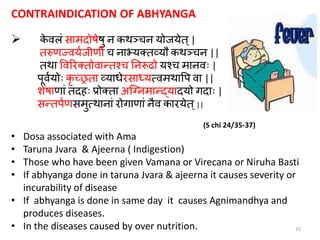
3. Absolute Contraindications for Abhyanga
Let's now examine the specific conditions where Abhyanga is strictly forbidden. Most of these are manifestations of Ama or profoundly weakened Agni.
"Fundamentals of Abhyanga" Talk By- Dr. Rajkala P. Patil
Dr. Rajkala P. Patil clearly lists the classical contraindications for Abhyanga. Pay close attention to her enumeration of these conditions.
Watch the segment from 24:18 to 25:12. Dr. Patil lists several conditions where Abhyanga should not be performed, including those related to Kapha, indigestion, and recent panchakarma.
a) Ajirna (Indigestion) & Agnimandya (Weak Digestive Fire)
This is the most direct contraindication. If the primary digestive fire (Jatharagni) is unable to properly digest food, it creates Ama. Furthermore, the body's metabolic intelligence is systemic. Weak Jatharagni implies weak Dhatu Agni (tissue-level metabolism) and weak Bhrajaka Pitta (the aspect of Pitta in the skin responsible for absorption).
Abhyanga - Ayurvedic Massage: How To Do? Benefits, Oil ...
Let's explore the physiological link between gut health and skin absorption. The Easy Ayurveda article explains this connection very well.
Read the section 'Why Oil Massage Should Not Be Done During Indigestion?'. Focus on the relationship between Pachaka pitta, Bhrajaka pitta, and the skin's ability to absorb oil.
As you read, when Pachaka Pitta in the gut is low, the Bhrajaka Pitta in the skin also functions poorly. The oil applied during Abhyanga is not properly absorbed or "digested" by the skin. It remains on the surface, clogging the Swedavaha Srotas (channels for sweat) and leading to further stagnation.
b) Taruna Jvara (Acute Fever)
In the initial stage of a fever, Ayurveda considers it an Amavastha of the disease. The body is actively trying to 'cook' (pachana) the pathogens and associated toxins. The channels, particularly the Swedavaha Srotas, need to be open to release excess heat.
Applying oil at this stage is highly detrimental. It blocks the channels, trapping heat inside and preventing the expulsion of toxins. This can significantly worsen the fever and prolong the illness.
c) Kaphagrasta Avastha (Conditions of high Kapha)
This refers to any condition where Kapha dosha is significantly aggravated. Examples include:
- Productive cough and colds
- Severe sinus congestion
- Obesity with feelings of heaviness and water retention
- High cholesterol (as an indicator of deranged Meda Dhatu metabolism)
Since oil shares the Snigdha (oily) and Guru (heavy) qualities of Kapha, performing Abhyanga will only serve to increase Kapha, leading to more congestion, lethargy, and dampness in the body. The classical text Ashtanga Hrudaya is unequivocal: varjyo’bhyaṅgaḥ kaphagrasta—Abhyanga is to be avoided by one afflicted with Kapha.
d) Immediately After Shodhana (Purificatory Therapies)
Following potent Panchakarma procedures like Vamana (therapeutic emesis) or Virechana (purgation), the body is in a deliberately weakened state. The digestive fire (Agni) is extremely low, akin to a state of severe indigestion. The body is sensitive and focused on recovery and re-establishing digestive capacity.
Performing a nourishing and heavy therapy like Abhyanga at this time would overwhelm the system, creating indigestion and undoing the benefits of the purification.
Test your understanding!
A 50-year-old patient presents with symptoms of early-stage rheumatoid arthritis (Amavata). They complain of migrating joint pain, severe stiffness, a feeling of heaviness, loss of appetite, and they have a thick, white coating on their tongue. They ask if a daily oil massage would help relieve their joint stiffness.
How would you respond, and what is your clinical reasoning based on today's lesson?
Show answer
This is a classic case where Abhyanga is contraindicated.
Response: "While oil massage is excellent for many types of joint pain, in your current condition, it would likely make things worse. The stiffness and pain you're experiencing are caused by a factor called Ama, or metabolic toxins, which is indicated by your loss of appetite and the coating on your tongue. Applying oil now would trap these toxins and increase the stiffness and inflammation."
Clinical Reasoning: The patient's symptoms (pain, stiffness, heaviness, loss of appetite, coated tongue) clearly indicate a Sama Avastha (state with Ama). This is the hallmark of Amavata.
- Presence of Ama: The primary pathology is Ama, which is Guru (heavy) and Snigdha (sticky).
- Contraindication: Abhyanga is also Guru and Snigdha. Applying it would violate the principle of opposites and increase the pathogenic qualities already present, leading to severe Srotorodha (channel blockage).
- Correct Approach: The correct initial treatment would be therapies that are Ruksha (drying) and Laghu (lightening) to digest the Ama. This might include Langhana (therapeutic fasting), administering Ama-pachaka herbs, and external therapies like Udvartana (dry powder massage) or Valuka Sweda (dry sand fomentation), not Snehana (oleation). Abhyanga might become appropriate much later in the treatment protocol, once the Nirama Avastha (state without Ama) has been firmly established.
Conclusion
Today we have balanced our understanding of Abhyanga by learning its critical contraindications. While it is a powerful tool for health, its application requires careful clinical judgment.
Key Takeaways:
- The fundamental principle is to avoid Abhyanga, a nourishing (Santarpana) therapy, in conditions that require lightening (Langhana) and drying (Rukshana) treatments.
- The presence of Ama (metabolic toxins from weak Agni) is the single most important contraindication.
- Absolute contraindications include Ajirna (indigestion), Taruna Jvara (acute fever), conditions of severely aggravated Kapha, and the period immediately following Shodhana therapies.
- Performing Abhyanga in these conditions can lead to harmful effects (Vyapat), such as increased channel blockage, worsening of fever, and aggravation of pain and stiffness.
In our next lesson, we will move on to the practical parameters of applying Abhyanga correctly. Now that we know who is a suitable candidate, we will learn to determine the appropriate time (kala) and duration (matra) for the massage based on individual factors like season, time of day, and health status.