Hello! Welcome back to our module on Abhyanga.
Introduction
In our last lesson, we focused on the critical importance of when not to perform Abhyanga. We analyzed how performing this therapy during contraindicated states like Ajirna, Sama Avastha, or Jvara leads to harmful effects, primarily through the mechanism of Srotorodha (channel obstruction). You learned that ignoring these contraindications can worsen a patient's condition, a crucial piece of clinical wisdom.
Having established who is not a candidate for Abhyanga, we now shift our focus to the suitable individual. This lesson addresses the learning outcome: Determine the appropriate time (kala) and duration (matra) for performing Abhyanga based on individual factors. Mastering these two parameters is essential for transforming Abhyanga from a generic procedure into a precise, personalized, and effective therapy. We will explore how to make these clinical decisions based on classical principles and individual needs.
1. Determining the Appropriate Kala (Time) for Abhyanga
Kala, or time, is a critical factor (karana) in Ayurveda that influences the outcome of any therapy. For Abhyanga, we must consider the time of day, relation to meals, and season.
Diurnal Timing (Dina Kala)
The classical texts strongly advocate for performing Abhyanga in the morning.
Abhyanga - Ayurvedic Massage: How To Do? Benefits, Oil ...
To understand the ideal timing, let's consult this article from Easy Ayurveda, which clearly outlines the classical recommendations and the reasoning behind them.
Please read the section titled 'Right time for oil massage'. Pay attention to the rationale for both morning and evening applications.
As you've just read, there are two primary options:
-
Morning (before bathing): This is the traditionally indicated time. The rationale is multifaceted:
- Vata Pacification: Vata dosha naturally predominates during the early morning hours. A morning Abhyanga directly counters this, preventing the accumulation of Vata and providing a sense of stability and groundedness for the day ahead.
- Preparation for Activity: It lubricates the joints, nourishes the muscles, and prepares the body for the day's physical and mental exertion (Shrama).
- Daily Ritual: Integrating it into the morning routine before a bath makes it a consistent part of Dinacharya.
-
Evening: An evening Abhyanga is also a viable and often beneficial option, particularly in modern lifestyles.
- End-of-Day Vata: The evening is another period of Vata dominance. A massage at this time helps to pacify the Vata aggravated by the day's stress and activities.
- Promoting Sleep: For individuals suffering from insomnia (Nidranasha) or stress, an evening Abhyanga, especially Padabhyanga (foot massage), is exceptionally effective at calming the nervous system and promoting restful sleep.
- Important Consideration: As the article notes, an evening massage, especially in cooler climates, should ideally be followed by a warm bath or local fomentation (Swedana). This prevents the Sheeta Guna (cold quality) from increasing stiffness and ensures proper absorption of the oil.
Relation to Food (Ahara Kala)
The timing of Abhyanga relative to meals is governed by the state of Agni. The resource you just read also touched on this, stating it should be done 1 hour before or after food. Let's formalize the reasoning.
- Contraindication: Abhyanga is contraindicated immediately after a meal (Bhuktaवत).
- Rationale: After eating, the digestive process begins, and Kapha dosha becomes dominant. Pachaka Pitta is fully engaged in the Koshtha (GI tract). Performing Abhyanga at this time would:
- Divert blood flow and metabolic energy from the digestive system to the periphery (skin and muscles).
- Increase the Guru (heavy) and Snigdha (unctuous) qualities in the body when Kapha is already high.
This combination interferes with digestion, weakens Agni, and can lead to the formation of Ama—precisely the state we strive to avoid.
2. Determining the Appropriate Matra (Duration & Quantity)
Matra refers to the proper measure or dose. In the context of Abhyanga, it primarily means the duration of the massage, which dictates the quantity of oil absorbed and the depth of its therapeutic effect. Deciding the Matra is a key aspect of clinical judgment.
The Guiding Factors of Matra
Before we talk about minutes, it's essential to understand that Matra is not a one-size-fits-all prescription. It is determined by a holistic assessment of the individual.
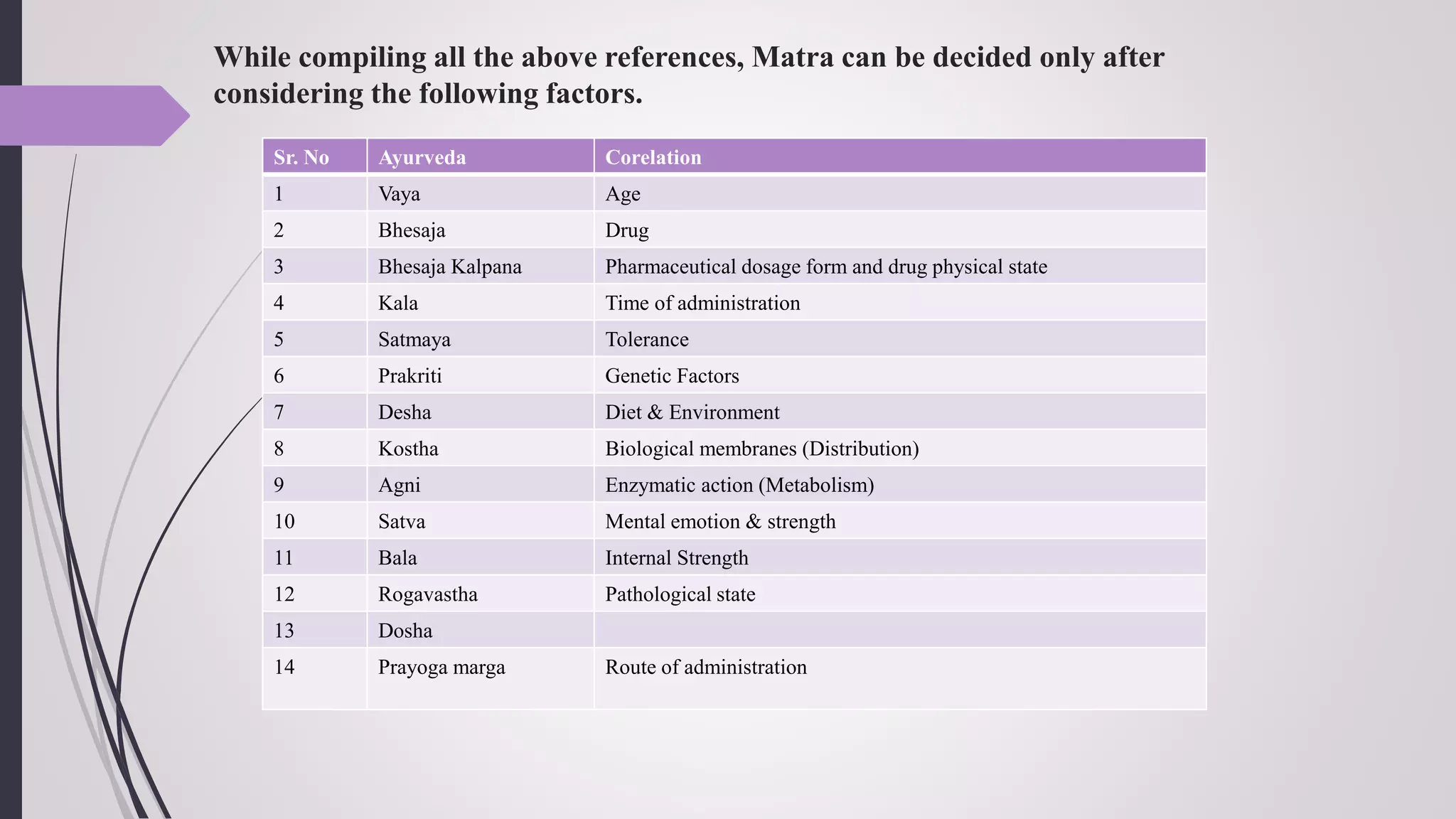
For Abhyanga, key factors to consider are:
- Bala (Strength): A strong individual (Balavan) can tolerate a longer, deeper massage, while a debilitated person (Durbala) requires a shorter, lighter application.
- Dosha: A Vata predominant person benefits from a longer, slower, more grounding massage. A Pitta person may need a shorter duration with cooling oils. A Kapha person requires a more vigorous and stimulating massage of shorter duration, often followed by Udvartana (powder massage).
- Agni: A person with strong Agni can metabolize the oil more effectively, allowing for a longer duration.
- Purpose: Is the Abhyanga for health maintenance (Swasthasya Swasthya Rakshanam) or for treating a disease (Aturasya Vikara Prashamanam)? The duration will vary accordingly.
The Physiological Basis of Duration: Dhatu Penetration Time
The duration of Abhyanga is scientifically grounded in the time it takes for the sneha (oil) to penetrate the successive layers of bodily tissues (dhatus). This concept, explained by commentators like Dalhana, provides the "why" behind the recommended timeframes.
Abhyanga - Ayurvedic Massage: How To Do? Benefits, Oil ...
This article from Easy Ayurveda provides an excellent breakdown of the time required for oil to reach each dhatu, based on classical commentaries.
Please read the section 'Time duration for oil massage', focusing on the table that correlates body tissues with penetration time in Matrakala and seconds.
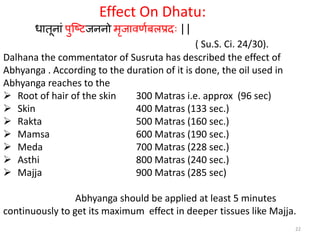
To synthesize this crucial information:
| Tissue (Dhatu) Reached | Time in Matrakala | Approximate Time in Seconds |
|---|---|---|
| Romanta (Hair Follicle) | 300 | ~95 seconds |
| Twak (Skin / Rasa) | 400 | ~127 seconds |
| Rakta (Blood) | 500 | ~159 seconds |
| Mamsa (Muscle) | 600 | ~190 seconds (3+ mins) |
| Meda (Fat) | 700 | ~220 seconds |
| Asthi (Bone) | 800 | ~254 seconds (4+ mins) |
| Majja (Bone Marrow) | 900 | ~285 seconds (~5 mins) |
This data is clinically profound. It tells us that a quick 1-minute rub is merely a superficial application. To address disorders of deeper tissues like Sandhigata Vata (affecting Asthi Dhatu) or neurological conditions (related to Majja Dhatu), the massage must be sustained for at least 5-7 minutes over the affected area to ensure the medicinal properties of the oil reach their target.
Practical Guidelines for Duration
With this theoretical foundation, let's look at the practical timeframes for different types of Abhyanga.
"Fundamentals of Abhyanga" Talk By- Dr. Rajkala P. Patil
Let's hear from Dr. Rajkala P. Patil about the typical duration in a clinical setting.
Watch the segment from 16:30 to 17:10. Dr. Patil provides a standard duration for a full-body Abhyanga performed by therapists.
-
Sarvanga Abhyanga (Full Body Massage):
- Therapeutic Setting: As Dr. Patil mentioned, a session typically lasts 45-60 minutes. This often involves one or two therapists and includes time for the patient to be in various positions.
- Daily Self-Massage: For a daily Dinacharya practice, a duration of 15-20 minutes is more realistic and still highly effective. The Easy Ayurveda article you read suggests a range of 15-35 minutes, with the lower end for health maintenance and the higher end for therapeutic purposes.
-
Sthanika Abhyanga (Local Massage):
- For specific areas like the head (Shiroabhyanga), feet (Padabhyanga), or an arthritic knee, a focused massage of 10-15 minutes is generally recommended.
- For specific therapeutic protocols, like a course of Padabhyanga for insomnia, the duration might be longer, for instance, 30 minutes daily for 7-14 days, as noted in the supplementary text for Dr. Patil's lecture (Resource LINK).
Test your understanding!
A 35-year-old male with a Kapha prakriti presents with dry, rough skin (twak-raukshya) and wants to start Abhyanga for improving skin texture. His Agni is good, and he has no signs of Ama. How would you advise him on the ideal Kala and Matra for his daily Abhyanga practice, and what would be your underlying rationale?
Show answer
Advice:
- Kala (Time): The best time would be in the morning, before his bath. This allows the stimulating effects of the massage to counter Kapha's natural tendency towards morning sluggishness.
- Matra (Duration): A shorter duration of about 10-15 minutes is appropriate. The massage should be vigorous and stimulating rather than slow and relaxing.
Rationale:
- Countering Kapha: A Kapha individual has inherent Snigdha (oily) and Guru (heavy) qualities. A long Abhyanga could easily aggravate Kapha, leading to lethargy or congestion. The goal is to nourish the skin without increasing systemic Kapha.
- Target Tissue: His goal is to address skin roughness, which is a condition of the superficial tissues (Rasa and Rakta). According to the dhatu penetration chart, the oil reaches these tissues within 2-3 minutes. A 10-15 minute massage is more than sufficient to achieve this goal without overburdening the system.
- Balancing the Therapy: You might also advise him to follow his Abhyanga with a light Udvartana (powder massage) using a substance like chickpea flour before bathing. This would help remove excess oil and provide the stimulating, drying qualities needed to balance Kapha.
Conclusion
You have now learned how to determine two of the most important parameters for performing Abhyanga effectively. By thoughtfully selecting the Kala and Matra, you can tailor this therapy to an individual's unique constitution, state of health, and specific goals.
Key Takeaways:
- Kala (Time): The ideal time for Abhyanga is in the morning before bathing. Evening is a good alternative, especially for calming Vata and promoting sleep. Always avoid performing it immediately after meals.
- Matra (Duration): The duration is not arbitrary but is based on factors like dosha, bala, and the therapeutic goal. It is physiologically linked to the time it takes for oil to penetrate the dhatus.
- Practical Durations: For daily self-massage, aim for 15-20 minutes. For therapeutic applications or local massage, the duration may be longer (30-45+ minutes) to ensure the oil reaches the deeper tissues.
In our previous lessons, we covered the contraindications and the harmful effects. Today, we've discussed the timing and duration. The next logical step is to learn the actual application. In our upcoming lesson, we will focus on the correct technique, pressure, and direction of massage strokes for different body regions, bringing together all the elements for a complete and professional understanding of Abhyanga.