Hello! Welcome to the fifth lesson in our course on the foundations of English language teaching.
In our previous lesson, we unpacked two essential lesson blueprints: Presentation-Practice-Production (PPP) and Test-Teach-Test (TTT). We discussed how the choice between these frameworks often depends on what your students already know and what they are capable of. This naturally leads to a critical question: how do we describe and measure student ability in a consistent, meaningful way? This lesson provides the answer.
Today, your learning outcome is to describe the CEFR levels (A1–C2) and the typical competencies of learners at each stage. The Common European Framework of Reference for Languages, or CEFR, is the global standard for describing language proficiency. For your CELTA/TESOL preparation, a solid understanding of the CEFR is non-negotiable. It's the common language that teachers, publishers, and assessment bodies use to talk about learner levels. As a B2 English user yourself, you have personally journeyed through these levels, giving you a unique perspective on this topic.
What is the CEFR and Why Does it Matter?
Before diving into the specifics of each level, it's important to understand what the CEFR is and why it replaced older, more ambiguous terms like "beginner" or "intermediate." The British Council provides a concise explanation.
This video, "CEFR and Language Assessment," explains the origin and purpose of the CEFR.
Please watch the first part of the video, from the beginning to the end of the introduction. As you watch, focus on the problem the CEFR was designed to solve: the subjective nature of terms like "intermediate."
As the video explained, the CEFR provides a shared, objective standard. This has profound implications for you as a teacher. Knowing your students' proficiency levels is not just an administrative detail; it's the foundation of effective teaching. Let's explore the practical reasons why this is so crucial.
What's the CEFR? The GSE? English Language Learner Levels ...
This article from Bridge.edu, a TEFL certification provider, outlines why understanding proficiency levels is a core teaching skill.
Please read the section titled "Why do teachers and students need to understand English proficiency levels?". This section lists key reasons that directly relate to your daily work as a teacher, from setting goals to selecting materials.
In short, understanding the CEFR allows you to:
- Plan effectively: You can choose appropriate lesson frameworks (like PPP for new language with A2 learners, or TTT for reviewing a topic with B1 learners).
- Select materials: You can identify coursebooks, articles, or videos that are challenging but not overwhelming.
- Set realistic goals: You and your students can work towards clear, achievable learning outcomes.
- Measure progress: You can provide learners with a tangible sense of their improvement.
The Six Levels of Proficiency
The CEFR is organized into six levels, grouped into three broad tiers: Basic User (A1, A2), Independent User (B1, B2), and Proficient User (C1, C2). Each level is defined by a set of "Can-Do" statements that describe what a learner is capable of doing with the language.
The infographic below gives a great at-a-glance overview of the six levels and their key descriptors.
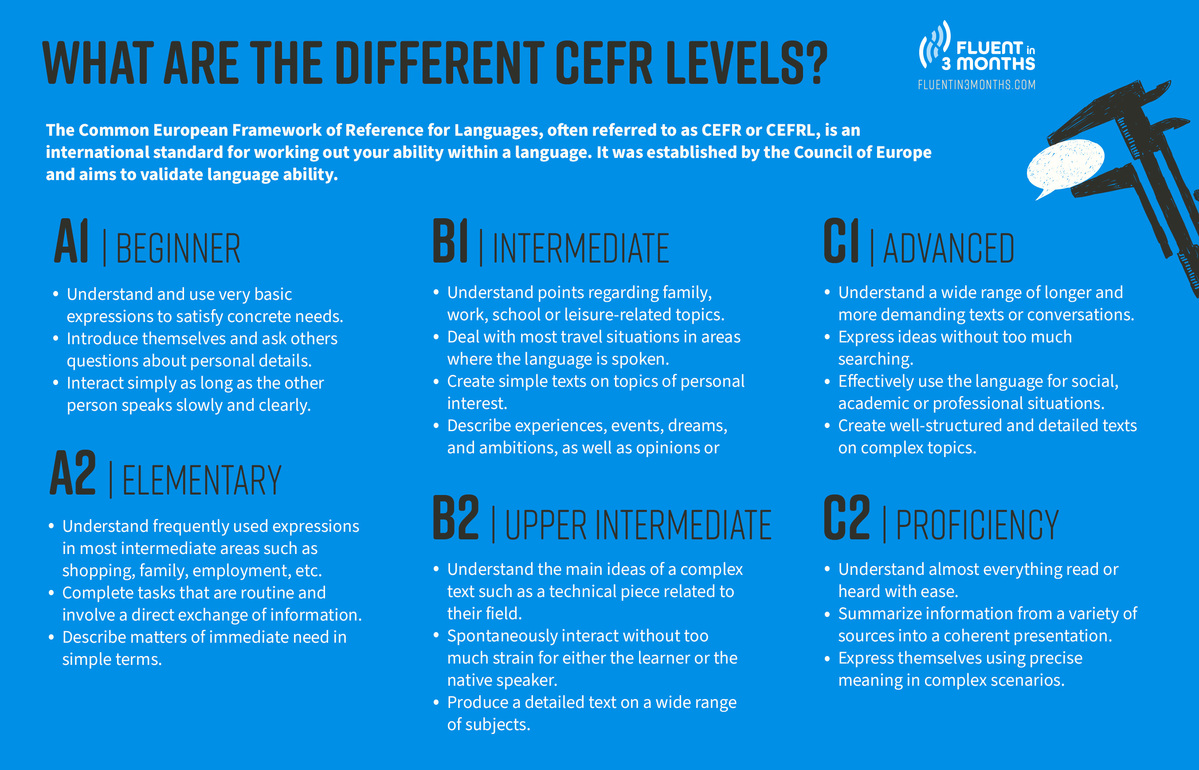
Now, let's explore these levels in greater detail. As a teacher, you need to have a more nuanced understanding of what a learner can and cannot do at each stage. As you read these descriptions, reflect on your own teaching experience. You have certainly taught learners across this spectrum. Also, consider your own language journey from B1 to your current B2 level. What new abilities did you gain?
What's the CEFR? The GSE? English Language Learner Levels ...
The same article from Bridge.edu provides detailed descriptions for each of the six CEFR levels.
Please read the section titled "What are the different CEFR levels of English proficiency?". Pay close attention to the action verbs used in the descriptions (e.g., interact, describe, understand, express), as these form the basis of "Can-Do" statements.
Your current B2 level is described as being able to "comment on various concrete and abstract topics" and "converse with native speakers." The next level up, C1, involves understanding "implicit meaning" and using language "flexibly" for social, academic, and professional purposes. This framework gives you a clear map not only for your students' progress but for your own as well.
From Theory to Practice: Teaching at Each Level
Knowing the descriptions is one thing; knowing how to adapt your teaching accordingly is another. This is where your skill as a teacher comes in. A lesson for A1 beginners will look and feel very different from a lesson for C1 advanced learners.
The following article offers practical tips and activity ideas tailored to each CEFR level. This is exactly the kind of practical knowledge that will be invaluable for your certification and your teaching career.
CEFR Levels Explained: What Do The Different Levels Mean? - The TEFL Academy
This article from The TEFL Academy gives concrete teaching advice for each proficiency level.
Read the section titled "Using CEFR levels in the EFL classroom." Focus on how the teaching approach changes as the learners' proficiency increases—from using lots of repetition and visuals at A1, to facilitating debates and analyzing complex texts at C1.
Notice the shift in the teacher's role. At lower levels (A1/A2), the teacher provides a lot of structure, models language, and uses techniques like Total Physical Response (TPR). At higher levels (B2/C1), the teacher's role shifts to that of a facilitator, prompting discussion, introducing nuanced language, and pushing learners to analyze and create.
A Note on "Spiky Profiles"
It's important to remember that the CEFR levels are a guide, not a rigid set of boxes. Learners are not always neatly "A2" or "B1". Often, a learner might have a spiky profile, meaning their skills are uneven. For example, a student might have B2-level speaking skills from living in an English-speaking country, but only A2-level writing skills because they've never studied it formally.
As a teacher, recognizing these spiky profiles is key to meeting individual student needs. This is a concept Jo Gakonga explains well.
Language Levels Explained; What do the CEFR, Cambridge and IELTS have in common?
In this video, "Language Levels Explained," Jo Gakonga introduces the idea of a "spiky profile."
Watch the first minute or two of the video, specifically the part where she discusses this concept from the spiky profile. This will help you think more critically about how you assess your students' true abilities beyond a single label.
Conclusion
Today, we've demystified the CEFR and established it as an indispensable tool in your teaching toolkit. You've moved from simply having an intuitive sense of learner levels to being able to describe them using a professional, internationally recognized framework.
Key Takeaways:
- The CEFR (Common European Framework of Reference) is a global standard that provides objective "Can-Do" statements to describe language ability across six levels (A1, A2, B1, B2, C1, C2).
- Understanding the CEFR is essential for planning lessons, selecting materials, setting goals, and measuring progress.
- Teaching strategies must be adapted to the learner's level, with the teacher's role shifting from a presenter at lower levels to a facilitator at higher levels.
- Learners often have "spiky profiles," with stronger skills in some areas than others, which requires a flexible and observant teaching approach.
Next Lesson Preview:
Now that you can describe proficiency levels in a standardized way, how do you determine the specific goals, wants, and needs of a new group of students? In our next lesson, you will learn how to conduct a basic needs analysis. This is the diagnostic process you'll use at the start of any new course to ensure your teaching is targeted, relevant, and truly learner-centered.