Welcome to the first lesson of your course on teaching English! We're starting with a foundational topic that will shape your entire approach to teaching. This lesson is designed to help you describe the role and core responsibilities of an English language teacher.
Given your year of experience teaching ESL students, you've already performed many of these roles, perhaps without always putting a name to them. Our goal today is to give you a structured, professional vocabulary to understand and articulate these functions. This is a crucial first step in preparing for certifications like CELTA or TEFL, which emphasize a deep understanding of the teacher's multifaceted role. We will explore these roles in both traditional classrooms and, importantly for your goals, the online environment.
The Flexible Teacher: More Than Just Talking
A common misconception is that a teacher's primary job is simply to present information. In reality, an effective language teacher is like a director, a coach, and a guide all rolled into one, constantly adapting their approach to meet the needs of the learners.
To get a quick, practical overview of these different functions, let's start with a short video from ITTT, a well-known TEFL certification provider. It gives concrete examples of what a teacher might say or do when adopting different roles.
Teaching English as a Foreign Language - Teachers & Learners - Role of the Teacher
This video, "Teachers & Learners - Role of the Teacher," illustrates several key roles with simple, clear examples.
As you watch, pay attention to how a simple phrase or action shifts the teacher's function in the classroom. Please watch the following segments: Manager: Taking control of the classroom. Organizer: Setting up a pair work activity. Assessor: Evaluating a student's contribution. Prompter: Encouraging a student to say more. Participant: Joining an activity with the students. Tutor: Providing individualized help. Facilitator: Guiding students to create something. Model: Demonstrating correct language. Monitor (Observer): Watching and taking notes on student performance.
A Framework for Teacher Roles
The roles in the video are based on a well-respected framework in English Language Teaching (ELT), developed by the methodologist Jeremy Harmer. Understanding this framework is essential for professional development and is a core component of many teacher training courses.
Let's deepen your understanding by reading a short article that explains some of these key roles in more detail.
This article from EDICT provides a written explanation of Harmer's classic teacher roles, which are fundamental in ELT training.
Please read the entire article. It's short and provides clear definitions. As you read, focus on the descriptions of these eight key roles: Controller: The teacher in charge, leading from the front. Organizer: The crucial role of setting up activities. Assessor: Giving feedback and evaluating performance. Prompter: Helping students when they get stuck. Participant: Joining in an activity to motivate students. Resource: Providing language when students need it. Tutor: Acting as a coach for individuals or small groups. Observer: Watching learners to gauge progress and inform future planning. While reading, reflect on your own teaching experience. Which of these roles did you find yourself playing most often? Which ones felt the most natural, and which were more challenging?
The key takeaway from Harmer's model is that no single role is "best." A skillful teacher fluidly shifts between these roles depending on the aim of a particular stage in the lesson. For example, you might be an Organizer when setting up a group discussion, an Observer while they are speaking, and an Assessor when giving feedback afterward.
Visualizing Roles and Responsibilities
Different models sometimes use slightly different terms to describe similar functions. The two diagrams below offer alternative ways to visualize the teacher's duties.
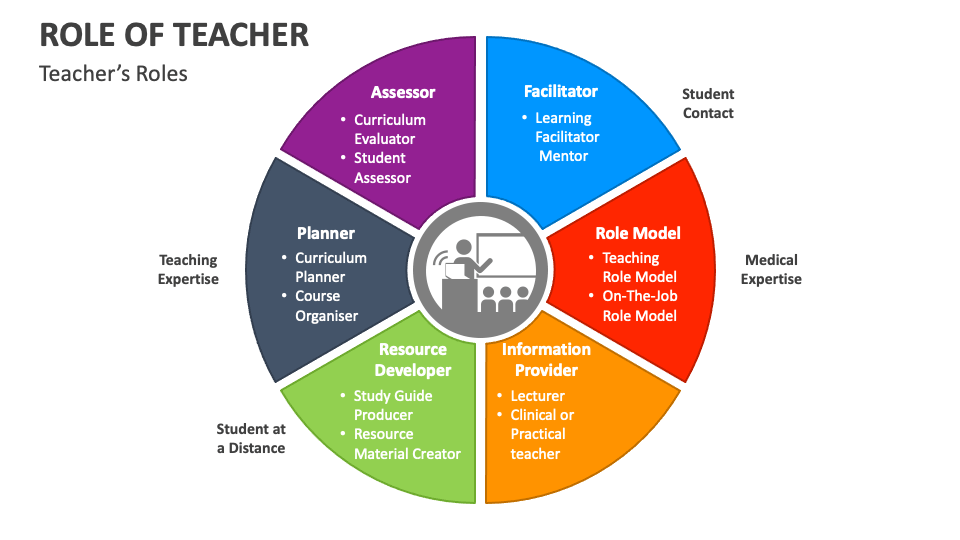
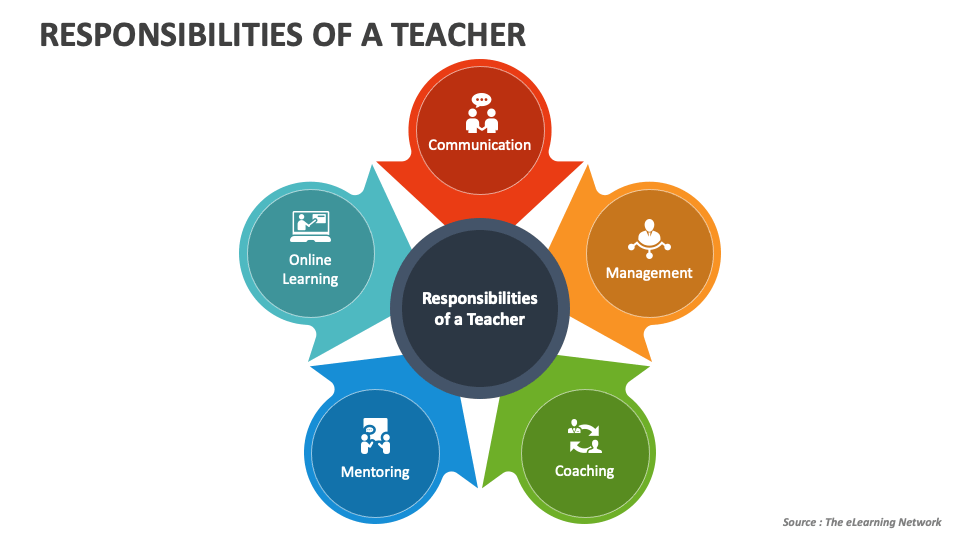
Notice the overlaps. The 'Planner' in the first image is Harmer's 'Organizer'. The 'Assessor' role appears in many models. The second image introduces 'Mentoring' and 'Coaching', which are deeper, more relationship-focused versions of the 'Tutor' role.
Teacher Roles in the Online Classroom
Your interest in online teaching is timely, as the profession is increasingly moving towards digital and hybrid models. While the core principles remain the same, the online environment demands a different emphasis and introduces new roles.
A recent academic review offers a powerful framework for understanding the roles of an online language teacher, structured into three stages: before, during, and after the lesson.
This article from Nature provides a research-based model of teacher roles specifically for online foreign language teaching. It's an excellent resource for aligning your practice with modern, digital pedagogy.
Please read the section titled "An ecological model of teacher agency in online FLT." Pay close attention to Figure 1 and the text that describes the three stages and the six key roles. Focus on understanding this central paragraph which summarizes the entire model.
Let's break down this model, as it is directly relevant to your goal of mastering online teaching:
1. Before the Lesson: The Technician and Designer
- Technician: This goes beyond just knowing how to use Zoom. It means mastering your platform's features (breakout rooms, polls, digital whiteboards), having backup plans for technical issues, and ensuring you can guide students through any difficulties.
- Designer: In the online space, you are not just delivering a lesson; you are designing a user experience. This means adapting materials for the screen, creating interactive digital tasks, and structuring activities that work well without physical presence.
2. During the Lesson: The Motivator and Communicator
- Motivator: The physical distance of online learning can lead to disengagement. Your role as a motivator is amplified. You need to create a positive, energetic atmosphere, use personalization to connect with students, and actively foster a sense of community.
- Communicator: Managing communication is more complex online. You must monitor the main audio/video feed, the chat box for questions, and private messages, all while facilitating interaction in breakout rooms. Clear, concise instructions are even more critical.
3. After the Lesson: The Assessor and Facilitator
- Assessor: Online tools offer powerful ways to assess. You might use shared documents for written feedback, video-recording tools for speaking practice, or online quiz platforms. Providing timely and constructive feedback is key to maintaining momentum between classes.
- Facilitator: This role extends beyond the live lesson. It involves being a resource for students, guiding them to self-study materials, and providing support via email or learning platforms. You facilitate their continued learning journey even when you are not in a live session.
Thinking about your teaching in these three distinct stages—before, during, and after—is a hallmark of the structured planning required for CELTA and other professional qualifications.
Conclusion
In this lesson, we have established that being an effective English teacher means being a master of many roles. You are not just a source of information, but a manager, organizer, assessor, motivator, and much more.
Key Takeaways:
- A professional teacher consciously and flexibly adopts different roles depending on the learners' needs and the lesson's aims.
- Classic ELT frameworks, like Harmer's eight roles (Controller, Organizer, Assessor, etc.), provide a foundational vocabulary for describing your actions in the classroom.
- The online environment introduces new challenges and requires a special focus on the roles of Technician, Designer, Motivator, and Communicator, organized across the stages of before, during, and after a lesson.
- Reflecting on which roles you are playing at any given moment is a key professional practice that this course will help you develop.
Next Lesson Preview:
Now that we have a solid understanding of what a teacher does, our next lesson will explore where they do it. We will distinguish between key English Language Teaching contexts, such as EFL, ESL, and ESOL. Understanding your teaching context is crucial because it directly influences which roles you will need to prioritize and how you will carry them out.