Hello! Welcome to the seventh and final lesson of our first module.
In our last lesson, we focused on conducting a needs analysis to understand what our students need to learn and where the gaps in their knowledge are. This diagnostic step is essential for learner-centered teaching. But once you've identified a "lack," how do you help a student bridge that gap without overwhelming them or oversimplifying the task? The answer lies in one of the most fundamental concepts in modern pedagogy.
Today, your learning outcome is to explain the concept of scaffolding and apply it to a lesson activity design. Scaffolding is the art of providing temporary, targeted support to enable learners to perform a task they couldn't do alone, and then gradually removing that support as they become more competent. Mastering this skill is non-negotiable for certifications like CELTA and is the key to creating effective, empowering lessons.
What is Scaffolding? The Core Concept
The term "scaffolding" is a direct analogy to construction: a temporary frame is erected to support a building during its construction and is taken down once the building can stand on its own. In education, we provide temporary support structures for our learners.
The Bell Foundation, a respected UK-based organization for EAL (English as an Additional Language) learners, provides a concise definition of scaffolding.
Please read the section What is scaffolding?. Pay close attention to the core idea of providing temporary support and the list of general strategies provided.
The key insight here is that we are not making the task easier; we are making it possible for the learner to achieve a challenging task. This idea is rooted in the work of psychologist Lev Vygotsky and his concept of the Zone of Proximal Development (ZPD).
The ZPD is the "zone" between what a learner can do independently and what they can achieve with guidance from a more knowledgeable other (like a teacher or a peer). Effective learning happens within this zone. Scaffolding is the set of actions the teacher takes to help the learner operate successfully within their ZPD.
Scaffolding for ELL Students That Benefits the Whole Class
This article from HMH provides an excellent overview of the theory behind scaffolding and how it translates into practice.
Read the section What is instructional scaffolding?. Focus on how Vygotsky's Zone of Proximal Development provides the theoretical foundation for this teaching approach.
The Gradual Release of Responsibility: "I Do, We Do, You Do"
The ZPD gives us the "why," but how does this look in a real lesson? The most common model for applying scaffolding is the Gradual Release of Responsibility. This is often simplified into a three-stage process: I Do, We Do, You Do.
- I Do (Teacher-led): The teacher takes full responsibility, demonstrating the task, modeling the language, and explaining the concept clearly. The learners watch and listen.
- We Do (Guided Practice): The teacher and learners perform the task together. This might involve the teacher eliciting answers, students working in pairs while the teacher monitors closely, or completing the first few items of an exercise as a whole class. Responsibility is shared.
- You Do (Independent Practice): The learners attempt the task on their own or in pairs/groups. The teacher steps back, monitors, and provides support only as needed. The responsibility has now shifted to the learners.
This progression ensures that students are never asked to do something they are unprepared for.
TESOL Concepts: Modeling and scaffolding in language teaching
This video from Edward TESOL visually represents how responsibility shifts from the teacher to the students during a lesson.
Watch from the section on task sequencing. Notice the "triangle" shape the presenter uses to show how teacher involvement decreases as student involvement and responsibility increase. Then, continue watching the segment about the famous quote, "Tell me and I will forget...", which perfectly captures the philosophy behind scaffolding.
Scaffolding vs. Differentiated Instruction
As you prepare for certification, it's important to use terminology precisely. A common point of confusion is the difference between scaffolding and differentiated instruction. While related, they are not the same.
- Differentiated Instruction involves modifying the content, process, or product to meet diverse learner needs. For example, giving different groups of students different texts to read based on their level, or allowing students to demonstrate understanding through either a written paragraph or a spoken presentation. It adapts the "what" and "how."
- Scaffolding is about providing temporary support to help all students access the same core task. The end goal is the same for everyone, but the amount and type of support vary.
Scaffolding for ELL Students That Benefits the Whole Class
Let's return to the HMH article, which offers a very clear distinction between these two concepts.
Read the section What Is the difference..., paying close attention to the comparison table. Also, review the explanation of the "I Do, We Do, You Do" structure within this section.
In short: Differentiation provides different paths to different or similar goals. Scaffolding provides different levels of support along the same path to the same goal.
Practical Scaffolding Techniques
Now, let's move from theory to the practical techniques you will use in your classroom. Scaffolding isn't a single action but a collection of strategies. The infographic below organizes them into helpful categories.
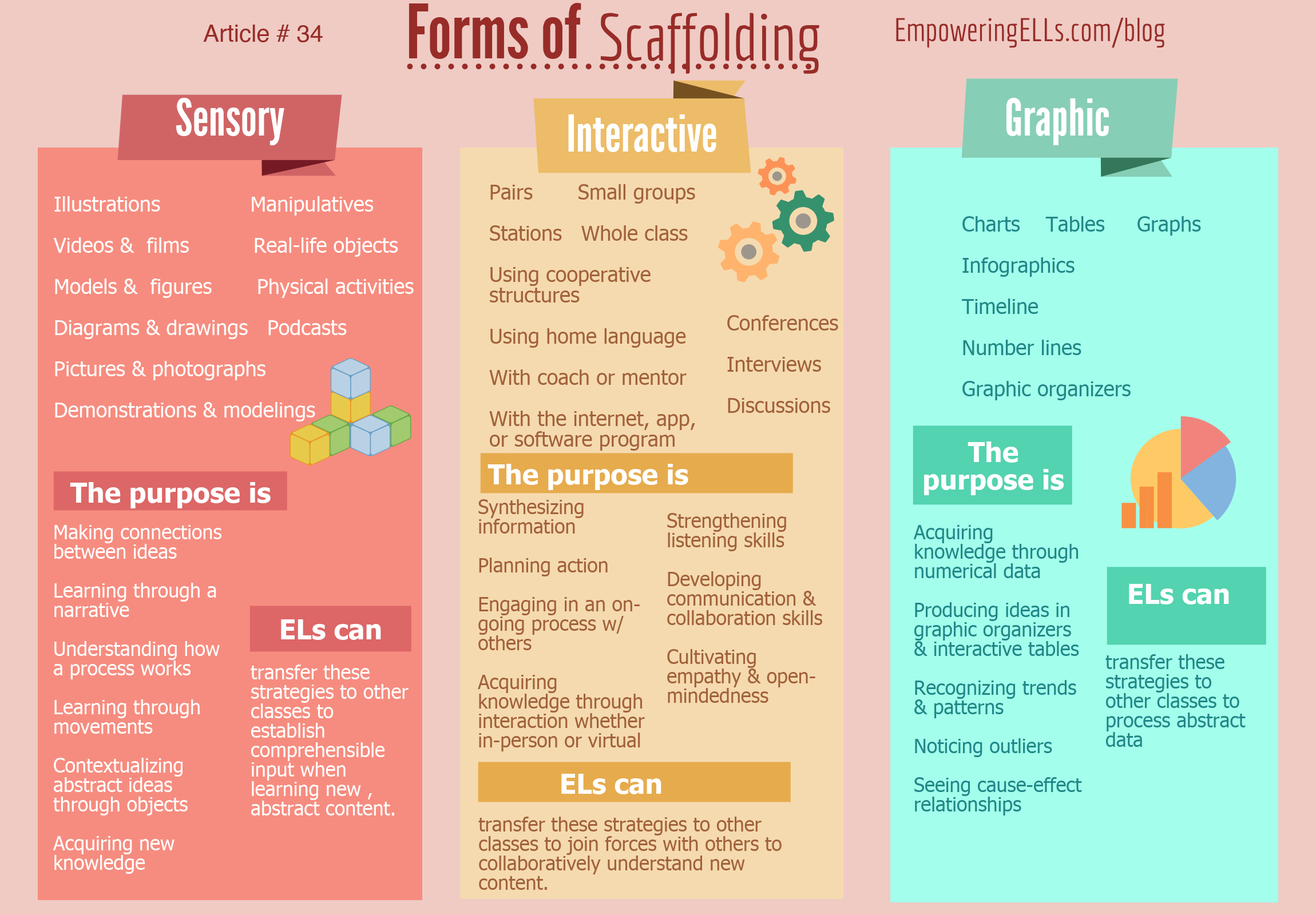
Many of these techniques will become second nature to you. Here are some of the most essential ones for language teaching:
- Modeling: This is perhaps the most important scaffolding technique. Before you ask students to do something, show them how. This applies to both activities and language. For example, before a discussion, model your own answer to the question. Before a worksheet, do the first question together.
- Pre-teaching Vocabulary: Introducing key words before students read or listen to a text removes a major barrier to comprehension.
- Using Visuals and Realia: Pictures, charts, diagrams, and real objects provide context and make abstract concepts concrete.
- Providing Language Frames: Give students sentence starters or structures to help them produce language. For example: "I think ________ because ________." or "In my opinion, ________."
- Chunking: Break down complex information or long texts into smaller, more manageable pieces.
- Activating Prior Knowledge: Start a topic by asking students what they already know about it. This builds a mental bridge to new information.
Here is an example of scaffolds specifically for teaching reading:

Scaffolding in Action: A Lesson Sequence
To see how these techniques come together, let's analyze a fully scaffolded lesson designed for young ESL learners. The goal is for students to be able to have a simple dialogue about clothes.
Scaffolding Secrets: Task-Based Lesson Tips!
The presenter, Teacher Val, provides an outstanding step-by-step walkthrough of a task-based lesson, demonstrating how to scaffold from single words to a full dialogue.
Watch the extended example from this segment. As you watch, identify the "I Do, We Do, You Do" pattern in her approach and note the specific games and activities she uses at each stage.
Let's break down the beautiful scaffolding in that example:
-
Stage 1: Vocabulary (Words)
- I Do: The teacher introduces new vocabulary (e.g., "t-shirt," "dress") using pictures, modeling the pronunciation.
- We/You Do: Students practice the vocabulary in a controlled game ("Hidden Picture"), where they only have to recall and say a single word. The task is simple, and the focus is clear.
-
Stage 2: Sentence Structure (Chunks)
- I Do: The teacher introduces the sentence pattern "I have a _______." She models it with gestures (TPR).
- We Do: The class practices the sentence pattern together.
- You Do: Students practice building the sentence in a highly structured game ("Sparkle"). Each student is only responsible for one word at a time, providing massive support while they internalize the structure.
-
Stage 3: Dialogue (Communication)
- I Do: The teacher introduces the full dialogue pattern: "What do you have?" / "I have a _______." She models it with the class.
- You Do: Students practice the full dialogue in a communicative game ("Find Mickey"). They are now putting all the pieces together in a purposeful, motivating task.
Notice how the cognitive demand increases at each stage, but so does the support. The teacher gradually releases responsibility until the students are performing the final task independently. This is a masterclass in scaffolding.
Conclusion
Today we've unpacked the crucial concept of scaffolding. You've seen how it's not about simplifying content, but about providing the temporary support that makes challenging content accessible. By understanding its theoretical roots in Vygotsky's ZPD and its practical application through the "I Do, We Do, You Do" model, you have gained a powerful framework for planning effective lessons.
Key Takeaways:
- Scaffolding is the temporary, targeted support provided to a learner to help them complete a task within their Zone of Proximal Development (ZPD).
- It follows a Gradual Release of Responsibility ("I Do, We Do, You Do"), shifting the cognitive load from the teacher to the learner.
- Scaffolding is distinct from differentiation; it provides support for all students to reach the same goal, rather than creating different paths or goals.
- Key techniques include modeling, providing language frames, chunking information, and using visuals.
- Effective scaffolding involves sequencing activities from highly controlled and supported practice to freer, more independent use of language.
Next Lesson Preview:
This lesson concludes our first module, "Foundations of English Language Teaching." You now have a solid grounding in the core frameworks and concepts. Scaffolding is a key technique for facilitating language learning. In our next module, "Core Principles of Language Acquisition," we will zoom out to explore the bigger picture. We'll begin by examining the fundamental difference between conscious language learning (like what we do in a classroom) and subconscious language acquisition (like how a child learns their first language). This distinction, proposed by Stephen Krashen, will profoundly shape your understanding of your role as a teacher.