Introduction
In our last lesson, we established the critical first step in your research plan: selecting an appropriate study design. We contrasted observational approaches like Ecological Momentary Assessment (EMA) with experimental methods such as Factorial Survey and Within-Triad Experiments, weighing the trade-offs between ecological validity and causal control. Whichever design you choose, the data you collect—whether from observations or interventions—will possess a complex, hierarchical structure. The emotions and behaviors of the husband, wife, and bull are not independent events; they are nested within dyads and the triad itself.
This lesson directly addresses the analytical challenge posed by this structure. Our objective is to select and justify the use of dyadic models for analyzing the husband-wife and wife-bull perspectives. We will focus on the Actor-Partner Interdependence Model (APIM), the standard for modeling dyadic data. You will learn how APIM not only accounts for non-independence but turns it into a source of valuable insight, allowing you to explicitly model how each person's experiences influence their own and their partner's outcomes.
The Statistical Case for Specialized Models
As we discussed in the first module, a core feature of your triadic data is non-independence. Data points from individuals within the same relationship are more similar to each other than they are to data points from individuals in other relationships. Your statistical training has already equipped you with the understanding that this violates a key assumption of ordinary least squares (OLS) regression.
To solidify why this is a critical issue that necessitates a different analytical approach, the following video provides a concise and clear explanation of hierarchical data and the consequences of ignoring it.
This video from Andy Field's lecture series on multilevel models explains the concept of hierarchical data and why it violates the independence assumption of standard regression models.
First, watch the segment that defines hierarchical data. While the examples are general (e.g., children in classrooms), they directly map onto your structure of individuals nested within dyads and triads. Next, pay close attention to the explanation of why this structure matters, from "data from the same context" to "p-values". The key takeaway is that violating the independence assumption leads to biased standard errors, confidence intervals, and p-values, making OLS results unreliable.
The issue described in the video is precisely why you cannot simply run a standard regression model with data from all three participants pooled together. Doing so would produce misleading results. The solution is to use a statistical framework that explicitly models this hierarchical structure. Multilevel Modeling (MLM), which you are already familiar with, provides this framework. Within MLM, the Actor-Partner Interdependence Model (APIM) is the specific application designed for dyadic data.
The Actor-Partner Interdependence Model (APIM)
APIM is the cornerstone of modern dyadic analysis. It moves beyond treating non-independence as a statistical nuisance to be corrected and instead conceptualizes it as a substantive phenomenon to be studied. It provides a formal structure to answer questions about how two interconnected people influence each other.
The following resource provides a comprehensive technical guide to APIM. We will use it to build our understanding of the model's components and logic.
How to Use the Actor-Partner Interdependence Model ( ...
This tutorial by Archambault, Sabourin, and Lussier is an excellent primer on the theory and application of APIM.
Begin by reading the introduction, which frames APIM as the primary method for measuring interpersonal influence in dyads. Continue through the section on dyadic data assumptions. Focus on the concept of non-independence and the distinction between indistinguishable and distinguishable dyads. This is a key conceptual point for applying the model correctly. Finally, read the section "The Actor-Partner Interdependence Model." Pay careful attention to the definitions of the actor and partner effects and the two correlations estimated in the model.
To visualize these concepts, let's examine a standard APIM path diagram.
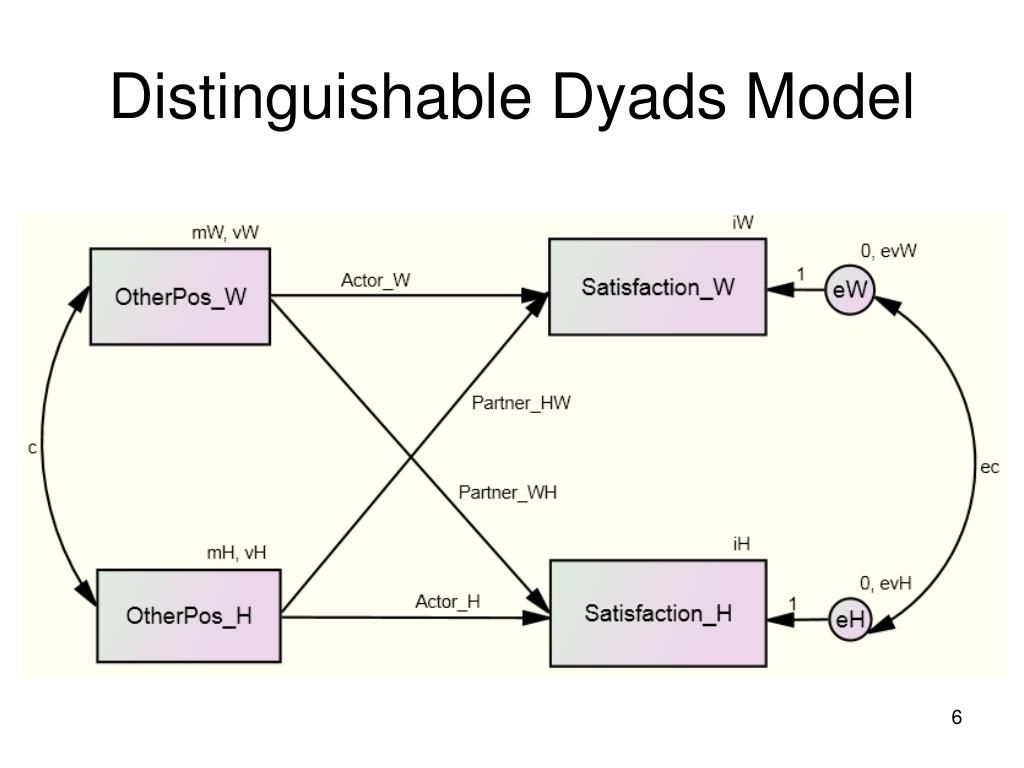
As the reading and diagram show, APIM deconstructs dyadic influence into two primary pathways:
- Actor Effects: These paths represent how an individual's own predictor variable influences their own outcome variable. For example, the path labeled
Actor_Wshows the effect of the wife'sOtherPos_Won her ownSatisfaction_W. In your study, this would be equivalent to testing how the wife's level of post-date disclosure affects her own level of guilt. - Partner Effects: These paths capture the core of interdependence. They represent how an individual's predictor variable influences their partner's outcome variable. The path
Partner_WHshows the effect of the wife'sOtherPos_Won the husband'sSatisfaction_H. This is the pathway that allows you to directly test, for example, how the wife's disclosure affects the husband's jealousy.
By estimating both actor and partner effects in the same model, APIM provides a complete picture of the interpersonal dynamics at play.
Justifying APIM for Your Research Dyads
Your capstone project requires analyzing two key dyads within the triad: the husband-wife dyad and the wife-bull dyad. APIM is the appropriate choice for both, as it allows you to test specific causal hypotheses about the emotional dynamics within each pair.
1. The Husband-Wife Dyad
This is a classic distinguishable dyad, where "husband" and "wife" are meaningful, distinct roles. APIM allows you to model how behaviors and emotions cross the boundary between them.
- Research Question Example: How does the wife's communication about her experiences with the bull affect both her own guilt and her husband's jealousy?
- Model Specification:
- Predictor: Wife's level of post-date disclosure (e.g., a continuous variable from 'vague' to 'detailed').
- Outcomes: Wife's guilt; Husband's jealousy.
- Justification: You would select APIM because it is the only model that can simultaneously test two critical hypotheses:
- The actor effect: Does greater disclosure from the wife predict a change in her own guilt? (e.g., does sharing more reduce her guilt?)
- The partner effect: Does greater disclosure from the wife predict a change in the husband's jealousy? (e.g., does more detail increase or decrease his jealousy?)
Without APIM, you could only examine these paths in separate, disconnected analyses, failing to account for their shared context and potentially drawing incorrect conclusions about the strength and significance of each effect.
2. The Wife-Bull Dyad
This is also a distinguishable dyad. The roles of "wife" and "bull" are distinct and carry different expectations and emotional contexts.
- Research Question Example: How do intimacy-related behaviors during an encounter affect the wife's feelings of guilt and the bull's feelings of connection?
- Model Specification:
- Predictor: Bull's use of aftercare/reassurance behaviors (e.g., a binary variable: 'low' vs. 'high').
- Outcomes: Wife's guilt; Bull's emotional connection to the couple.
- Justification: You would justify using APIM to untangle the reciprocal influence in this crucial interaction.
- The partner effect: Does a higher level of aftercare from the bull predict a reduction in the wife's guilt?
- The actor effect: Does a higher level of aftercare from the bull predict an increase in his own sense of connection to the couple?
APIM allows you to model how one person's actions have consequences for both themselves and their partner within a specific event, providing a nuanced understanding that is essential for your research goals.
An Applied Example in Consensual Non-Monogamy (CNM)
Theoretical justification is essential, but seeing the model in practice provides clarity on its power. The following research paper is a superb example of APIM applied to a context highly relevant to your own: need fulfillment in CNM relationships.
A dyadic examination of self-determined sexual motives, need ...
This study by Wood et al. uses APIM to explore how sexual motives and need fulfillment with a second partner are associated with outcomes in a primary relationship. Its methodology and findings are directly applicable to your capstone project.
First, read "The current research" section to understand the authors' rationale. Note how they frame the need for dyadic analysis and how they plan to use APIM to test competing models of need fulfillment by examining the influence of a second partner on the primary dyad. See their path diagrams in Fig 1 and Fig 2. Next, review the "Analytic approach" for Part 1. Pay close attention to their discussion of distinguishable vs. indistinguishable dyads and the justification for their modeling choice. Read the results section titled "Associations...with the first partner". This shows a straightforward application of APIM, identifying significant actor and partner effects within the primary dyad. Now, read the crucial follow-up section, "Associations...with a second partner". The key finding here is a significant negative partner effect: when one person felt more fulfilled by a second partner, their primary partner reported lower satisfaction. This is a concrete example of a "contrast model." Finally, read the discussion section titled "Sexual motives and need fulfillment with a concurrent sexual partner". This section interprets the contrast model finding, offering a powerful example of how APIM results can be used to build a causal narrative.
This paper provides a clear blueprint for how you can use APIM. Not only can you model the dynamics within the husband-wife dyad, but you can also test how a variable from the wife-bull dyad (e.g., wife's need fulfillment with the bull) acts as a predictor influencing outcomes (e.g., husband's relationship satisfaction) in the husband-wife dyad. This directly addresses the complex, interwoven nature of the triadic system. The discovery of a "contrast pattern" is a compelling demonstration of APIM's ability to uncover non-obvious dynamics that would be invisible to simpler analytical methods.
Conclusion
In this lesson, we have established the rationale for selecting and using the Actor-Partner Interdependence Model to analyze the dyadic perspectives within your triadic research. This choice is not merely a technical preference but a necessary step to validly analyze interdependent data and to substantively investigate the cross-person causal pathways at the heart of your project.
Key Takeaways:
- Dyadic data are inherently non-independent, violating the assumptions of standard regression and necessitating the use of specialized techniques like Multilevel Modeling.
- The Actor-Partner Interdependence Model (APIM) is the justified choice for analyzing dyadic data because it explicitly models both actor effects (how one's own traits affect one's own outcomes) and partner effects (how one's traits affect their partner's outcomes).
- APIM is ideally suited for analyzing both the husband-wife and wife-bull dyads, as both are "distinguishable" dyads where you can test specific hypotheses about reciprocal influence on emotions like jealousy and guilt.
- The model's output allows for the interpretation of rich dyadic patterns (e.g., actor-only, partner-only, couple, contrast), enabling you to test competing theories about how relationships function, as demonstrated in the CNM study.
While APIM is the premier tool for analyzing dyads, your data structure involves a third person. Analyzing the husband-wife and wife-bull dyads separately provides crucial insights, but it doesn't capture the full picture of the triadic system simultaneously. In our next lesson, we will address this by selecting and justifying a comprehensive model, such as the Social Relations Model (SRM) or a Cross-Classified Multilevel Model, capable of analyzing the emotional variance across all six relational perspectives of the triad at once.