Introduction
In our last lesson, we explored sensitivity analysis, a crucial tool for assessing the robustness of our causal claims against unmeasured confounding. We saw how methods like the E-value can quantify how strong a hidden confounder would need to be to invalidate our results. A key context where this becomes vital is in mediation analysis, where we seek to understand the mechanisms or pathways through which a cause produces its effect.
Today, we shift from testing the robustness of pathways to specifying them in the first place. Our focus will be on constructing a mediation model for a causal chain that crosses multiple perspectives within the triad. We will tackle exactly the kind of complex question central to your research, using a guiding example: How does a specific wife-bull activity lead to a change in the wife's feeling of guilt, which in turn affects the husband's level of jealousy? This involves modeling a flow of influence from a dyadic context (wife-bull) to an individual's emotion (wife's guilt) and then across to another individual's emotion (husband's jealousy).
The Logic of Mediation
At its core, mediation analysis seeks to explain how an independent variable affects a dependent variable . Instead of a single direct path, mediation posits an indirect path through a third variable, the mediator . The causal logic is that causes , and in turn causes .
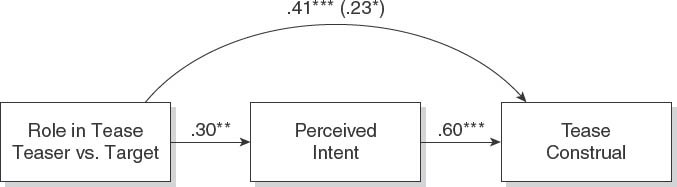
Statistically, this is typically represented by a system of two regression equations:
- Mediator Model:
- Outcome Model:
The coefficient represents the effect of on , and represents the effect of on while controlling for . The indirect effect is quantified as the product of these two coefficients, . The coefficient represents the direct effect of on that remains after accounting for the mediated pathway.
The Framework for Complex Pathways: Structural Equation Modeling
When pathways become more complex, especially when they involve multiple variables, cross-person effects, and latent constructs like emotions, we need a more comprehensive framework than running separate regression models. This is the role of Structural Equation Modeling (SEM). SEM is a general framework that integrates path analysis and factor analysis, making it perfectly suited for testing systems of relationships.
This introductory video provides an excellent overview of what SEM is and the types of research questions it helps answer.
Structural Equation Modeling: what is it and what can we use it for? (part 1 of 6)
This video from the National Centre for Research Methods introduces the core concepts of Structural Equation Modeling (SEM).
Please watch the following segments: First, watch the introduction to understand SEM as a general modeling framework. Next, focus on the types of research questions SEM is suited for, particularly its ability to handle systems of relationships and indirect effects. Finally, watch the overview of path analysis. This explains how a model is represented diagrammatically and how direct, indirect, and total effects are defined and calculated.
The video highlights two key features relevant to your work. First, SEM's ability to model latent variables is critical. Psychological constructs like jealousy and guilt are not directly observable; they are latent factors that we measure using multiple indicators from your psychometric scales. SEM allows you to model these constructs directly, correcting for measurement error. Second, SEM is built to estimate and test entire causal systems, including the indirect effects that are central to mediation.
Specifying a Triadic Mediation Model
Let's return to our guiding research question: does a wife-bull activity (X) influence the husband's jealousy (Y) through the wife's guilt (M)?
- X: Wife-Bull Activity (e.g., duration, type, location). This is a characteristic of the wife-bull dyad.
- M: Wife's Guilt. This is an individual-level variable for the wife.
- Y: Husband's Jealousy. This is an individual-level variable for the husband.
The challenge here is that the data are not independent. The husband, wife, and bull form an interdependent system. As we saw in Module 4, the Social Relations Model (SRM) provides a powerful way to conceptualize and analyze such interdependent data. A triadic mediation model is essentially a path model that is specified on top of an SRM data structure.
The following paper, which analyzes stepfamily triads (a structure analogous to your husband-wife-bull triad), is an excellent resource for understanding how to conceptualize this.
A Social Relations Model of Everyday Talk and ...
This paper by Schrodt et al. uses SEM and SRM to analyze the dynamics within a three-person family system, providing a strong conceptual parallel for your research.
Please read the following two sections: Begin with the "Theoretical Perspective" section, focusing on the discussion of the family systems 'triangle'. This reinforces the idea of the triad as the core unit of analysis. Next, carefully read the section titled "A Social Relations Model of Everyday Talk and Relational Satisfaction in Stepfamilies." Pay close attention to the definitions of actor, partner, and relationship effects. This framework is what allows us to disentangle individual-level from relationship-level phenomena.
The SRM framework allows us to correctly situate the paths in our mediation model.
- Path
a(X → M): The effect of thewife-bull activityon thewife's guilt. This is an effect on an individual from an activity she participates in. - Path
b(M → Y): The effect of thewife's guilton thehusband's jealousy. In the language of APIM and SRM, this is a partner effect. The wife's personal state (her guilt level) is influencing her partner's (the husband's) outcome (his jealousy).
By using an SEM framework that accounts for the non-independence of the triad (as described in the SRM paper), we can specify a model that correctly estimates these paths.
From Theory to Practice: Implementation in Mplus
With the conceptual model established, the next step is implementation. SEM software like Mplus is designed for this. You can specify the entire system of equations in a single syntax file, and the software will estimate all parameters simultaneously and, crucially, calculate the indirect effect and its standard error.
The following video provides a practical walkthrough of specifying a simple mediation model in Mplus. The principles are directly transferable to our more complex triadic case.
Path Analysis & Mediation in Mplus
This QuantFish tutorial by Christian Geiser demonstrates exactly how to define, run, and interpret a path analysis with mediation in Mplus.
As you watch, think about how you would adapt this to your own research question. Model Syntax: Watch the segment from the beginning of the Mplus section. Notice how the two regression equations are specified using the ON statement. For our example, this would translate to: husband_jealousy ON wife_guilt wife_bull_activity; (This is the outcome model, Y on M and X) wife_guilt ON wife_bull_activity; (This is the mediator model, M on X) Specifying the Indirect Effect: Pay close attention to the MODEL INDIRECT command, explained from this timestamp. This command tells Mplus to compute the indirect effect of wife_bull_activity on husband_jealousy. The video also explains the critical importance of requesting CINTERVAL(BCBOOTSTRAP) to get bias-corrected bootstrap confidence intervals, which is the current best practice for testing indirect effects. Interpreting the Output: Review the final segment on interpreting the results. Focus on where to find the path coefficients (a, b, c') and, most importantly, the confidence interval for the indirect effect. The key test is whether the 95% confidence interval for the indirect effect contains zero.
While this video uses a simple three-variable model with independent observations, the syntax for specifying the mediation paths remains the same. In more advanced models for triadic data, you would add syntax to account for the non-independence (e.g., using TYPE = COMPLEX and clustering by triad), but the core logic of defining the mediation pathway is identical.
A Formal View: The Group Actor-Partner Interdependence Model (GAPIM)
For a more formal statistical perspective, the Group Actor-Partner Interdependence Model (GAPIM) extends the dyadic APIM to small groups, including triads. This framework provides the precise vocabulary for the effects we are modeling.
[PDF] Using the Actor-Partner Interdependence Model to Study the Effects ...
This seminal paper by Kenny and Garcia details the GAPIM. Your statistical background makes this a valuable read to solidify the theoretical underpinnings.
First, read the section "Individual Outcomes" which presents the GAPIM-I model. In our example, both the wife's guilt and husband's jealousy are individual outcomes. Notice how the model includes actor effects and "others' effects." The path from wife's guilt to husband's jealousy is a specific instance of an "others' effect." Next, glance at the "Dyad-Level Outcomes" section, which introduces the GAPIM-D model. This is relevant for modeling the first stage of our pathway, where the predictor wife-bull activity is a property of a dyad within the larger triad.
The GAPIM framework confirms that our multi-perspective mediation model is a well-defined system of effects that can be decomposed and estimated. It provides the formal justification for specifying a path from a characteristic of one group member (the wife's guilt) to the outcome of another (the husband's jealousy).
Conclusion
In this lesson, we have laid the groundwork for analyzing the mechanisms of emotional influence within the triad. We've moved from a simple causal arrow to a specified, testable causal chain that spans multiple participants.
Key Takeaways:
- Mediation analysis explains how an effect occurs by modeling an indirect pathway through a mediator variable ().
- A causal pathway can span multiple perspectives, such as from a dyadic activity (wife-bull) to one person's emotion (wife) and on to another's (husband).
- Structural Equation Modeling (SEM) is the ideal framework for specifying and testing these complex systems of relationships, as it can simultaneously model all paths and account for latent variables.
- The path from one person's state (e.g., wife's guilt) to another's outcome (e.g., husband's jealousy) is a partner effect, a core concept from APIM and related models like SRM and GAPIM.
- Software like Mplus allows for the direct specification of these models and provides robust methods (bootstrapping) for testing the significance of the all-important indirect effect.
In our next lesson, we will build directly on this foundation. Having learned how to specify these models, we will focus on how to test indirect effects in actor-partner mediation models, exploring cases where a mediator for one participant influences an outcome for another in greater detail.