Hello. In our recent lessons, we've constructed Actor-Partner Interdependence Models (APIMs) for each of the three dyads within the triad: husband-wife, wife-bull, and husband-bull. By estimating actor and partner effects, you've learned to quantify the direct influence each person's characteristics have on their own and their partner's outcomes. These models provide a robust foundation for understanding the main pathways of influence.
However, interpersonal dynamics are rarely so simple. The effect of one person's actions often depends on the context, or on the characteristics of the other person. This lesson moves beyond main effects to explore these conditional relationships by testing and interpreting interaction effects within the APIM. Our goal is to answer more nuanced causal questions, such as identifying when one participant's behavior amplifies (strengthens) or buffers (weakens) another's emotional response. This is a critical step toward building a truly comprehensive model of the triad's emotional ecosystem.
What is an Interaction Effect?
In statistical terms, an interaction occurs when the effect of one predictor variable on an outcome variable depends on the level of a second predictor variable. Given your background in Design of Experiments, this concept should be familiar; it's analogous to interaction effects in factorial ANOVA, where the effect of one factor is not consistent across the levels of another.
Within APIM, this allows us to model how actor and partner effects might change under different conditions. For example, a partner effect might exist for some people but not others, or it might be positive in one context and negative in another.
To build our intuition, let's start with two excellent videos that explain the concept of interactions from both a regression and an experimental design perspective.
This video, "Interaction Variables", provides a clear, step-by-step introduction to how interaction terms work in a regression model. It masterfully explains how adding a product term allows you to estimate different slopes for different groups.
Please watch the first three segments. The introduction explains the core motivation: moving beyond a single marginal effect to ask how an effect differs across groups. The next section shows how an interaction between a binary variable (gender) and a continuous variable (education) is modeled and interpreted. Pay close attention to how the coefficients are interpreted as intercepts, slopes, and differences in intercepts and slopes. Finally, the subsequent part applies numerical estimates, which solidifies the interpretation.
The second video, "Main effects & interactions", explains the concept from a visual, ANOVA-centric viewpoint, which will connect directly with your DOE knowledge.
Focus on the segment explaining interactions, which begins around the 5:33 mark. The key insight here is the framing of an interaction as a "difference of differences." The effect of sleep deprivation is different for the caffeine group than for the placebo group. This is exactly the logic we will apply in APIM.
Types of Moderators in APIM
In dyadic analysis, the variables that create these interaction effects—called moderators—can be categorized into three types. Understanding these types is essential for formulating precise hypotheses. The following reading provides a formal introduction to this topic.
A Primer Into Moderated Actor–Partner Interdependence ...
This article is a foundational text on moderation in APIM. It clearly defines the different ways a variable can moderate actor and partner effects.
Please read the introduction and the three short sections defining the types of moderators: Start with the introductory section, "Extending APIM to Moderation Hypotheses". Read about the Within-dyads moderator, which are variables that distinguish partners within a dyad (e.g., Role: Husband vs. Wife). Read about the Between-dyads moderator, which are variables that characterize the dyad as a whole (e.g., relationship length, communication style). Finally, read about the Mixed moderator. This is often the most interesting type, where we test an actor-partner interaction—how a partner's characteristic moderates an actor's own processes.
To summarize the reading, we can investigate questions like:
- Within-dyads: Does the actor effect of personality on guilt differ for the wife versus the bull? (Here,
Roleis the moderator). - Between-dyads: Is the partner effect of wife's excitement on husband's jealousy weaker in dyads that practice a high degree of "aftercare" communication? (Here,
Aftercare Practiceis the moderator). - Mixed (Actor-Partner Interaction): Does the wife's level of reassurance (partner variable) buffer the effect of the husband's low self-esteem (actor variable) on his jealousy? (Here, the partner's variable moderates the actor's process).
Specifying and Interpreting an Actor-Partner Interaction
Let's focus on the actor-partner interaction, as it directly addresses hypotheses about one person's behavior amplifying or buffering another's. We model this by adding a product term of the actor's and partner's predictor variables to the APIM regression equation.
Let's build a specific model for the husband-wife dyad to investigate a buffering hypothesis.
- Research Question: Does a wife's reassurance buffer the relationship between a husband's attachment anxiety and his jealousy?
- Variables:
- Outcome : Husband's Jealousy
- Actor Predictor : Husband's Attachment Anxiety
- Partner Predictor : Wife's Reassurance Communication (e.g., frequency or quality score)
- Hypothesis: We expect a positive actor effect of anxiety on jealousy (). We expect a negative partner effect of reassurance on jealousy (). Crucially, we hypothesize an interaction: the wife's reassurance will be more effective at reducing jealousy for husbands with high anxiety.
The model for the husband's jealousy is:
The interpretation hinges on the interaction coefficient, :
- : The actor effect of husband's anxiety on his jealousy when the wife's reassurance is zero.
- : The partner effect of wife's reassurance on husband's jealousy when the husband's anxiety is zero.
- : This is the key. It represents how the actor effect of anxiety changes for every one-unit increase in wife's reassurance. Equivalently, it is how the partner effect of reassurance changes for every one-unit increase in husband's anxiety. A significant indicates moderation.
If our hypothesis is correct, we expect to be negative. Why? The total effect of Reassurance is . If is negative, then as Anxiety_H gets larger, the term becomes a larger negative number, making the overall effect of reassurance stronger (i.e., more protective).
Probing and Visualizing Interactions
A significant interaction term is just the first step. To truly understand its meaning, you must probe the interaction. This is typically done by calculating and testing simple slopes: the effect of one variable at specific levels of the moderator (e.g., at -1 SD, mean, and +1 SD).
The most intuitive way to present these results is with a graph.
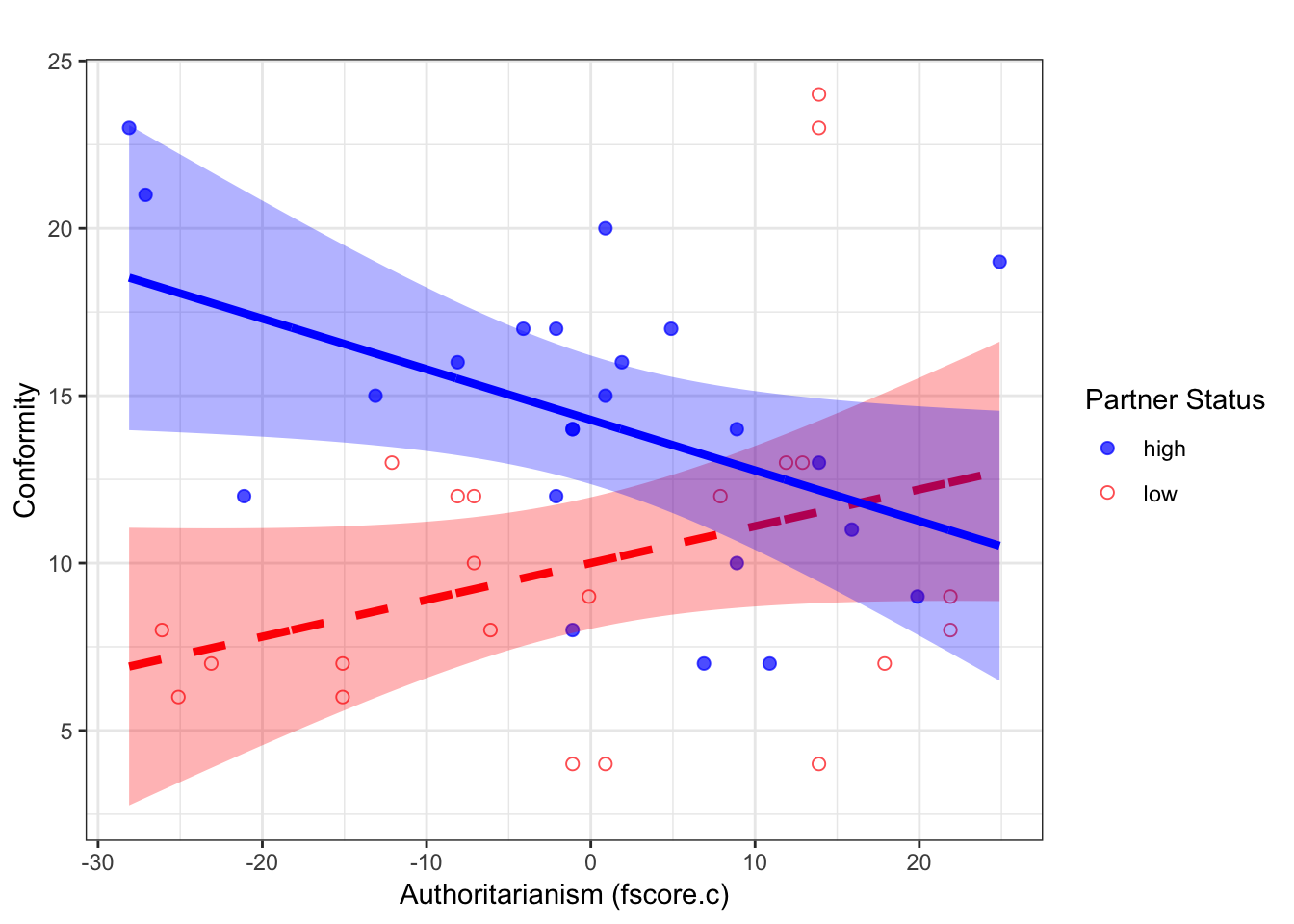
The following practical guide demonstrates how to implement, probe, and visualize these interactions. While it uses R, the logic of re-centering variables to test simple slopes is a standard technique applicable in any statistical software.
This guide walks through the practical steps of modeling and interpreting actor-partner interactions. It provides a clear, code-based example.
Focus on the following sections for distinguishable dyads, which is most relevant for your research: First, review the Product Approach section for indistinguishable dyads to see the basic model setup with a predictor_A * predictor_P term. Then, jump to the section on Distinguishable Dyads and review the product approach example. Pay close attention to the model specified in the gls function call which includes GenderstringMan:CAvoid_A:CAvoid_P. This is estimating separate interaction terms for men and women. Next, review the crucial section on Testing Simple Slopes. Notice the re-centering strategy: creating new variables where high (+1 SD) or low (-1 SD) values of the moderator are set to zero. Rerunning the model with these new variables allows the main effect of the predictor to be interpreted as the simple slope at that specific level of the moderator. Finally, look at the Graphing the Interaction section to see how these results are translated into an interpretable plot, similar to the one shown above.
By probing and plotting the interaction from our anxiety-reassurance example, we could generate a plot showing two lines: one for high-anxiety husbands and one for low-anxiety husbands. The x-axis would be "Wife's Reassurance" and the y-axis would be "Husband's Jealousy." If our buffering hypothesis holds, we would see that the line for high-anxiety husbands has a much steeper negative slope than the line for low-anxiety husbands, visually demonstrating that reassurance is a more potent antidote to jealousy for them.
Conclusion
In this lesson, you've added a powerful tool to your dyadic analysis toolkit. Moving beyond main effects to model interactions allows you to capture the conditional nature of interpersonal influence.
Key Takeaways:
- An interaction effect in APIM means that an actor or partner effect's strength or direction depends on a third variable (a moderator).
- Moderators can be characteristics of the individuals (within-dyads), the dyad itself (between-dyads), or the partner's score on a predictor (actor-partner interaction).
- Statistically, interactions are modeled by adding a product term of the predictor and moderator to the regression equation.
- A significant interaction term must be interpreted by probing it, typically by calculating and graphing simple slopes to visualize how the effect changes at different levels of the moderator.
You are now equipped to model not just if one person affects another, but also when and how that influence operates. This completes our deep dive into dyadic modeling with APIM. In the next module, we will broaden our focus from dyads to the entire triad, introducing the Social Relations Model (SRM) to decompose emotional responses into perceiver, target, and relationship-specific components.