In our previous lessons, we established the Actor-Partner Interdependence Model (APIM) as a robust framework for analyzing the husband-wife dyad, focusing on how to estimate and interpret the effects of personality traits on emotional outcomes like jealousy and guilt. You learned to move beyond simple significance testing to identify nuanced dyadic patterns that describe the nature of their interdependence.
This lesson extends that knowledge to another critical dyad within your research focus: the wife-bull dyad. While the APIM structure remains the same, its application here requires a conceptual shift. Instead of modeling a continuous relationship, we are now modeling the effects of discrete, shared activities. This will allow you to answer questions about how the nature of an encounter influences the emotional responses of both the wife and the bull. The central concept we will introduce is distinguishability, which is crucial for correctly specifying the model when the two partners have fundamentally different roles.
Defining the Wife-Bull Dyad: Distinguishable Roles and Activity-Based Variables
In the husband-wife dyad, both individuals are partners in a marriage, and while they have different genders, their roles can sometimes be treated as exchangeable for certain variables. In the wife-bull dyad, the roles are intrinsically different and non-exchangeable. The wife is a partner in the primary relationship, while the bull is an external participant. This makes them a distinguishable dyad. This distinction is not merely semantic; it has direct implications for how we specify the model. It means we must estimate separate, unique effects for each person without assuming their influences are reciprocal or identical.
Since this dyad is defined by shared encounters, our predictor variables will be characteristics of those activities. Let's consider a practical example:
- Predictor Variable (X):
Activity Intimacy. This could be a measure rated by both the wife and the bull after each encounter, capturing their subjective perception of the intimacy level (e.g., on a scale from 1 for a public meeting to 10 for a multi-day trip). Let's denote the wife's rating as and the bull's rating as . - Outcome Variables (Y):
- Wife's Outcome ():
Post-Encounter Guilt. - Bull's Outcome ():
Emotional Investment.
- Wife's Outcome ():
The fundamental causal question is: How does the perceived intimacy of an encounter (from both participants' perspectives) affect the wife's guilt and the bull's emotional investment?
The APIM provides a perfect structure to disentangle these effects. Let's visualize it.
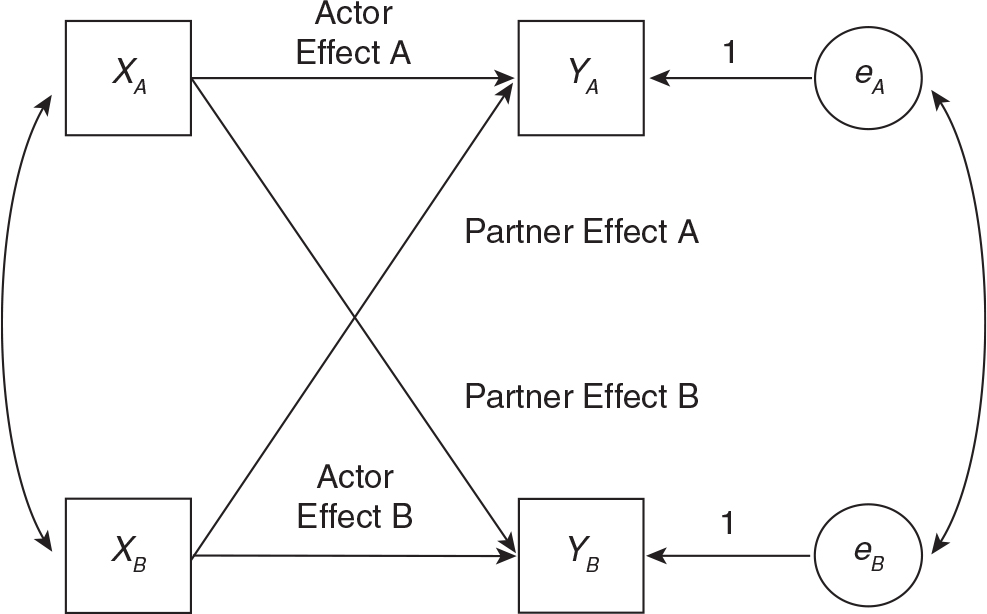
This diagram shows four key causal paths:
- Wife's Actor Effect: The path from her own perceived intimacy () to her own guilt ().
- Bull's Partner Effect (on Wife): The path from the bull's perceived intimacy () to the wife's guilt (). This is labeled "Partner Effect B" in the diagram.
- Bull's Actor Effect: The path from his own perceived intimacy () to his own emotional investment ().
- Wife's Partner Effect (on Bull): The path from the wife's perceived intimacy () to the bull's emotional investment (). This is labeled "Partner Effect A" in the diagram.
To formalize this, please review the core concept of distinguishability.
Section 10 The Actor-Partner Interdependence Model (APIM)
This section from a guide on dyadic models provides a concise definition of distinguishability and presents the corresponding path diagrams.
Please read the section titled "10.2 Distinguishability". Focus on the conceptual difference between the models in Figures 10.1 and 10.2. Note how the subscripts differ, signifying that the effects are estimated separately for each member in the distinguishable case.
Specifying the Model Equations
Given that the wife-bull dyad is distinguishable, we specify two separate regression equations. We do not constrain the actor effects or partner effects to be equal across participants.
The equation for the wife's guilt () is:
The equation for the bull's emotional investment () is:
Let's break down the four crucial coefficients:
- (Wife's Actor Effect): How the wife's own perception of intimacy influences her guilt. A positive coefficient would suggest that the more intimate she finds an encounter, the more guilt she feels.
- (Bull's Partner Effect on Wife): How the bull's perception of intimacy influences the wife's guilt. This is a measure of interpersonal influence. For example, if the bull perceives and communicates high intimacy, does that increase or decrease the wife's guilt?
- (Bull's Actor Effect): How the bull's own perception of intimacy influences his emotional investment. A positive coefficient would be expected, indicating that his investment grows with perceived intimacy.
- (Wife's Partner Effect on Bull): How the wife's perception of intimacy influences the bull's emotional investment. This path is particularly interesting for understanding the dyadic dynamic. Does the bull's investment depend more on his own feelings or on the signals he gets from the wife?
Additionally, the model estimates the correlation between the predictors () and the correlation between the residuals (), which captures any remaining non-independence in the outcomes not explained by the predictors.
From Specification to Estimation
Your background in statistics means you are familiar with fitting such models. For distinguishable dyads, Structural Equation Modeling (SEM) is the most direct estimation method. This requires structuring your data in a "dyad-wide" format, where each row represents a single unit of analysis (in this case, a single wife-bull encounter) and contains the variables for both participants.
For an encounter i, a row in your dataset would look something like this:Encounter_ID | Wife_Intimacy_i | Bull_Intimacy_i | Wife_Guilt_i | Bull_Investment_i
The following resource provides a concrete example of how to specify and estimate a distinguishable APIM using the lavaan package in R, which is a common tool for SEM.
Section 10 The Actor-Partner Interdependence Model (APIM)
This guide walks through the practical steps of data organization and model estimation for a distinguishable dyad using SEM.
First, read section "10.7 Dyadic Data Organization" to see how data is structured for this type of analysis, focusing on the "Dyad" or wide format. Next, review section "10.8 Distinguishable Case" and its subsection "10.8.1 SEM Approach: Data Setup". You don't need to replicate the R code, but focus on how the lavaan syntax in the model specification block directly translates the path diagram and equations we've discussed into a testable model. Notice how future.m ~ contrib.m + contrib.f specifies the actor and partner effects for one member of the dyad.
Interpreting the Dyadic Dance
The real insight comes from interpreting the pattern of these four effects. Let's consider some plausible hypotheses you could test:
- A "Self-Contained" Dynamic: You might find significant actor effects ( and ) but non-significant partner effects. This would suggest that the wife's guilt is driven primarily by her own interpretation of the event, and the bull's investment is driven by his, with little cross-influence during the event itself.
- A Wife-Led Dynamic: You might find a significant partner effect from the wife onto the bull () but a non-significant partner effect from the bull onto the wife (). This could indicate that the wife's perception of intimacy is a key driver of the bull's emotional investment, but her guilt is less susceptible to his perception.
- Contrast Effects: You could find that the wife's perception of intimacy decreases her guilt (a negative actor effect, , perhaps because high intimacy feels more "justified"), while the bull's perception of intimacy increases her guilt (a positive partner effect, , perhaps because his investment feels threatening to her primary relationship). This is a "contrast pattern," which you'll recall from our previous lesson.
To formally compare the relative strength of actor versus partner effects for each person's outcome, you would again use the parameter (), calculated separately for the wife and the bull. For a brief refresher on the logic of these patterns, you can revisit the tutorial from our last lesson.
How to Use the Actor-Partner Interdependence Model ( ...
This tutorial provides a good review of the foundational concepts of APIM.
Briefly reread the sections "The Actor-Partner Interdependence Model" (p. 75) and "Dyadic patterns" (p. 75). This will reinforce the definitions of actor/partner effects and the four main patterns that can emerge from their interplay.
Conclusion
In this lesson, we have adapted the APIM framework to the specific context of the wife-bull dyad. You have learned how to specify a model that accounts for the distinguishable roles of the participants and uses activity-based measures as predictors. This approach allows you to dissect the complex interplay of perceptions and emotions within each encounter.
Key Takeaways:
- The wife-bull dyad is best modeled as a distinguishable dyad because the participants have distinct and non-exchangeable roles.
- For distinguishable dyads, APIM estimates four unique paths: two actor effects and two partner effects, without assuming equality between them.
- Predictor variables can be based on the characteristics of a specific activity or encounter, as rated by both participants.
- The interpretation of the four effects can reveal the underlying emotional "dance" of the dyad—for instance, whether it is driven more by one person's perceptions or if there is significant mutual influence.
- SEM is the preferred method for estimating APIMs in distinguishable dyads, requiring data in a dyad-wide format.
In our next lesson, we will complete our tour of the dyadic subunits by applying this same logic to the husband-bull dyad. We will consider how to adapt the APIM framework to model their unique, and often indirect, relationship, further building our comprehensive understanding of the entire triadic system.