In our previous lesson, we established the fundamental environmental context of the GCC, focusing on the core agricultural constraints of water scarcity, extreme climate, and limited arable land. Today, we'll examine how the region's two largest economies, Saudi Arabia and the UAE, are strategically responding to these challenges. This lesson focuses on their ambitious national food security strategies: Saudi Arabia's Vision 2030 and the UAE's National Food Security Strategy 2051.
Understanding these high-level strategies is crucial for your career preparation. They are the roadmaps that dictate government investment, private sector opportunities, and technological adoption. Knowing the direction the industry is headed will allow you to position yourself as a knowledgeable and relevant candidate in the job market.
The Shift in Food Security Strategy
Historically, food security might have been equated with complete self-sufficiency. However, given the constraints we discussed, the modern definition in the GCC is more nuanced. It's about ensuring a stable, accessible, and affordable food supply through a combination of four pillars:
- Strategic Domestic Production: Increasing local output of selected food items using water-efficient technologies.
- Strategic International Investments: Acquiring farmland and food production assets overseas.
- Resilient Supply Chains: Maintaining diverse import sources and efficient logistics.
- Strategic Reserves: Holding significant stockpiles of essential commodities.
The strategies of Saudi Arabia and the UAE are heavily focused on the first pillar, driving a technological revolution in local agriculture.
Saudi Arabia: Vision 2030 and Agricultural Transformation
Saudi Arabia's Vision 2030 is a massive national blueprint to diversify the economy away from oil. Agriculture is a key component of this vision, not just for food security, but for economic growth and rural development. The strategy represents a significant shift from the unsustainable "groundwater mining" practices of the past toward a more calculated, technology-driven approach.
For a detailed look at the specific agricultural targets within Vision 2030, the following report from Saudi FoodTech is an excellent resource.
Food and Agriculture Sector in the Saudi Vision 2030 Annual Report 2024 - Saudi FoodTech
This report clearly outlines the specific, measurable goals that the Kingdom has set for its food and agriculture sector.
Please read two sections. First, read the section under the heading "Vision 2030 Targets" to understand the four main goals. Then, continue to the next section, "Sustainable Agricultural Development," which details the critical focus on resource management.
As you can see from the reading, the Saudi strategy is multi-faceted:
- Targeted Self-Sufficiency: Rather than trying to grow everything, the focus is on achieving over 100% self-sufficiency in products well-suited to controlled environment production, like dairy and eggs, while significantly boosting poultry and aquaculture.
- Economic Diversification: Increasing agriculture's contribution to the national GDP.
- Waste Reduction: A major initiative to cut food waste by 50%, recognizing that saving food is as important as producing it.
- Sustainability and Technology: This is the core of the new approach. The vision explicitly calls for improving water efficiency and expanding the use of modern technologies like vertical farming and smart agriculture. This is a direct response to the lessons learned from the depletion of fossil aquifers.
To understand the strategic thinking behind this transformation, this next video provides an expert perspective on the evolution of Saudi agricultural policy.
Transforming Food Security: The Saudi Agricultural Experience
In "Transforming Food Security: The Saudi Agricultural Experience," Dr. Turki Faisal AlRasheed discusses the drivers behind the country's agricultural strategy.
Watch the segment from 2:32 to 3:17, where the author explains how global crises reinforced the importance of food security as a national priority. Then, watch the section from 3:56 to 5:21, which details the complex challenges (water scarcity, population growth) and the resulting focus on water optimization and technological innovation.
This emphasis on technology and sustainability is creating significant job opportunities in areas like greenhouse management, precision irrigation, and agronomy for soilless systems.
UAE: National Food Security Strategy 2051
The UAE, with its smaller landmass and historic reliance on imports (around 90% of its food), has adopted a strategy that leans even more heavily into technology and innovation. The National Food Security Strategy 2051 is ambitious, aiming to position the UAE as a world-leading hub in food security innovation.
The financial publication Alpen Capital provides a concise summary of the key pillars.
This short article gives a high-level overview of the GCC strategies.
Focus on the bullet point for the UAE's strategy. Note the emphasis on "modern technologies" as the primary driver.
The core of the UAE's strategy is to overcome its natural limitations—land and water—through technology. This involves creating entire new ecosystems for food production where none existed before.
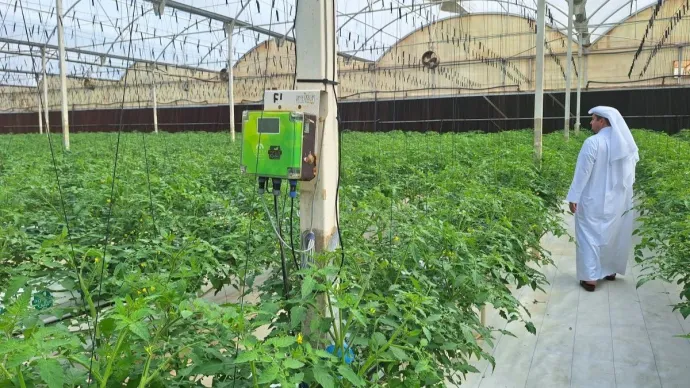
A perfect example of this strategy in action is the recent initiative to grow wheat in the Sharjah desert. This project showcases the UAE's willingness to invest heavily in large-scale, high-tech solutions to reduce import dependency.
UAE farms the desert in quest for food security
This Reuters report, "UAE farms the desert in quest for food security," provides a look at the Sharjah wheat project.
Watch the entire video (it's short). Pay attention to the scale of the project and the challenges mentioned, such as the need for desalinated water. Notice the use of technology, including AI and thermal imaging for monitoring, and the forward-looking plans for water recycling and experimental fields.
This project encapsulates the UAE's approach: if the environment isn't suitable, change the environment. This philosophy drives the rapid growth of vertical farms, indoor hydroponic facilities, and advanced greenhouses that you see across the country.
A Tale of Two Strategies
While both nations are moving in the same direction, there are subtle differences in their approaches driven by their unique circumstances.
| Aspect | Saudi Arabia (Vision 2030) | UAE (Strategy 2051) |
|---|---|---|
| Primary Driver | Economic diversification and resource sustainability | Import substitution and innovation leadership |
| Scale & Scope | Large-scale production, revitalizing vast rural areas | High-intensity, high-tech "hubs" and landmark projects |
| Key Emphasis | Targeted self-sufficiency, waste reduction, sustainable use of existing resources | Pushing technological boundaries, creating new production environments |
| Example | Achieving 109% self-sufficiency in dairy through large, efficient farms. | Cultivating wheat in the desert using desalinated water and AI. |
For a job seeker with a background in agriculture, these strategies signal a clear demand for professionals who are proficient in technology, data analysis, and resource management—the very skills this course is designed to build.
Conclusion
In this lesson, you have seen how Saudi Arabia and the UAE are translating the immense challenges of their environment into strategic, technology-forward agricultural policies.
Key Takeaways:
- Both Saudi Arabia's Vision 2030 and the UAE's National Food Security Strategy 2051 prioritize boosting domestic food production through technology.
- The Saudi strategy focuses on targeted self-sufficiency in key sectors, economic contribution, and sustainable management of its vast land resources.
- The UAE's strategy is heavily centered on technological innovation to overcome natural limitations, aiming to become a global leader in agritech.
- Both strategies create a strong demand for professionals skilled in Controlled Environment Agriculture (CEA), precision irrigation, and data-driven farming.
In our next lesson, we will identify the main public agricultural bodies in the region, such as Saudi Arabia's Ministry of Environment, Water and Agriculture (MEWA) and the UAE's Ministry of Climate Change and Environment (MoCCAE). These are the government entities tasked with implementing the ambitious strategies we have discussed today.