Hello. In the previous lesson, you carried an age-62 primary insurance amount forward with cost-of-living adjustments (COLAs), including adjustments made before claiming, and then applied the claiming-age factor. A larger monthly check from waiting does not tell you whether waiting produces more total payments: the earlier claimant has been collecting checks in the meantime.
This lesson compares those two streams in constant dollars—amounts expressed in the same year’s purchasing power. You will find the age when their cumulative totals are equal, then distinguish that break-even age from the first month when delayed claiming is ahead. This is a comparison of retirement checks under stated assumptions, not a comparison with lifetime payroll contributions.
What the crossing point means
Suppose one worker could claim at 62 or wait until 67. These are alternative choices for the same worker, not payments that can both be collected. Claiming at 62 creates an initial lead: five years of checks have arrived before the age-67 option pays anything. After 67, the later option pays more each month and gradually closes that lead.
The crossing point is called the break-even age. Before it, the earlier claim has produced more cumulative payments. At it, the totals are equal. After it, the later claim has produced more—provided payments continue. Notice that the question is about how long the worker receives payments, not simply which monthly benefit is higher.
Watch the worked comparison in Social Security Breakeven Math EXPLAINED In 5 Minutes by Ari Taublieb. Focus on the two quantities needed for the calculation: the payments forgone while waiting and the extra amount received each month afterward.
Social Security Breakeven Math EXPLAINED In 5 Minutes
Ari Taublieb's short worked example shows how an early claimant's initial lead is recovered by a larger later monthly benefit.
Watch the calculation, from the age-62 and age-67 benefit amounts through the resulting crossover age. The video rounds its conclusion to about age 79; below, we will locate equality more precisely and identify the first monthly payment that puts the later claimant ahead.
Calculate the age, one month at a time
Use the video’s simplified figures: an age-62 benefit of per month and an age-67 benefit of per month. The latter is the primary insurance amount in this example. Assume the worker’s earnings record does not change either estimate, benefits remain constant in purchasing power, and every scheduled monthly payment is received. For now, set aside taxes, investment returns, and other deductions.
The age-62 claimant receives 60 months of payments before the other option begins:
At 67, that is the initial lead to overcome. From then on, both options pay each month, but waiting provides an extra:
Dividing the lead by this monthly advantage gives the time needed to erase it:
That is 140 months after age 67, not after age 62. Since 140 months is 11 years and 8 months, cumulative payments are equal at approximately age 78 years and 8 months.
It is worth checking the result against the totals. By that point, the early claimant has collected for months; the later claimant has collected for 140:
Equality is not yet an advantage for waiting. After one more monthly payment, the early option totals , while the later option totals . Thus, in this monthly-payment model, the later option first overtakes the earlier one with the 141st payment after claiming at 67, about age 78 years and 9 months. Describing this loosely as “around age 79” is useful for orientation, but it hides the distinction between equality and overtaking.
A formula you can reuse
The same reasoning works for any two claiming ages with fixed real monthly amounts. Let be the earlier monthly benefit and the later monthly benefit. Let be the number of months between the claiming ages, and the number of months paid after the later claim begins. At that point, cumulative payments are:
Set them equal and solve for the months after the later claim:
The numerator, , is the early claimant’s lead when later claiming begins. The denominator, , is how much of that lead the later option recovers each month. This shortcut requires ; otherwise, the later option cannot catch up under these assumptions.
A published example offers a useful check with different ages and amounts. In the Financial Planning Association article When to Start Collecting Social Security Benefits: A Break-Even Analysis, the worker’s full retirement age is 66 because the example concerns a worker born in 1949. Treat its dates and benefit amounts as an illustration, not current benefit estimates for everyone.
Read the Financial Planning Association's worked age-62-versus-age-66 comparison to see the same calculation expressed as cumulative payment totals.
In “Break-Even Calculations,” go to the subsection “The Analysis Begins.” Start with the paragraph about a worker born March 2, 1949, and read the worked example through the sentence reporting equal totals 144 months after full retirement age. Focus on why the age-62 option leads by 48 months of checks and why the age-66 option catches up 144 months later. You can follow the prose without reproducing its spreadsheet.
In that example, four years of monthly payments create a lead. Claiming at 66 instead pays , an extra per month. The lead therefore disappears after months, or 12 years beyond age 66. Different claiming ages and benefits produce a different break-even age; there is no universal “magic” age.
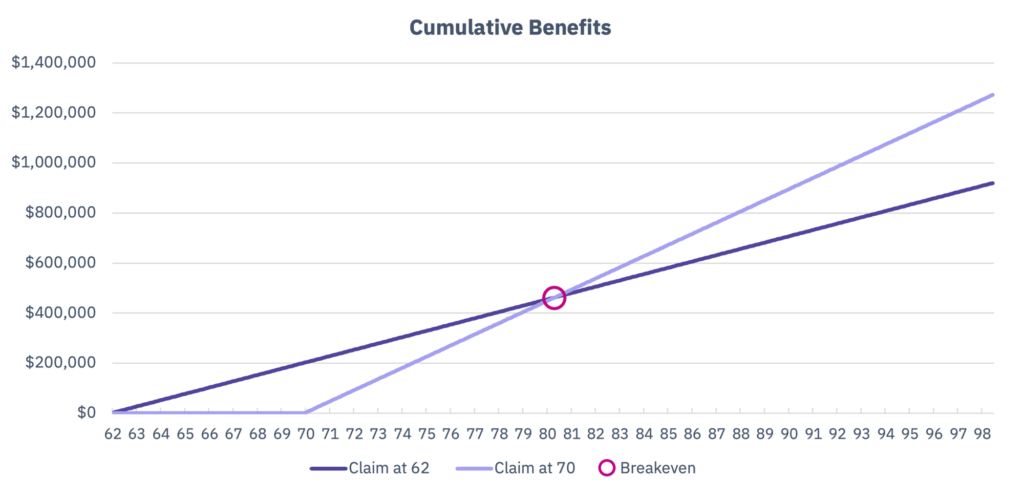
The same picture applies when the later claim is at 70. In the illustrative chart, the age-62 line rises first, while the age-70 line begins later but rises more steeply. Their intersection depicts equality of cumulative payments, not equality of monthly checks.
What this calculation does—and does not—settle
The figures above are in constant purchasing-power dollars. That choice connects this lesson to the previous one: actual dollar checks can rise with COLAs, including COLAs credited before a later claim. For this simplified comparison, imagine expressing each check in the same year’s purchasing power, so a general rise in prices does not masquerade as a gain from delaying. Actual COLAs, benefit rounding, and the prices a household faces need not line up perfectly with that simplification.
The calculation also adds checks without discounting them. A dollar received earlier can have a different financial value from a dollar received later; tax treatment can matter too. Those considerations can change a comparison, but they are not part of this lesson’s cumulative-payment crossing. Nor does a break-even age predict anyone’s lifespan or, by itself, prescribe a claiming decision.
Finally, these two lines compare retirement payments under two claiming choices. They say nothing yet about whether the worker “got back” their payroll contributions. That question calls for additional choices about which contributions and benefits to count and how to compare dollars received in different years.
Key takeaways
To find a constant-dollar break-even age, calculate the early claimant’s lead when the later claim begins, then divide by the later option’s extra monthly benefit. Add the resulting months to the later claiming age. Check whether the answer marks equality or the first full monthly payment that puts later claiming ahead.
Next, the course moves from an individual’s checks to Social Security’s financing: you will reconcile a simplified annual trust-fund account and see how taxes, benefit payments, interest, and Treasury securities fit together.