Hello! Welcome to the sixth lesson in your course on Computerized Accounting.
In our last lesson, we concluded the first module by differentiating between ready-made, customized, and tailor-made accounting software. This provided a clear picture of the "Software" component within a Computerized Accounting System (CAS).
Today, we begin our second module, "Accounting Process and Data Management." This lesson marks a shift from the tools of CAS (like software) to the system and process itself. Our focus will be on the learning outcome: Define an Accounting Information System (AIS) and describe its role within a CAS.
Understanding this is fundamental. While CAS refers to the computerized method, AIS is the broader system that manages accounting information. Clarifying this relationship is crucial for building a strong conceptual foundation and for answering exam questions accurately.
1. What is an Accounting Information System (AIS)?
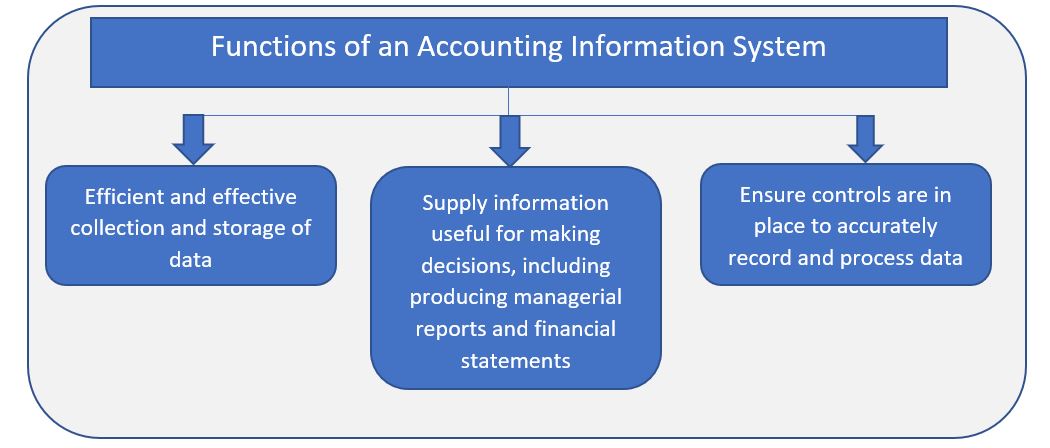
At its core, an Accounting Information System (AIS) is a structure that a business uses to collect, store, manage, process, retrieve, and report its financial data. This information is then used by internal decision-makers (like managers) and external parties (like investors and tax authorities).
An AIS has three primary functions, which are neatly summarized in the flowchart below.
Just like the CAS we discussed, an AIS is built from several key components.

You might notice that these components are very similar to the five "pillars" of a CAS we covered in a previous lesson (Hardware, Software, People, Procedure, Data). This is no coincidence, and it points directly to the close relationship between the two concepts.
2. The Relationship Between AIS and CAS
The terms AIS and CAS are often used together, but they are not exactly the same. The simplest way to understand the relationship is:
A Computerized Accounting System (CAS) is the implementation of an Accounting Information System (AIS) using computers and accounting software.
Think of it this way: any system that processes accounting information is an AIS. A manual system using paper ledgers and journals is an AIS. A computerized system using Tally or Zoho Books is also an AIS. The CAS is simply the modern, automated version of an AIS.
To hear this explained in a clear, exam-oriented way, let's watch a short clip from a familiar source.
👉Class 12 Chapter 1: Overview of Computerized Accounting | Computerised Accounting
This video from the 'Commerce By Harshita' channel, which you recommended, directly explains how a CAS is defined as a type of AIS.
Please watch the following two short segments. Focus on how the narrator defines a CAS and then explicitly links it to the concept of an AIS. Defining CAS as an AIS: from 00:04:40 to 00:05:45. Defining AIS and its implementation: from 00:25:42 to 00:26:15.
As the video highlights, a CAS is an AIS that processes financial transactions according to GAAP (Generally Accepted Accounting Principles) and generates reports for users. The computer and software are the tools that make this happen efficiently.
3. The Role and Structure of an AIS
Now that we've defined AIS and linked it to CAS, let's look at its structure in more detail. An AIS is not a single, monolithic entity. Instead, it is an integrated system composed of various sub-systems, each handling a specific business function.
To get a formal understanding of this, let's turn to a resource based on the NCERT textbook.
Chapter 01 Overview of Computerized Accounting System
The chapter 'Overview of Computerized Accounting System' provides a concise, syllabus-aligned explanation of AIS and its various sub-systems.
Please read Section 1.8, 'ACCOUNTING INFORMATION SYSTEM (AIS)'. It begins by defining AIS and then introduces its various sub-systems with a helpful diagram. You don't need to memorize every sub-system right now, but focus on understanding that an AIS is a collection of these smaller, specialized parts.
The key role of the AIS is to integrate the data from all these different sub-systems (like Sales, Purchases, Payroll, etc.) to create a complete financial picture of the organization. In a CAS, this integration is seamless and automatic, which is one of its major advantages over a manual system.
For example, when a sales transaction is entered into the Sales sub-system, the CAS automatically updates the Accounts Receivable sub-system and the Inventory sub-system without any extra manual work. This ensures that the information is always consistent and up-to-date across the entire organization.
Conclusion
In this lesson, we established the relationship between a Computerized Accounting System and an Accounting Information System. This is a crucial concept for understanding how modern accounting functions.
Key Takeaways:
- An Accounting Information System (AIS) is a broad framework for collecting, processing, and reporting financial data.
- A Computerized Accounting System (CAS) is a specific type of AIS that uses computer hardware and software.
- The primary role of an AIS is to transform raw data into useful information for decision-making while ensuring data integrity through internal controls.
- An AIS is typically composed of several integrated sub-systems, each managing a specific area of business operations (e.g., sales, inventory, payroll).
We've just touched upon the idea of sub-systems. In our next lesson, we will dive deeper into this topic by examining the functions of key AIS sub-systems, specifically Cash & Bank, Sales & Accounts Receivable, and Final Accounts, as these are frequently tested in your CBSE exam.