Hello! Welcome to your seventh lesson.
In our previous lessons, we traced the historical evolution of psychology's major schools of thought. We saw how psychoanalysis first tried to map the unconscious, how behaviorism reacted by focusing only on observable actions, and how the humanistic and cognitive schools then rebelled against behaviorism to bring the mind and human experience back into focus.
This historical journey sets the stage for understanding how psychology operates today. Modern psychologists rarely align with a single school of thought. Instead, they draw from multiple viewpoints to build a more complete and nuanced understanding of human behavior. This is often called an integrative or biopsychosocial approach, a concept that should be familiar from your medical training, where understanding a patient requires considering their biological state, psychological health, and social situation.
Today’s lesson directly addresses this modern approach. The learning outcome is to: Synthesize the six modern psychological perspectives (biological, evolutionary, cognitive, humanistic, psychodynamic, and sociocultural) by applying them to a complex clinical case.
We will first define each of these six perspectives, clarifying their core assumptions and the kinds of questions they ask. Then, we will introduce a professional tool used by clinicians—case formulation—to see how these perspectives are integrated in practice to understand a person's struggles.
The Modern Toolkit: Six Key Perspectives
Think of these perspectives not as competing theories, but as different lenses in a toolkit. Each one reveals a different, valuable facet of the same complex phenomenon.

To start, let's get a clear overview of the key ideas associated with each perspective.
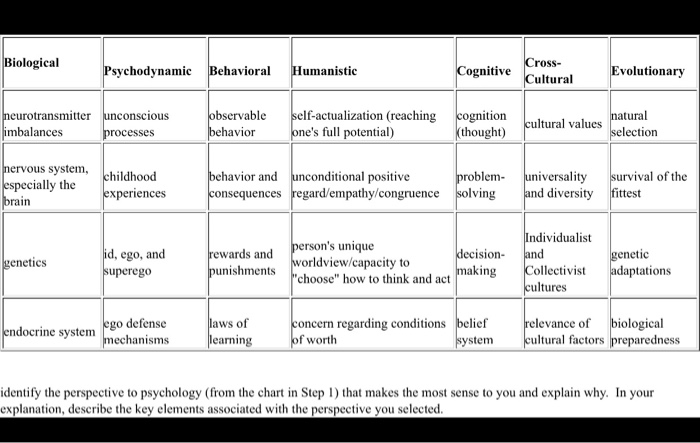
For a foundational understanding of these viewpoints, please begin by reading a brief online article.
Perspectives In Psychology (Theoretical Approaches)
The article 'Perspectives In Psychology' from Simply Psychology provides a clear and concise summary of the major theoretical approaches. It will serve as our foundation for this lesson.
Please read the short sections on each of the following perspectives: Behaviorist Perspective (as a quick review) Psychodynamic Perspective Humanistic Perspective Cognitive Perspective Biological Perspective Evolutionary Psychology \nFocus on each perspective's main assumptions about the causes of behavior. You can skim the sections on behaviorism, humanistic, and cognitive psychology, as we covered them in detail previously.
Now, let's add PhD-level depth to each of these, with a special focus on the perspectives that are new to our course.
1. Biological Perspective
- Core Idea: All thoughts, feelings, and behaviors have a biological basis. It seeks to explain the mind in terms of the body.
- Focus: Genes (behavioral genetics), brain structures and chemistry (neuroscience), and hormones (endocrine system).
- Example Questions: How do neurotransmitter imbalances contribute to mood disorders? What is the heritability of intelligence? How do hormones influence aggression?
- Strength: Highly scientific and often leads to effective medical treatments (e.g., pharmaceuticals).
- Limitation: Can be reductionist, explaining complex behaviors solely in terms of physical processes while potentially overlooking environmental and cognitive factors.
2. Evolutionary Perspective
- Core Idea: Human behavior is the result of psychological adaptations that evolved over millions of years to solve recurrent problems in our ancestral environments.
- Focus: Natural selection, sexual selection, and adaptation. It explains why a particular behavior or cognitive mechanism exists.
- Example Questions: Why are humans universally afraid of snakes and spiders? What is the evolutionary function of jealousy? Why do we find certain traits in a partner attractive?
To grasp the power of this perspective, it's crucial to move beyond the simplistic "survival of the fittest" mantra and understand the core mechanisms of modern evolutionary theory.
Professor Robert Sapolsky of Stanford University is a leading expert in behavioral biology. In this clip from his lecture 'Behavioral Evolution', he masterfully debunks common misconceptions and lays out the three fundamental building blocks of modern evolutionary theory as it applies to social behavior.
Please watch the segment from 14:10 to 20:05. Pay close attention to his explanation of: The fallacy of 'group selection' ('for the good of the species'). The three core mechanisms: individual selection, kin selection, and reciprocal altruism.
As Sapolsky explains, evolutionary psychology isn't about animals consciously trying to pass on their genes. Rather, it's about how natural selection has shaped behavioral strategies (like individual competition, helping relatives, and cooperating with non-relatives) that, on average, resulted in greater reproductive success.
3. Psychodynamic Perspective
- Core Idea: Behavior is driven by unconscious conflicts, desires, and motives, many of which stem from early childhood experiences.
- Focus: The unconscious mind, defense mechanisms, and the lasting impact of early relationships.
- Example Questions: How might an unresolved childhood conflict manifest in an adult's relationship patterns? How does a person use denial to cope with anxiety?
- Strength: Emphasizes the depth and complexity of mental life and the importance of the past.
- Limitation: Concepts like the unconscious are difficult to test scientifically.
4. Cognitive Perspective
- Core Idea: Behavior is the result of how we process, store, and retrieve information. It focuses on the mental processes (the "software") that underlie behavior.
- Focus: Memory, perception, attention, language, problem-solving, and decision-making.
- Example Questions: How do our expectations (schemas) influence our perception of an event? Why are we prone to certain errors in judgment (cognitive biases)?
- Strength: Rigorous scientific methodology and wide-ranging applications (e.g., cognitive-behavioral therapy, improving eyewitness testimony).
- Limitation: Sometimes compared to a computer, it can under-appreciate the role of emotion and motivation.
5. Humanistic Perspective
- Core Idea: Humans are inherently good and have free will. Our primary motivation is to grow and achieve our full potential (self-actualization).
- Focus: Subjective experience, personal growth, free will, and the self-concept.
- Example Questions: Is this person living in a way that is authentic to their true self? What is preventing them from achieving their goals?
- Strength: Offers an optimistic view and values the individual's subjective experience.
- Limitation: Concepts like "self-actualization" are difficult to measure and test empirically.
6. Sociocultural Perspective
- Core Idea: Behavior is shaped by the social and cultural context in which we live.
- Focus: Social norms, cultural values, group dynamics, and socioeconomic factors.
- Example Questions: How do cultural differences in individualism vs. collectivism affect behavior? How does poverty impact psychological development? How do social roles and expectations influence how men and women behave?
- Strength: Highlights the powerful influence of the situation and culture, which other perspectives may neglect.
- Limitation: Can lead to cultural relativism or overlook the role of universal biological and cognitive factors.
Synthesis in Action: Case Formulation
Now, how do we bring these lenses together? In a clinical setting, this is done through case formulation (or case conceptualization). It's the process of developing a "theory" or story that explains a specific person's problems, integrating information from different perspectives. A widely used framework for this is the "Six Ps" model.
Let's watch a video that introduces this practical framework and presents a case study that we can analyze.
Case Formulation: making sense of the information you obtain
In this video from The Association for Psychological Therapies, Dr. William Davies explains case formulation and the 'Six Ps' model. He then presents the case of a man named 'Joe' who is struggling with depression.
Please watch the following two segments: The 'Three Ps' (11:38 - 19:48): Dr. Davies explains Predisposing, Precipitating, and Perpetuating factors. As you watch, think about how these relate to the different psychological perspectives. The Case of Joe (37:01 - 41:52): Listen carefully to the details of Joe's situation.
To summarize the "Six Ps" model and Joe's case:
- Problem: Joe (40) is depressed, drinking too much, and has a poor relationship with his wife.
- Predisposing Factors (Vulnerabilities): What made him vulnerable in the long term? He describes himself as always having been "volatile" and "moody."
- Precipitating Factors (Triggers): What started the current problem? The depression began after he started his new charity work. He also experienced a gradual decline in his social circle.
- Perpetuating Factors (Maintaining Factors): What keeps the problem going? The drinking, conflict with his wife, and extramarital affairs which lead to guilt and a poor self-image.
- Positive/Protective Factors (Strengths): What are his strengths? He is articulate, charming, intelligent, and energetic. His charity work is important to him.
- Plan: The proposed intervention for Joe.
Applying the Six Perspectives to Joe's Case
This is where we synthesize. Let's use our six perspectives to fill in the details of the "Six Ps" for Joe. This demonstrates how a multi-faceted analysis provides a much richer understanding than any single perspective could.
| Perspective | Analysis of Joe's Case (mapped to the "Six Ps") |
|---|---|
| Biological | Predisposing: His self-described "volatile" and "moody" temperament may point to a genetic predisposition for mood instability or depression. A biological approach might also investigate potential neurotransmitter imbalances (e.g., serotonin, dopamine) that are perpetuating his low mood. |
| Psychodynamic | Predisposing: The long-standing "moodiness" could be explored for links to early childhood experiences or attachment patterns. Perpetuating: The extramarital affairs represent a classic psychodynamic conflict. They may be driven by an unconscious desire (the "id") that clashes with his self-concept and marital commitment (his "superego"), leading to intense guilt and self-criticism, which fuel his depression. |
| Sociocultural | Precipitating: The gradual loss of his social circle, particularly his male friends, represents a breakdown in his social support system. Perpetuating: The ongoing conflict with his wife is a key social factor maintaining his distress. His charity work, while meaningful, might also create social pressures or isolation due to travel. |
| Cognitive | Perpetuating: Joe's belief that the affairs are "wearing down his image of himself" points to negative core beliefs and automatic thoughts. A cognitive psychologist would focus on these maladaptive thought patterns (e.g., "I am a bad person," "My life is a mess") that maintain the depression. His drinking is a behavioral coping strategy to avoid these painful thoughts. |
| Humanistic | Perpetuating: Joe is experiencing a major gap between his actions (drinking, affairs) and his values or "ideal self" (a good husband, a dedicated charity worker). This lack of congruence is a source of profound distress. His depression could be seen as a signal that his life is not authentic to his true self. Positives: A humanist would focus on his strengths (articulate, intelligent, energetic) as the resources for personal growth and self-actualization. |
| Evolutionary | Perpetuating: This perspective offers speculative but deep insights. The extramarital affairs could be viewed in the context of male reproductive strategy. However, humans are also a "confused" pair-bonding species, so acting on this drive creates conflict with the evolved need for stable attachment, leading to guilt. His depression itself could be analyzed as an adaptive "cry for help" to signal his distress to his wife and social network, or as a mechanism to force a withdrawal from an unsustainable lifestyle (the demands of his work). |
Conclusion
As you can see, no single perspective holds the complete truth about Joe. The biological lens points to his underlying vulnerability, the psychodynamic lens to his inner conflicts, the cognitive lens to his thought patterns, the sociocultural lens to his isolation, the humanistic lens to his crisis of values, and the evolutionary lens to the deep-seated drives that may be at play.
A skilled psychologist does not choose one perspective but weaves them together into a coherent case formulation. This integrative approach is the hallmark of modern psychology.
Key Takeaways:
- Modern psychology utilizes six main perspectives: biological, evolutionary, psychodynamic, cognitive, humanistic, and sociocultural.
- Each perspective offers a unique level of analysis and asks different questions about the causes of behavior.
- The biopsychosocial model is a framework that encourages integrating these perspectives to understand a person holistically.
- Case formulation, using tools like the "Six Ps," is the practical skill of synthesizing these theoretical lenses to understand and help an individual.
Preview of the Next Lesson:
Having now surveyed the major theoretical frameworks—the "what" of psychology—we will shift our focus to the "how." In the final lesson of this module, we will examine the scientific methods psychologists use to study behavior: descriptive, correlational, and experimental research designs.