Welcome to your first lesson. Your goal is to achieve a PhD-level mastery of introductory psychology, and our journey begins with the most fundamental question: What is psychology?
This lesson addresses the learning outcome: Define psychology as a scientific discipline and critically distinguish it from pseudoscience and folk psychology.
We will establish the criteria that make a field scientific and see how psychology meets them. More importantly, we'll build a critical toolkit to differentiate scientific psychology from two other influential but unreliable ways of understanding the human mind: our own common-sense intuition (folk psychology) and systems that merely imitate science (pseudoscience). Mastering this distinction is the bedrock upon which all your future, more advanced knowledge will be built.
1. What Makes Something a Science?
Many people think sciences are defined by their subject matter—biology studies life, chemistry studies matter. However, the true hallmark of a science is not what it studies, but how it studies it. Science is a systematic approach to understanding the natural world.
To explore this, please read the first part of the provided text, which lays out the three fundamental features of the scientific approach.
Chapter 1: The Science of Psychology
This brief excerpt from 'The Science of Psychology' defines science by its general approach, not its content. It introduces the three core features that we will use as our framework.
Please read the sections titled 'What Is Science?' and 'Features of Science.' Focus on understanding the three fundamental features described.
As you've just read, the scientific approach is characterized by:
- Systematic Empiricism: Learning about the world through structured, planned observation. It's not just "looking," but looking with a plan.
- Empirical Questions: Focusing on questions that can be answered by making those systematic observations. These are questions about how the world is, not how it ought to be.
- Public Knowledge: Sharing findings with the scientific community and the public. This allows for collaboration and, crucially, for self-correction. Science is a community effort to get closer to the truth by finding and fixing errors.
2. Psychology's Scientific Credentials
Psychology is the scientific study of behavior and mental processes. It earns its scientific status by adopting the approach we've just defined:
- Psychologists practice systematic empiricism by designing experiments, conducting surveys, and making structured observations to study everything from brain activity to social behavior.
- They ask empirical questions like: "Does expressing anger reduce it?" or "What are the most effective treatments for anxiety?"
- They create public knowledge by publishing their methods and findings in peer-reviewed journals, allowing other scientists to replicate, critique, and build upon their work.
While psychology is firmly a science, its path is filled with unique philosophical and methodological challenges, largely because its subject matter—the mind—is so complex.

3. The Challenge of Folk Psychology
If psychology is the science of the mind, what about the intuitive understanding we all have about ourselves and others? This is often called folk psychology or "common sense." We need a scientific approach precisely because this common-sense understanding is often wrong.
Let's examine why our intuition can be an unreliable guide.
Chapter 1: The Science of Psychology
This section of the text explores the limitations of folk psychology and introduces the cognitive biases, like confirmation bias, that lead our intuitions astray.
Please read the section '1.3 Science and Common Sense.' Pay close attention to the examples of incorrect common-sense beliefs and the reasons given for why we hold them.
As the text explains, we are all susceptible to cognitive shortcuts and biases. Confirmation bias, for instance—our tendency to seek out and favor information that confirms what we already believe—is a powerful and pervasive error in thinking. A scientific mindset, therefore, requires cultivating skepticism: not a cynical distrust, but a habit of pausing to ask, "What is the evidence?"
4. The Demarcation Problem: Science vs. Pseudoscience
A more complex challenge comes from pseudoscience: beliefs and practices that are presented as scientific but lack the core principles of the scientific approach. The question of how to draw the line between science and non-science is a deep philosophical issue known as the demarcation problem.
To begin exploring this, watch the following video clips. The first introduces the demarcation problem, and the second explains the most famous proposed solution: falsifiability.
The Demarcation Problem: Falsificationism
This video from The Autodidact's Toolkit introduces the demarcation problem and the concept of pseudoscience.
Watch from 01:51 to 06:56. Focus on the definition of a demarcation criterion and how pseudoscience is defined as non-science masquerading as science.
The Demarcation Problem: Falsificationism
Now, let's look at philosopher Karl Popper's influential solution to the demarcation problem. He argued that the key difference between a scientific theory and a pseudoscientific one is its 'falsifiability.'
Watch from 11:21 to 18:28. Pay close attention to the definition of a falsifiable claim and why Popper found theories like Freud's and Adler's to be unfalsifiable, and thus unscientific.
As Popper argued, a key feature of a scientific theory is that it makes risky predictions. It must state not only what it expects to happen, but also what would prove it wrong. A claim that can explain any conceivable outcome isn't a powerful scientific theory; it's an unfalsifiable belief system.
Warning Signs of Pseudoscience
While falsifiability is a powerful idea, the line between science and pseudoscience is often blurry. It's better to think of pseudoscience as having a set of "warning signs" or a "family resemblance." The more of these indicators a discipline shows, the more skeptical we should be.
The following text provides a comprehensive list of these indicators.
[PDF] Science and Pseudoscience in Clinical Psychology, Second Edition
This excerpt from 'Science and Pseudoscience in Clinical Psychology' provides a detailed 'primer' on the key differences, offering ten warning signs to help identify pseudoscientific claims.
Please read the section titled 'The Differences Between Science and Pseudoscience: A Primer.' As you read the 10 points, think of them as a checklist for evaluating claims you might encounter.
To summarize the most crucial warning signs from your reading:
- An overuse of ad hoc hypotheses: Inventing "escape hatches" to explain away any negative findings (e.g., "The psychic's powers were disrupted by the skeptic's negative energy").
- Lack of self-correction: Ideas remain unchanged for decades or centuries, despite contrary evidence (e.g., astrology).
- Reversed burden of proof: Demanding that critics prove the claim is false, rather than the claimant proving it is true.
- Overreliance on anecdotes: "I know a person who..." is not a substitute for controlled evidence.
This table provides a concise comparison of the fundamental attitudes of science and pseudoscience.
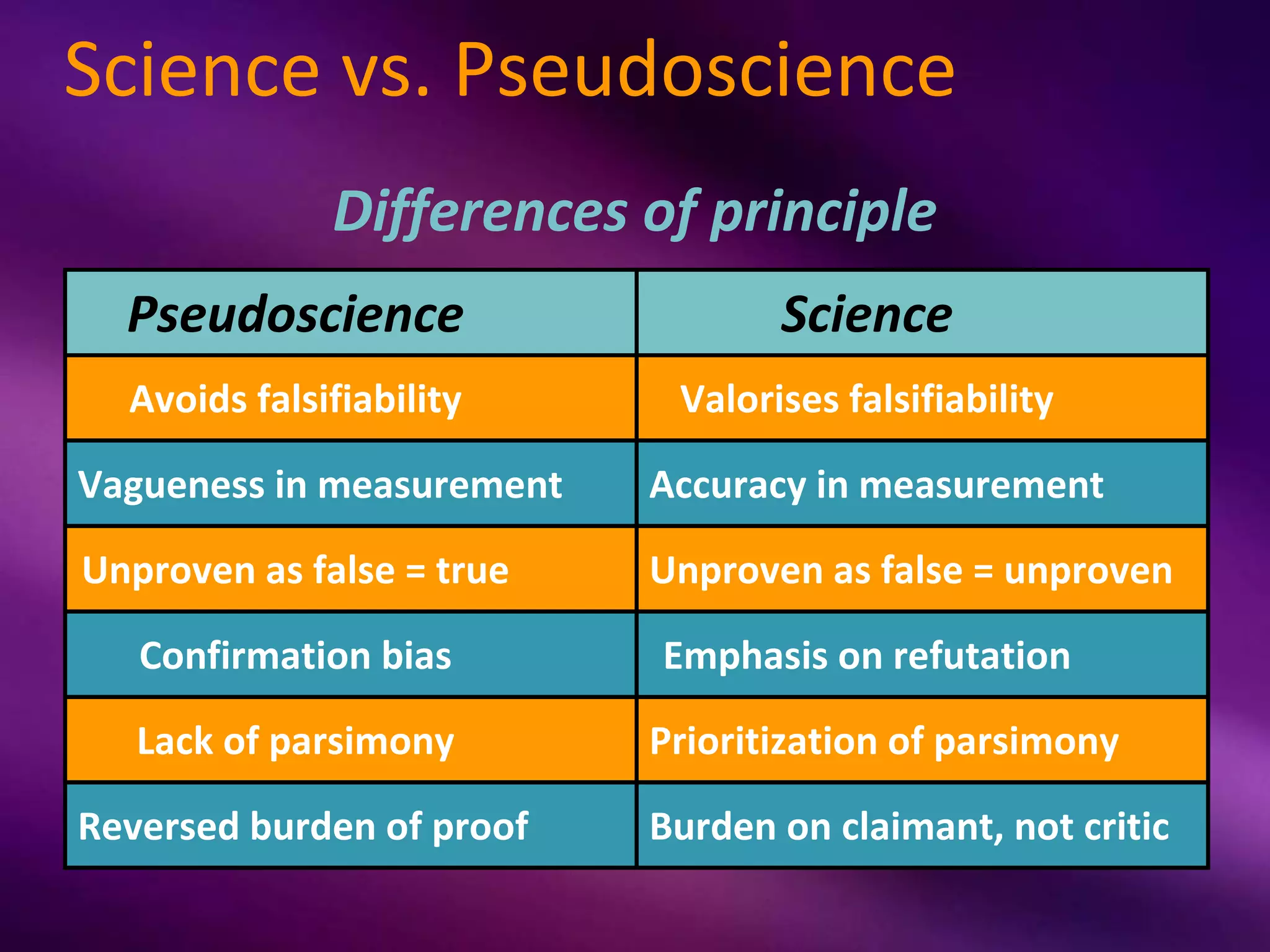
5. Why This Distinction Is Critical
Distinguishing science from pseudoscience isn't just an academic exercise. In fields like psychology, where people's well-being is at stake, the consequences can be profound.
First, read this short section on the potential harms of pseudoscientific techniques.
[PDF] Science and Pseudoscience in Clinical Psychology, Second Edition
This section outlines three major reasons why promoting and using pseudoscientific techniques can be actively harmful, going beyond simply being 'ineffective.'
Read the section 'Why Potentially Pseudoscientific Techniques Can Be Harmful.' Focus on the three distinct types of harm: direct harm, opportunity cost, and damage to the profession.
The harms of pseudoscience—direct physical harm, the opportunity cost of forgoing effective treatment, and the erosion of scientific credibility—make the scientific approach essential.
Science is not a perfect body of knowledge. Rather, it is the best tool we have for overcoming our own biases. Watch this final clip from a talk by psychologist Scott Lilienfeld, who also co-edited the text you just read.
Why Pseudoscience Belongs in the Psychology Classroom
In this powerful conclusion to a talk on pseudoscience, Scott Lilienfeld defines science not as a body of facts, but as a set of safeguards against human error—a 'prescription for humility.'
Watch from 43:48 to 46:46. Listen for the definition of science as a method of 'bending over backwards to prove ourselves wrong' and as a set of systematic safeguards against confirmation bias.
Conclusion
In this lesson, we have established a foundational understanding of psychology as a science.
Key Takeaways:
- Psychology is a science because it uses the scientific approach: a commitment to systematic empiricism, answering empirical questions, and creating public, self-correcting knowledge.
- This approach is necessary because our intuitive folk psychology is often flawed, misled by cognitive biases like the confirmation bias.
- Pseudoscience mimics science but lacks its core principles, especially falsifiability. It is identified by a cluster of warning signs, such as avoiding self-correction and reversing the burden of proof.
- The distinction is critical because pseudoscientific practices can cause direct harm, create significant opportunity costs, and undermine public trust in science.
Ultimately, science is not a collection of settled facts but an ongoing process—a set of tools for overcoming our natural tendency to fool ourselves. While the boundary between science and pseudoscience can be fuzzy, the commitment to rigorous evidence, skepticism, and self-correction is what sets the scientific endeavor apart.
Preview of the Next Lesson:
Now that we've defined psychology as a science, our next lesson will delve into its origins. We will analyze the foundational philosophical debates—such as nativism vs. empiricism (nature vs. nurture) and dualism vs. monism (mind vs. body)—that have shaped the questions psychologists ask and the methods they use to answer them.