Earlier in the course, you distinguished advice, boundaries, requests, agreements, and controlling behavior. This first lesson in the module on communicating limits takes up a harder distinction: a consequence can be either a way to protect your own limit or a way to pressure someone into obedience. The words alone do not settle which it is.
The aim is to judge a consequence by its purpose, the surrounding relationship context, and its effect on the other person’s freedom to choose. That matters when a partner gives forceful advice, when you need to step away from an interaction, and when a relationship may no longer meet an important need.
The same sentence shape can do different work
A boundary consequence describes what you will do if a situation continues. Suppose a conversation has become loud and distressing. “If we keep shouting, I’m going to end this call and talk tomorrow” identifies a limit on your participation and an action you can take. The other person may lower their voice, or they may not; you do not have to remain on the call either way.
A coercive threat may also have the form “If you do this, I’ll do that.” Its function is different. “If you disagree with my advice, I’ll embarrass you in front of your friends” uses a threatened harm to secure compliance. The speaker’s ability to carry out the consequence does not make it a healthy boundary.
Watch Stephanie Rigg’s explanation of why boundary language can sound threatening, and why a genuine limit cannot be identified by wording alone.
Are You Setting a Boundary — or Giving an Ultimatum? | On Attachment | Ep 192
In “Are You Setting a Boundary — or Giving an Ultimatum?” from Stephanie Rigg’s On Attachment, the speaker distinguishes an action taken to protect a limit from a statement used to force a partner’s behavior.
Watch the boundary example for the distinction between asking someone to stop yelling and deciding whether to stay in the conversation. Continue through the apparent threat, focusing on the speaker’s purpose rather than the conditional wording. Finally, watch dealbreakers and ultimatums for the point that nearly identical statements can be used differently.
One useful insight from the video is that a boundary must be something you can act on without obtaining the other person’s agreement. There is an important qualification: being within your control is necessary, but not sufficient. You can choose to leave a room; you can also choose to disclose someone’s private information. The first might protect you from an upsetting exchange. The second could be retaliation. Purpose and effect still matter.
Purpose, context, and freedom to choose
Consider three aspects together rather than treating any one as a definitive test.
Purpose: A self-protective consequence addresses what you can remain involved in, tolerate, or offer. It need not be painless for either partner. Ending a call, declining to lend your belongings, or deciding that a relationship is incompatible may disappoint someone. The difference is that the action responds to your limit, rather than adding a penalty to make the other person submit.
Context: The same action can mean different things in different circumstances. Taking an hour apart after a heated argument can allow both people to settle. Repeatedly disappearing for days whenever a partner expresses an unwelcome opinion can function as punishment, even if it is called “taking space.” Likewise, withdrawing financial support has a different significance when it means declining a new, optional expense than when it means threatening a partner’s access to necessities to dictate whom they see. Existing commitments, dependency, past intimidation, and patterns of behavior all matter.
Effect on freedom to choose: Respecting autonomy does not mean ensuring that the other person faces no consequences from a disagreement. Both partners remain free to decide whether to continue a conversation or a relationship. It does mean avoiding surveillance, humiliation, intimidation, or manufactured hardship as tools for obtaining the answer you want. A person may be unhappy that you end a conversation when shouting starts; that does not, by itself, mean their autonomy has been taken away.
Read two focused passages that put this distinction in terms of self-protection and punishment.
Setting Healthy Boundaries: Differences Between Boundaries, Control, and Ultimatums
This counseling article offers practical criteria for examining what a stated consequence does, rather than relying only on whether it begins with “I.”
In “How to Tell the Difference: Boundaries vs. Control,” begin with the sentence about good boundaries allowing both people to remain independent. Read the comparison through the point about guilt trips and the silent treatment. Then go to “How to Set and Communicate Healthy Boundaries,” subsection “3. Stick to Your Guns (Mostly).” Start at “Following through with consequences is different from issuing an ultimatum” and read the paired examples. Focus on the difference between leaving a difficult conversation for now and using permanent withdrawal as a penalty.
The article treats calm wording as a useful sign, but tone is not a verdict. Someone can communicate a protective limit while upset or frightened. Someone else can deliver an intimidating demand in a perfectly calm voice. The more reliable evidence is what the person does, what resources or vulnerabilities they use, and whether disagreement remains genuinely possible.
Where the distinction gets difficult
Imagine that one partner offers persistent advice about the other’s friendships. “I’m worried this friendship leaves you drained” conveys a concern that the listener may accept or reject. “If you see that friend again, I’ll make sure you have no way to get there” is not simply stronger advice. It uses control over transportation to restrict a choice. Calling it a boundary would not change its effect.
Now consider shared time rather than friendships. “I don’t want to keep discussing this tonight. I’ll leave the conversation and we can return to it tomorrow” limits the speaker’s own participation. It also gives the other person a clear account of what the pause means. By contrast, refusing all contact indefinitely whenever the other person disagrees may turn withdrawal into a means of punishment. The distinction does not rest on a fixed number of hours: a longer period apart may sometimes be needed. It rests on the pattern, the reason for stepping away, and whether the withdrawal is being used to extract compliance.
Relationship endings are especially easy to misread. “I want children, and I cannot continue this relationship if we want fundamentally different futures” may describe a genuine incompatibility. The partner is free to want something different, while the speaker is free not to remain in that relationship. No one has to stay merely to prove that their limit is not an ultimatum. But repeatedly announcing a breakup whenever a partner refuses a smaller demand, then withdrawing the announcement as soon as they comply, suggests that the threatened loss is being used as leverage.
The Gottman Institute’s discussion of boundaries and ultimatums explores this gray area through a relationship-compatibility example.
Requests Vs. Boundaries Vs. Ultimatums: The Ultimate Guide
Read this passage for the difference between naming a relationship need and wielding a possible breakup to force an immediate response.
In “What are ultimatums in relationships?”, start where the article says the area between boundaries and ultimatums can be gray. Read the full comparison through its final point about protecting needs, stopping before “Get your Relationship Communication Score.” Notice that a possible relationship ending appears in both examples; its presence alone does not decide the issue.
A sincere consequence does not become coercive merely because it matters greatly to the other person. Equally, a speaker’s claim to be “just stating my boundary” does not erase an intimidating pattern. These judgments require attention to behavior over time. Follow-through is evidence of a real limit, not proof that the limit is fair or safe.
When safety changes the priority
The distinction becomes more urgent when the context includes intimidation, surveillance, isolation, sexual coercion, or threats. The Power and Control Wheel groups several tactics that can be used together to restrict a partner’s independence.
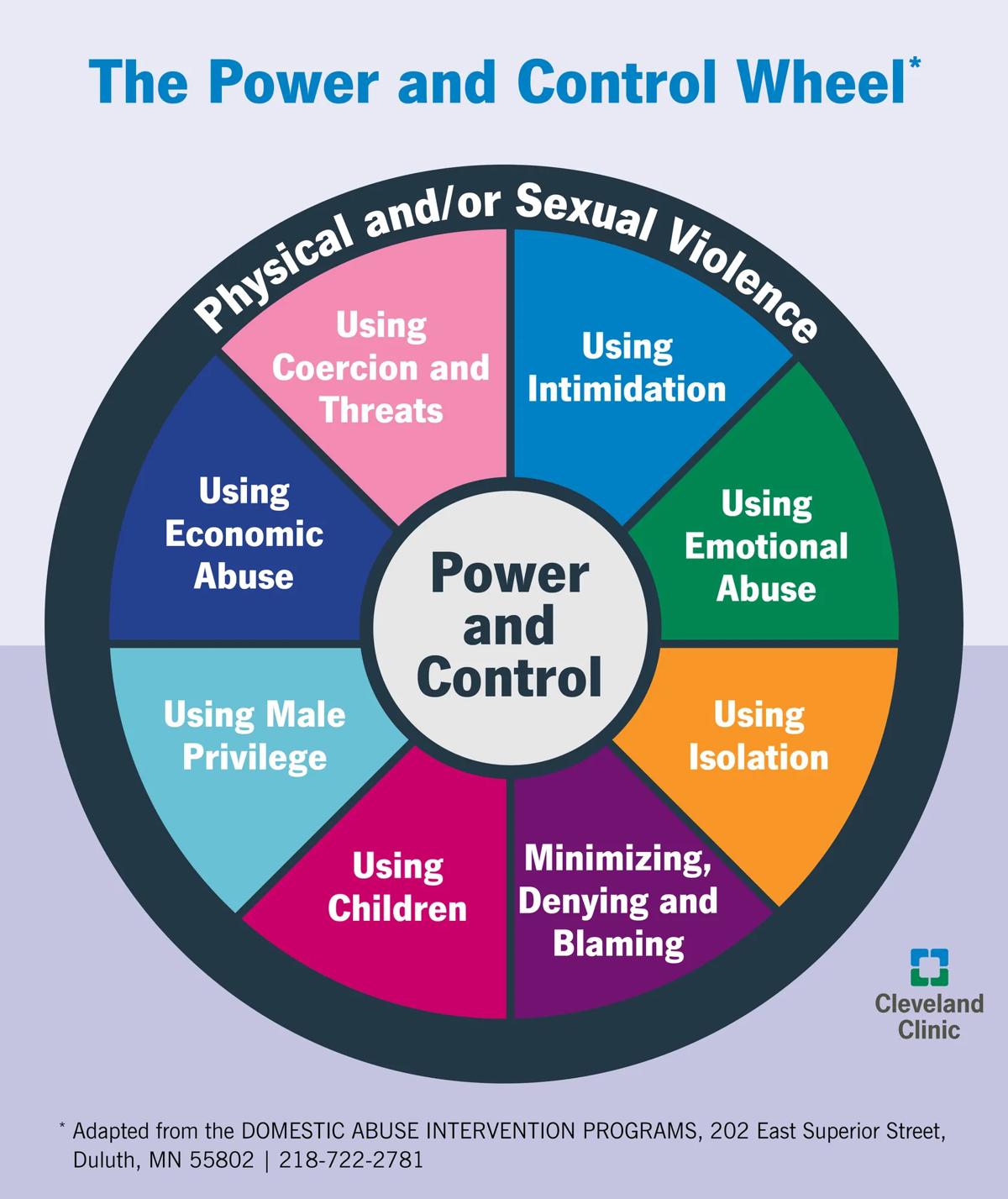
The wheel depicts one model of abuse; it is not a checklist that must be completed before a concern is serious. Physical or sexual violence need not be present for a controlling pattern to matter. Nor does the wheel imply that abuse affects only one gender.
In a threatening situation, the priority is safety, not a perfectly phrased boundary or a demonstration of follow-through. A person who fears retaliation does not owe the other partner advance notice of every protective step, an in-person confrontation, or a return to an unsafe conversation. Practical options depend on the circumstances; confidential support from a trusted person or a specialist service can help someone consider them. If there is immediate danger, seeking emergency help takes precedence. A later lesson will address safety-oriented next steps in more detail.
This qualification also prevents a common misreading of boundary advice: difficulty leaving, pausing contact, or following through does not make someone responsible for another person’s intimidation or coercion. Dependencies and risks can make seemingly simple actions difficult or dangerous.
Key takeaways
A self-protective boundary consequence concerns your own participation, access, or relationship choices. A coercive threat uses prospective harm or leverage to make another person comply. Conditional wording and first-person phrasing cannot distinguish them on their own. Look at the purpose of the action, the surrounding pattern and dependencies, and whether the other person can disagree without intimidation or manufactured punishment. Where retaliation is a risk, safety comes before direct boundary-setting.
The next lesson turns from consequences to requests: expressing what you would prefer while leaving the other person free to decline without retaliation.