In the previous lesson, the next step in a non-threatening disagreement was to follow through on a limit you could carry out yourself, such as ending a repetitive conversation. That advice has an important condition: disengaging must be reasonably safe. If a partner might threaten you, block your exit, track you, or punish you for seeking independence, a clearer boundary statement is not the priority.
This final lesson is about choosing a safety-oriented next step instead. The aim is not to diagnose a relationship or prescribe one decision for everyone. It is to recognize when the ordinary boundary-setting approach no longer fits, then prioritize immediate safety and confidential support.
When the priority changes
Consider two versions of the same situation. In the first, a partner keeps raising a topic after you have said you will not discuss it tonight. They are disappointed when you end the conversation, but you can leave the room without fearing what they will do. The self-directed response from the previous lesson may fit.
In the second, the partner says, “If you walk away, you’ll regret it,” stands between you and the door, or checks your location whenever you go out. The issue is no longer how to phrase your limit. Even if your proposed boundary is fair, asserting it could increase your exposure to harm. You do not owe anyone a further warning, a final explanation, or a demonstration that you can stand firm.
A threat need not be explicit to matter. Surveillance, isolation from people who could help, control of money or transport, sexual coercion, and credible fear of retaliation all change what is feasible. You do not have to establish a partner’s motive—or wait for physical violence—before taking your concern seriously. At the same time, repeated disagreement by itself does not establish danger; the distinction rests on the surrounding behavior and what may happen when you exercise a choice.
A useful first decision is whether danger is immediate. If you are in immediate danger, getting to a safer place and contacting local emergency services, if you can do so safely, takes precedence over documenting events, collecting possessions, or making a complete plan. If there is no immediate emergency but retaliation is a concern, a discreet conversation with a domestic abuse advocate or a trusted person can help you assess options before taking a visible step.
Safety planning is more than a plan to leave
Safety planning can begin while you are still living with a partner. It does not require you to announce a boundary or decide today whether to end the relationship. It means considering where you could go during an escalating incident, how you could reach help, and who could assist without alerting the partner.
Safety Planning While Living with an Abusive Partner - The Hotline
Read The Hotline’s guidance for practical steps that do not depend on persuading a partner to cooperate.
In “Here are some important steps for safety planning while living with an abusive partner,” read the bullets beginning with safe areas, through the point about practising how to get out safely. Focus on access to exits, a phone if safe, and ways to reach help. Then, under “How others can help with a safety plan,” read trusted support. Notice that the guidance includes agreeing in advance on what another person should do, rather than assuming they will know.
The right step depends on what is safe and available. Identifying an exit may be useful in one home; arranging a discreet signal with a trusted person may be more useful in another. Involving someone else should be selective: a person who means well could inadvertently reveal your plans or confront your partner. Clear instructions can include how to reach you safely, when to seek help, and whether contacting law enforcement is part of your plan. An advocate can help think through these choices.
For example, if a partner becomes threatening when you try to leave a conversation, privately arranging a way to contact a trusted person may be safer than announcing, “Next time you threaten me, I’m leaving.” The first step builds an option you can use; the second alerts the partner to your intentions and may provoke the very response you fear. A safety plan is not a test of courage. You can adapt it as circumstances change.
Make support genuinely confidential
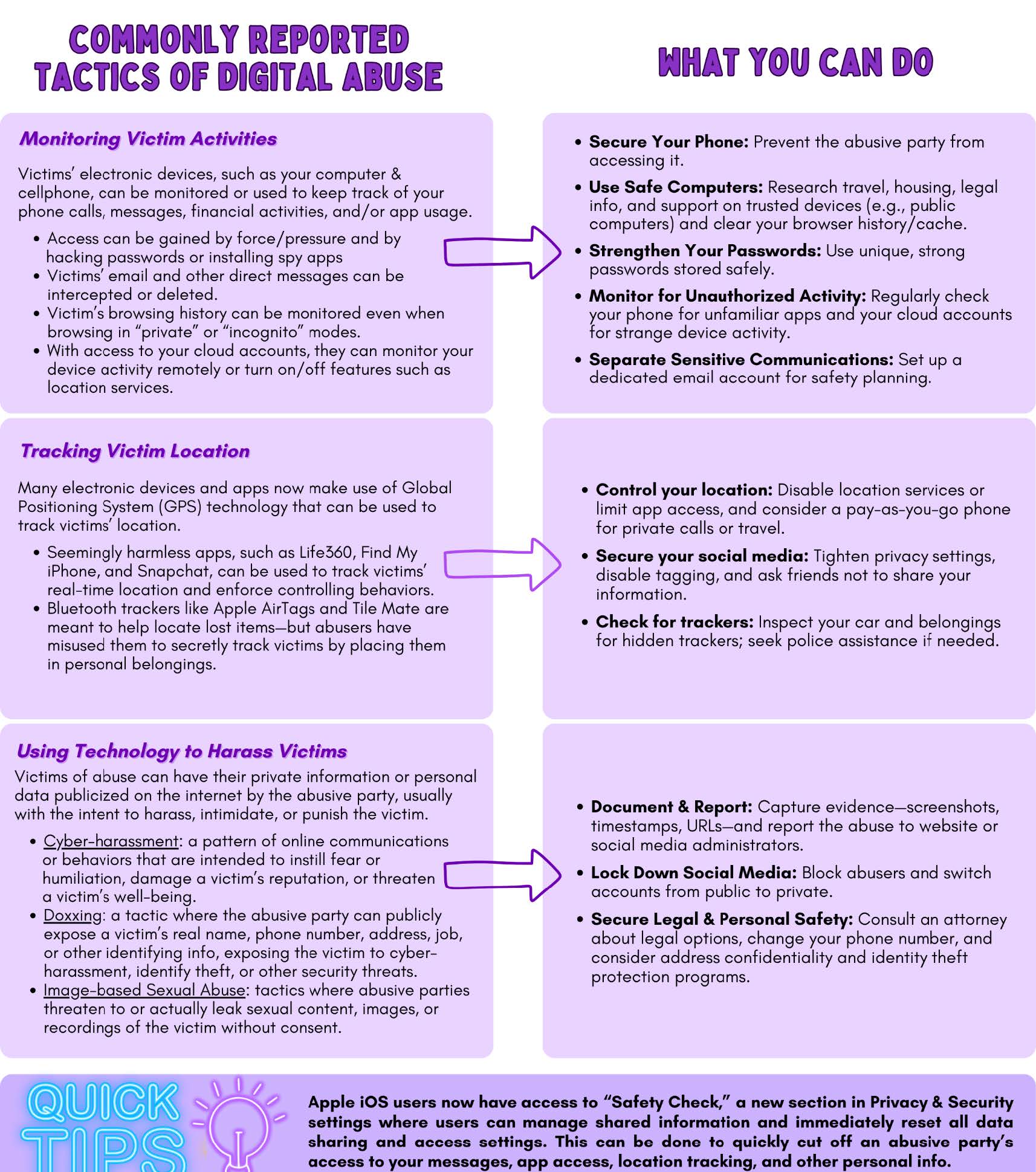
A plan is only discreet if the means of making it are discreet. A partner with access to your phone, shared accounts, location-sharing settings, or browser activity may be able to see attempts to seek help. Private-browsing mode is not a guarantee that activity cannot be monitored.
The image below illustrates several forms of digital abuse. Use it to recognize possible channels of monitoring, not as a checklist of settings to change immediately.
The Hotline’s Security Alert also notes that internet use can be monitored. Read
If monitoring is a possibility, consider contacting an advocate from a device or account the partner cannot access, if one is safely available. A trusted person, a public device, or an in-person service may offer alternatives, but none is automatically private. Abruptly turning off location sharing, changing passwords, or deleting history can itself be noticed; seek situation-specific advice before making changes that could trigger retaliation. You need not solve every digital-security problem before asking for help.
A domestic abuse advocate can discuss options even if you are uncertain what to call the behavior, are not ready to leave, or want help choosing one safer next step. The purpose of confidential support is to expand your choices, not to transfer your decisions to someone else.
If leaving is one of the options
Leaving can be a safety decision, but it is not always safest to announce it or do it without preparation. A partner who fears losing control may retaliate when they learn of a plan. That is one reason advice such as “Just tell them it’s over” is inadequate when threats or coercion are present.
When Ending the Abusive Relationship | WomensLaw.org
Read WomensLaw.org’s leaving guidance to understand why a prepared departure and a rapid departure may require different plans. This is an option to study, not an instruction that everyone must leave.
On the “When Ending the Abusive Relationship” page, read the checklist from two possible plans, then continue through preparation and timing. Pay particular attention to the guidance that getting out safely comes before taking a bag. Some items and legal considerations on the page are specific to the United States; an advocate or qualified local professional can help assess what applies elsewhere.
The distinction between a plan for a hurried exit and one made with more time is useful even if you never need either. Documents, money, medication, children, pets, shared housing, and legal obligations may affect what is feasible. None is a reason to delay escaping an immediate threat in order to complete a checklist. Conversely, when there is time to plan, discreet professional support may help you avoid preventable risks.
If you are deciding what to do next, keep the order of priorities clear:
| Situation | Safety-oriented next step |
|---|---|
| Immediate danger | Move toward safety and seek emergency help if you can do so safely. Do not delay for possessions or a confrontation. |
| Credible concern about retaliation, without an immediate emergency | Seek discreet support and make a situation-specific plan before a visible boundary statement or departure. |
| No signs of danger or retaliation | A feasible, self-directed boundary response from the previous lesson may be appropriate. |
These are distinctions for choosing a next step, not guarantees about how another person will behave. You remain entitled to set limits. When retaliation is possible, respecting your own autonomy may mean choosing when, how, and with whose support to act, rather than asserting the limit face to face.
Key takeaways
When a boundary could trigger retaliation, do not treat confrontation as the required next step. Assess immediate danger first; otherwise, look for a discreet way to reach a trusted person or domestic abuse advocate and plan around the risks you face, including possible digital monitoring. Leaving may be one option, but safety planning is useful whether or not you have made that decision.
This completes the course’s central distinction: ordinary relationship disagreement calls for respect for both people’s choices, while threats and coercion call for attention to safety. A boundary does not become less valid because it is unsafe to announce it.