Welcome to our final lesson in this foundational module. In our last two sessions, we mastered subject-verb agreement and then used that skill to describe completed actions with the past passive, such as "The legacy module was refactored." Today, we will build directly on that to describe the current state of a system after those actions are complete.
Your goal is to produce present passive sentences to describe a system's current status, like "The data is now stored in a secure cloud environment." This is a crucial skill for the "Result" part of a STAR story. It allows you to shift the focus from the action you took to the positive, stable, and improved system that now exists, which is exactly what interviewers want to hear.
By the end of this lesson, you will be able to confidently describe the results of your work using professional, system-focused language.
The Present Passive: From Action to State
While the past passive describes the action that happened, the present passive describes the state that exists now. This distinction is key.
- Past Passive (Action): The API endpoint was deployed yesterday.
- Present Passive (Current State): The API endpoint is now available for developers.
The structure for the Present Simple Passive is one you'll find very familiar:
- Use
isfor singular subjects (the data, the configuration, the system). - Use
arefor plural subjects (the files, the logs, the credentials).
Let's examine the structure and its purpose in a bit more detail.
English Grammar Essentials for Exams: Active vs Passive Voice with Easy Examples | BabyCode Blog
This blog post provides a clear, structured guide to different passive forms. We'll focus on the section covering the present tense.
Please read the section under the heading Simple Present Tense. You can find it by searching for the phrase that heading. Pay close attention to the "Passive Voice Structure" and the examples provided, such as "Applications are processed automatically by the system." This section perfectly outlines the grammatical formula we will be drilling in this lesson.
The resource you just read explains the rule. Now, let's make it automatic through practice.
Visualizing the Transformation
Before we start drilling, take a look at this simple chart. It provides a quick visual reference for the transformation from active to passive in various tenses. For this lesson, we are focused entirely on the first row, "Present simple."
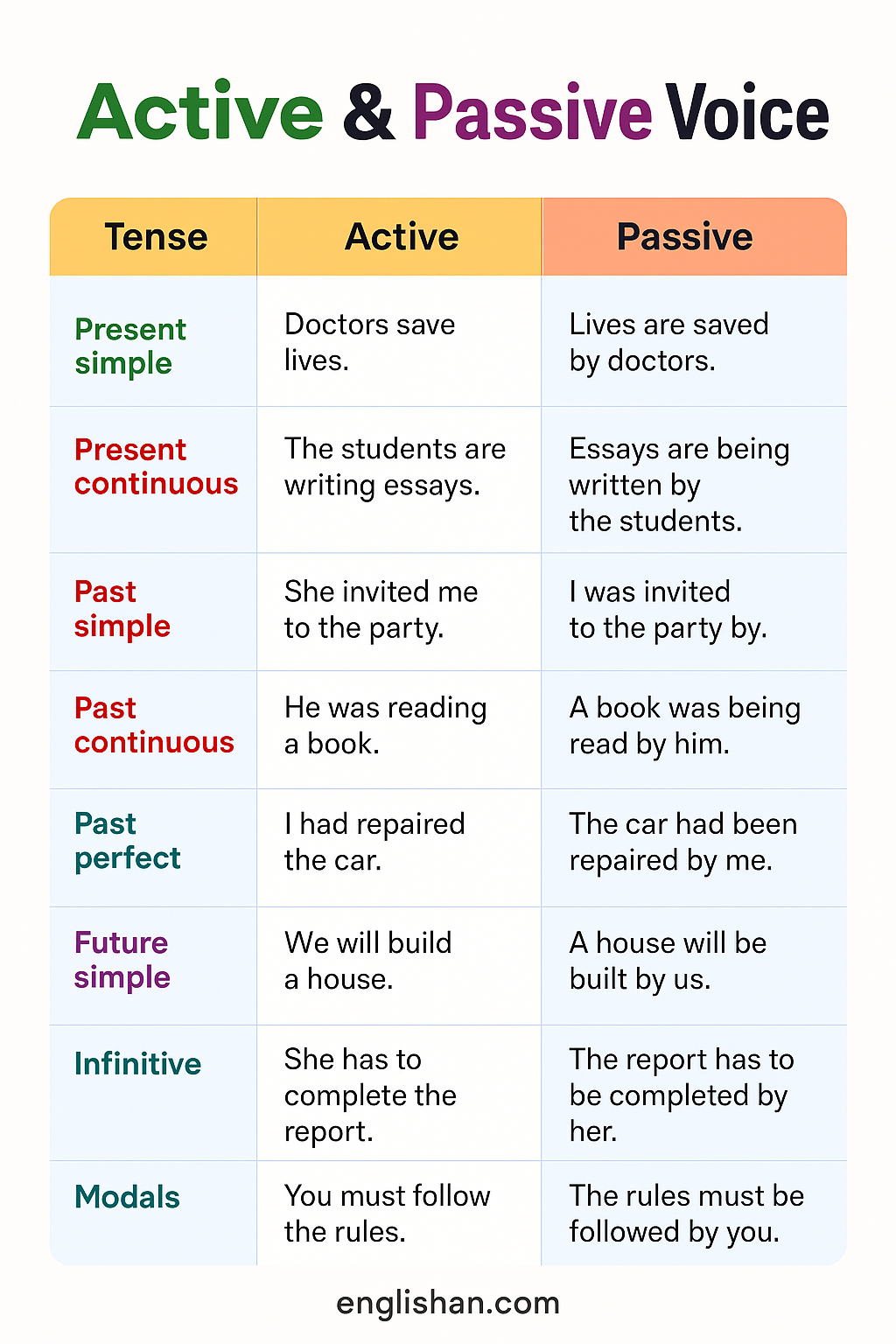
Drill 1: Simple Conversion
Your first task is to convert the following active present tense sentences into the agentless present passive. Omit the "by..." phrase to focus on the system's state. This is pure mechanical practice to build speed and accuracy.
Example:
- Active: The new algorithm sorts the data much faster.
- Your Passive Sentence: The data is sorted much faster.
Now, transform these sentences:
- Active: The monitoring service logs all API requests in real-time.
Your Passive Sentence: - Active: A dedicated server hosts the new microservice.
Your Passive Sentence: - Active: The CI/CD pipeline runs automated tests before each deployment.
Your Passive Sentence: - Active: The system stores user preferences in a JSONB column.
Your Passive Sentence: - Active: We encrypt all sensitive information at rest.
Your Passive Sentence:
Check your answers
- All API requests are logged in real-time.
- The new microservice is hosted on a dedicated server.
- Automated tests are run before each deployment.
- User preferences are stored in a JSONB column.
- All sensitive information is encrypted at rest.
Drill 2: Describing the "Result"
Excellent. Now for the most important part: connecting a past action to a present state. This is how you build the "Result" part of your STAR story.
For each scenario, you are given a past action. Your task is to complete the second sentence, which describes the current state, using the present passive form of the verb in parentheses.
Example:
- Past Action: I refactored the error handling.
- Current State: Now, specific exceptions are caught and logged properly. (to catch)
Let's begin.
- Past Action: We migrated the database from MySQL to PostgreSQL last month.
Current State: As a result, complex geospatial queries ______ (to support) natively. - Past Action: I implemented a caching layer using Redis.
Current State: Now, frequently accessed data ______ (to serve) from memory, not the database. - Past Action: The team decoupled the front-end from the back-end services.
Current State: The user interface and the business logic ______ (to maintain) and deployed independently. - Past Action: We introduced versioning for our public API.
Current State: Breaking changes are avoided because older versions of the API ______ still ______ (to support). - Past Action: I wrote extensive documentation for the onboarding process.
Current State: Every step of the setup process ______ (to document) clearly in the repository's README file.
Check your answers
- ...complex geospatial queries are supported natively.
- ...frequently accessed data is served from memory, not the database.
- ...The user interface and the business logic are maintained and deployed independently.
- ...older versions of the API are still supported.
- ...Every step of the setup process is documented clearly in the repository's README file.
Conclusion
You have successfully completed the first module of our course, building a solid foundation for your technical interview sentences. Today, you learned to use the present passive to describe the current, improved state of a system, which is the perfect way to present the "Result" in a STAR story.
Here are the key takeaways:
- The present passive (
is/are + Past Participle) is used to describe a current state or ongoing process. - It's the ideal structure for the "Result" section, shifting focus from your past action to the present positive outcome.
- Using sentences like "The system is now stabilized" and "Performance is improved" sounds highly professional and objective.
This lesson concludes our module on the foundational elements of technical statements. You can now ensure your subjects and verbs agree, and you can strategically choose between active and passive voice in both past and present tenses to tell a clear, compelling story.
In our next lesson, we will begin a new module, "Mastering Verb Patterns." We will explore what happens when you need to use two verbs together, a very common situation in technical English. You will learn the rules for using gerunds (verb-ing) and infinitives (to + verb), which will allow you to construct even more sophisticated sentences like, "I was responsible for refactoring the code" and "I needed to reduce database load."