Hello! Welcome back.
In our previous lesson, we explored the specific secretions of the stomach, pancreas, and liver, and we introduced the key chemical messengers—gastrin, secretin, and cholecystokinin (CCK)—that regulate them. We saw, for example, that CCK triggers pancreatic enzyme release and secretin drives bicarbonate secretion.
Today, we will synthesize and expand on that knowledge. The objective of this lesson is to describe the hormonal regulation of digestion, focusing on the integrated roles of gastrin, secretin, and cholecystokinin (CCK). We will move from understanding what each hormone does in isolation to appreciating how they function as a coordinated system to manage the processing of a meal from the stomach through the small intestine.
The Gastrointestinal Tract: A Master Endocrine Organ
Before we dive into the specific hormones, it's essential to frame the GI tract not just as a digestive tube, but as the largest endocrine organ in the body. It produces a vast array of hormones that act through different signaling mechanisms to control its own function.
Gastrointestinal Secretions (Hormones) - GI physiology Series - Physiology Playlist
To start, let's watch this brief segment from Medicosis Perfectionalis that defines the different types of hormonal signaling in the gut. This provides a crucial theoretical framework.
Watch from 02:30 to 05:09. Focus on understanding the distinction between: Endocrine: Hormones released into the blood to act on distant targets. Paracrine: Hormones that act on nearby cells. Autocrine: Hormones that act on the same cell that secreted them.
The key hormones we are discussing today—gastrin, secretin, and CCK—are all true endocrine hormones. They are secreted by specialized enteroendocrine cells sprinkled throughout the mucosa of the stomach and small intestine, released into the bloodstream, and travel to their target organs.
Let's now examine each of these key players in detail.
1. Gastrin: The Stomach's "Go" Signal
Gastrin is the primary hormone responsible for preparing the stomach to do its job of sterilization and protein digestion.
- Source: Secreted by G cells, which are located mainly in the antrum of the stomach, with some in the duodenum.
- Stimuli for Release:
- Stomach Distension: The physical stretch of the stomach wall as it fills with food.
- Products of Protein Digestion: The presence of small peptides and amino acids (especially phenylalanine and tryptophan) in the stomach.
- Vagal Stimulation: The parasympathetic nervous system directly stimulates G cells to release gastrin, often via an intermediary neurotransmitter called Gastrin-Releasing Peptide (GRP).
- Primary Actions:
- Stimulates Gastric Acid (HCl) Secretion: This is its most famous role. Gastrin acts both directly on parietal cells and, more potently, indirectly by stimulating nearby ECL cells to release histamine, which then powerfully stimulates the parietal cells.
- Increases Gastric Motility: Promotes stomach churning to mix food with gastric juices.
- Trophic Effect: Stimulates the growth of the gastric mucosa, helping to maintain the stomach lining.
- Inhibition:
- Low pH: A classic negative feedback loop. When the stomach lumen pH drops below 3.0, gastrin release is strongly inhibited. This prevents excessive acidification.
- Somatostatin: This is a universal inhibitory paracrine hormone, released from D cells, that shuts down gastrin secretion.
The following video provides a concise, high-yield summary of gastrin's function.
GI Secretory/Regulatory Physiology
The video 'GI Secretory/Regulatory Physiology' from Dirty Medicine offers a clear and memorable overview of gastrin, ideal for exam preparation.
Watch from 05:28 to 08:13. Pay close attention to the stimuli for gastrin release and the crucial negative feedback mechanism involving low pH.
2. Secretin: Nature's Antacid
Once the stomach has processed the food into acidic chyme, it begins to empty into the duodenum. The primary job of the duodenal environment is to neutralize this acid and begin the next phase of digestion. This is where secretin takes charge.
- Source: Secreted by S cells, located in the mucosa of the duodenum and jejunum.
- Stimulus for Release: The presence of acid (H+) in the duodenum. Secretin release is triggered when the duodenal pH drops below 4.5.
- Primary Actions:
- Stimulates Pancreatic Bicarbonate () Secretion: This is secretin's main purpose. It acts on pancreatic ductal cells, causing them to release a large volume of bicarbonate-rich fluid to neutralize the acidic chyme.
- Stimulates Biliary Bicarbonate Secretion: It has a similar effect on the liver, increasing the bicarbonate content of bile.
- Inhibits Gastric Acid Secretion: It acts as an "enterogastrone," a hormone from the intestine that inhibits stomach function. This is a key part of the "brakes" put on the stomach once chyme moves on.
- Inhibits Gastric Motility: Slows down stomach emptying.
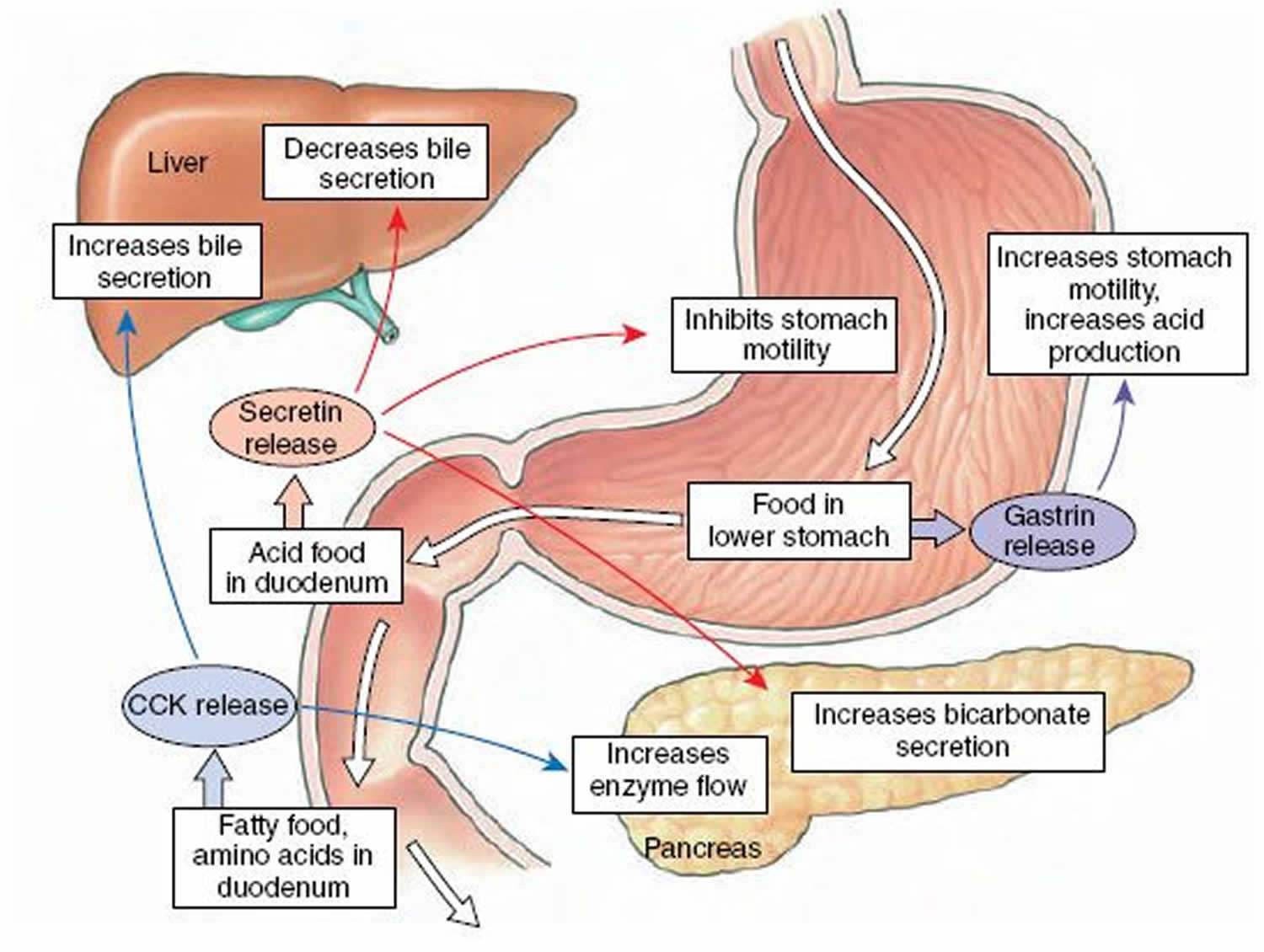
The Physiology, Gastrointestinal Hormonal Control article provides an excellent summary of these actions.
Physiology, Gastrointestinal Hormonal Control
To solidify your understanding, please read the summary of hormone functions from this NCBI StatPearls article. It presents the information in a clear, list-based format.
Read the sections titled 'Gastrin', 'CCK', and 'Secretin' under the 'Function' heading. This will reinforce the key actions of each hormone.
Test your understanding!
Imagine a scenario where the pancreatic ductal cells are unable to respond to secretin. What would be the immediate consequence in the duodenum when acidic chyme arrives from the stomach?
Show answer
Without a response to secretin, the pancreas would fail to secrete its bicarbonate-rich fluid. The acidic chyme would not be neutralized. This would result in a persistently low pH in the duodenum, which could damage the duodenal mucosa (leading to ulcers) and would prevent pancreatic digestive enzymes (which require a neutral or alkaline environment) from functioning properly.
3. Cholecystokinin (CCK): The Duodenal Manager
While secretin handles the acid, CCK manages the digestion of the nutrients themselves, particularly fats and proteins. Its name gives away its two primary functions: cholecysto (gallbladder) + kinin (movement) and its older name, pancreozymin (pancreas enzyme).
- Source: Secreted by I cells, located in the mucosa of the duodenum and jejunum.
- Stimuli for Release: The presence of fatty acids and amino acids/peptides in the duodenum.
- Primary Actions:
- Stimulates Pancreatic Enzyme Secretion: CCK is the most potent stimulator of pancreatic acinar cells, causing the release of digestive enzymes like lipase, amylase, and proteases.
- Stimulates Gallbladder Contraction: It causes the gallbladder to contract, ejecting stored bile into the duodenum.
- Relaxes the Sphincter of Oddi: This allows both bile and pancreatic juice to enter the duodenum.
- Inhibits Gastric Emptying: It significantly slows down the stomach, ensuring the duodenum is not overwhelmed and has adequate time to digest the fats and proteins present.
- Induces Satiety: CCK also acts on the brain to promote a feeling of fullness.
This video from Dirty Medicine offers an excellent mnemonic to remember CCK's functions.
GI Secretory/Regulatory Physiology
Let's watch the segment on CCK. The mnemonic provided is very effective for memorizing its key roles.
Watch from 10:43 to 12:28. The mnemonic 'CCK contracts and causes kickoff' is a great way to remember that it contracts the gallbladder and 'kicks off' the enzymatic digestion in the duodenum.
Integrated Hormonal Response to a Meal
Now, let's put it all together and trace the hormonal sequence following a mixed meal (containing proteins, fats, and carbohydrates).
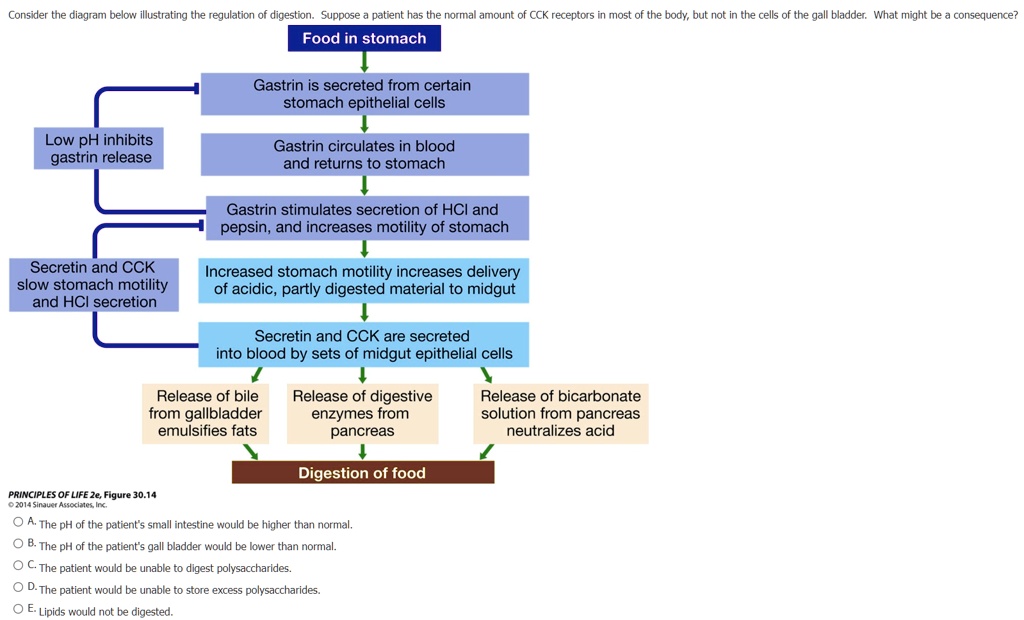
- Gastric Phase: As food enters the stomach, distension and the presence of proteins trigger gastrin release. Gastrin stimulates HCl secretion and motility, creating acidic chyme.
- Intestinal Phase - Arrival of Chyme: The acidic, fatty, and protein-rich chyme is squirted into the duodenum. This triggers the intestinal phase, which is primarily inhibitory for the stomach but stimulatory for the pancreas and gallbladder.
- Duodenal Response:
- The acid immediately stimulates S cells to release secretin. Secretin travels to the pancreas and liver, causing a massive output of bicarbonate to neutralize the duodenal contents. Secretin also tells the stomach to slow down acid secretion.
- The fats and proteins stimulate I cells to release CCK. CCK travels to the pancreas (to release enzymes) and the gallbladder (to release bile). Crucially, CCK also strongly inhibits gastric emptying, giving the small intestine time to work on the fat and protein it has just received.
This beautifully coordinated system ensures that:
- The stomach's harsh acidic environment is contained.
- The duodenum is protected from acid damage.
- The correct digestive agents (enzymes and bile) are delivered at the precise time that their substrates (nutrients) are present.
- The pace of digestion is controlled to allow for efficient processing and absorption.
A Note on Hormone Families
Finally, for a complete theoretical understanding, it's useful to know that these hormones belong to structural families. This explains why they can sometimes have overlapping effects.
- The Gastrin-CCK Family: Gastrin and CCK share an identical 5-amino-acid sequence at their C-terminus. This allows them to bind to each other's receptors, although with much lower potency. For example, CCK can weakly stimulate acid secretion, and gastrin can weakly contract the gallbladder.
- The Secretin Family: This family includes secretin, glucagon, GIP (glucose-dependent insulinotropic peptide), and GLP-1 (glucagon-like peptide-1). They share structural similarities but do not have the same level of cross-reactivity as the gastrin-CCK family.
You can read a more detailed description of these families in the NCBI article under the "Development" section.
Conclusion
In this lesson, we have integrated our knowledge of GI hormones into a coherent physiological narrative. We have seen how the GI tract acts as a sophisticated endocrine organ, using gastrin, secretin, and CCK to orchestrate the complex process of digestion in response to the specific content of a meal.
Key Takeaways:
- Gastrin is the hormone of the stomach, stimulated by food presence to promote acid secretion and motility. Its release is halted by low pH.
- Secretin is the hormone for acid neutralization, released from the duodenum in response to low pH. It stimulates bicarbonate secretion from the pancreas and biliary system while inhibiting the stomach.
- Cholecystokinin (CCK) is the hormone for nutrient digestion, released from the duodenum in response to fats and proteins. It stimulates the delivery of pancreatic enzymes and bile while potently slowing gastric emptying.
- These three hormones work in a tightly regulated sequence of stimulation and feedback inhibition to ensure digestion proceeds at a controlled and efficient pace.
Preview of the Next Lesson:
With the chyme now neutralized by bicarbonate and mixed with digestive enzymes and bile, the stage is set for the chemical breakdown of nutrients. In our next lesson, we will begin to explore this process, starting with the digestion and absorption of carbohydrates.